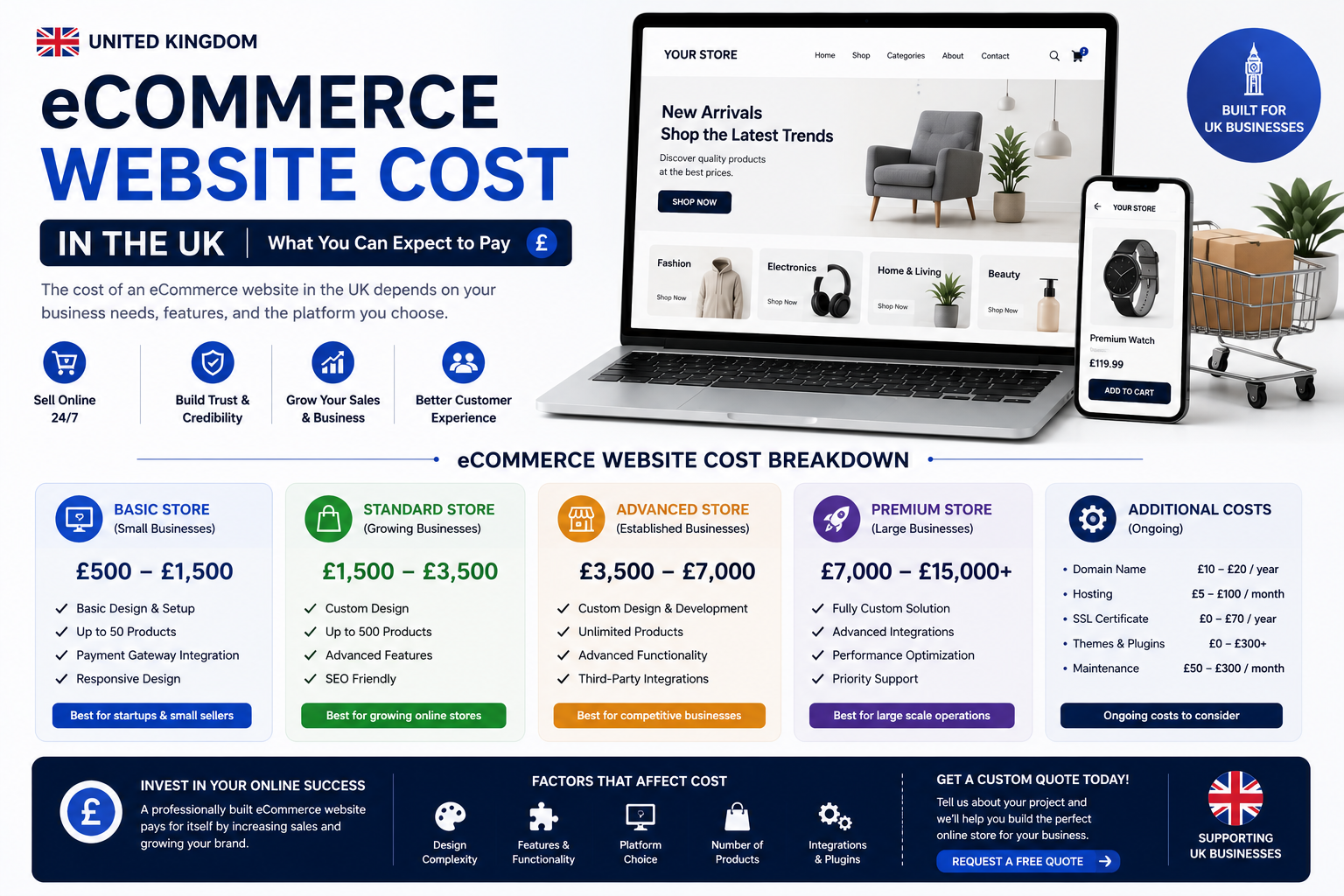
If you’re budgeting for an online store, here’s the short answer: a UK e-commerce website costs anywhere from £1,500 for a template-based Shopify store to £4,000–£10,000 for a custom WooCommerce build, and £10,000–£50,000+ for a bespoke, high-volume platform with custom integrations.
Where you land in that range depends on a handful of concrete factors: product count, payment and shipping integrations, whether you need a custom checkout, subscriptions, and whether you’re migrating from an existing platform. This guide breaks down real 2026 pricing by store type, what actually drives the cost up or down, the ongoing bills nobody mentions upfront, and two anonymised quotes from real projects so you can sanity-check anything you’re sent.
E-commerce Website Cost UK: Price Table by Store Type
| Store type | Typical UK cost (2026) | Best for |
| Template Shopify store | £1,500–£4,000 | Startups, single founders, <100 SKUs |
| Custom Shopify build | £4,000–£12,000 | Growing brands needing custom design/apps |
| Custom WooCommerce store | £4,000–£10,000 | WordPress-based businesses wanting control over hosting and cost |
| Headless/bespoke platform | £15,000–£50,000+ | High-volume retailers, complex catalogues, multi-warehouse |
| Marketplace integration add-on | £1,000–£5,000 | Sellers extending into Amazon/eBay alongside their own store |
(Image: tiered pricing graphic alt text: “E-commerce website cost UK pricing tiers 2026”)
These figures are for the build itself. They don’t include the ongoing running costs, which we cover further down and which matter more for e-commerce than for a standard brochure site, since a store keeps generating monthly obligations long after launch. If you’re weighing up a store against a simpler site, it’s worth reading our comparison of standard website costs first.
Shopify website cost UK vs WooCommerce development cost
The Shopify-vs-WooCommerce question comes up in almost every budgeting conversation, and the honest answer is that neither platform is universally cheaper the right choice depends on how the business plans to grow.
Shopify’s pricing is more predictable upfront. You pay a monthly platform fee, choose from a library of themes and apps, and a developer’s job is largely customisation rather than infrastructure. This is why a template Shopify website cost UK founders see quoted often starts lower than an equivalent WooCommerce job the platform absorbs hosting, security patching, and PCI compliance as part of the subscription.
WooCommerce development cost tends to be higher at the point of build, because you’re paying for hosting setup, security configuration, and plugin selection that Shopify bundles in automatically. In exchange, WooCommerce gives more control: no percentage-based transaction fees stacked on top of your payment processor, no restrictions on which apps or code you can run, and full ownership of the hosting environment. For businesses with unusual logic trade pricing, complex shipping rules, tight margins where extra transaction fees matter that control tends to pay for itself within a year or two, even if the initial WooCommerce development cost is higher.
What Drives E-commerce Website Cost Up or Down
Two stores that look similar on the surface can differ in price by thousands of pounds. Here’s what actually moves the number.
Product count and catalogue complexity
A 20-product store and a 2,000-product store are not the same job. More products usually mean more variants (size, colour, material), more complex filtering and search, and more time spent on data structure and import. Agencies typically price this in bands under 100 SKUs, 100–1,000, and 1,000+ because each band changes how the catalogue needs to be built, not just how long data entry takes.
It’s also worth budgeting separately for product content itself: photography, descriptions, and SEO metadata for each listing. A store with a well-priced build but thin, copy-pasted product descriptions across a large catalogue is common and it’s usually the content, not the platform, that ends up limiting how well the store ranks or converts.
Payment integration
Standard gateways like Stripe or PayPal are usually included in a base quote. Costs rise when you need multiple payment methods (Klarna, Clearpay, Apple Pay), multi-currency pricing, or region-specific gateways for international customers. Each additional payment provider adds testing time and, occasionally, compliance work.
Businesses selling into both the UK and EU or US markets often underestimate this line item. Multi-currency pricing isn’t just a display setting it usually means decisions about whether prices are fixed per region or converted live, how refunds are handled across currencies, and which gateways actually settle in which currencies. None of this is difficult, but it does need to be scoped rather than assumed.
Custom checkout
Shopify and WooCommerce both ship with a default checkout that covers most stores. A custom checkout needed for things like split payments, unusual shipping logic, age verification, or a checkout that matches an unusually specific brand experience is one of the more expensive line items, because it touches security, payment compliance, and platform limitations all at once.
Subscriptions and recurring billing
Subscription boxes, membership stores, and repeat-order businesses need recurring billing logic, failed-payment handling, and customer self-service (pause, skip, cancel). This is rarely a simple plugin install once you factor in edge cases like partial refunds or plan changes, and it typically adds £1,000–£3,000 to a build.
Migrations
Moving from an existing platform Magento to Shopify, a legacy custom build to WooCommerce, or even Shopify to Shopify Plus adds cost because of data cleanup, URL redirects (to protect SEO rankings), and testing to make sure nothing breaks for existing customers mid-migration. Migrations are one of the most commonly underquoted parts of an e-commerce project, because the scope only becomes clear once someone actually looks at the old data.
Design and app customisation
A theme with a few colour and logo changes costs far less than a fully custom design system. Similarly, each third-party app (reviews, loyalty points, upsells, inventory sync) adds setup time, licensing cost, and one more thing that can break during updates.
Ongoing Costs: What It Costs to Run a Store After Launch
The build price is only half the picture. Budget-planning founders are usually most caught out by the monthly costs, which typically include:
- Hosting/platform fees: Shopify plans run from roughly £25–£300+/month depending on tier; WooCommerce hosting (on managed WordPress hosting) is typically £20–£100/month.
- Apps and plugins: most stores run 3–10 paid apps for reviews, email marketing, upsells, or inventory often £50–£300/month combined.
- Payment processing fees: usually 1.5–2.9% + a small fixed fee per transaction, charged by the payment provider rather than the developer.
- Maintenance retainers: ongoing security updates, plugin/theme updates, and small fixes, typically £100–£500/month depending on store complexity.
- Domain and SSL: usually under £20/year combined, often bundled into hosting.
A realistic full monthly running cost for a small-to-mid store sits somewhere between £150 and £600, before marketing spend.
| Ongoing cost | Typical monthly range |
| Platform/hosting fees | £20–£300 |
| Apps and plugins | £50–£300 |
| Maintenance retainer | £100–£500 |
| Domain/SSL (averaged) | ~£2 |
| Payment processing | 1.5–2.9% + fixed fee per transaction |
It’s worth treating the maintenance retainer as non-optional rather than a nice-to-have. E-commerce platforms push regular updates to themes, plugins, and payment/security modules, and a store that isn’t kept current is the one most likely to break at checkout which is the single worst place for something to go wrong, since that’s the moment revenue is actually being lost. Founders who skip the retainer in year one often end up paying more for an emergency fix later than the retainer would have cost across the whole year.
Example Itemised Quotes (Real Projects, Anonymised)
Project A Independent skincare brand, ~45 products Shopify template customisation, Stripe + PayPal + Klarter integration, product photography upload and variant setup, basic email marketing connection, no subscriptions.
- Design/theme customisation: £900
- Product and variant setup (45 SKUs): £600
- Payment integrations: £400
- Testing and launch: £300
- Total: £2,200
Project B B2B homeware wholesaler, ~600 products, custom checkout Custom WooCommerce build, trade pricing tiers, custom checkout with minimum order quantities, migration from an ageing Magento site, staff training.
- Discovery and data migration: £1,800
- Custom theme build: £2,600
- Custom checkout logic (MOQs, trade pricing): £2,400
- Payment and shipping integration: £900
- Testing, redirects, and launch: £900
- Total: £8,600
These two examples sit at opposite ends of the “template vs custom” spectrum in the table above, and the gap between them is almost entirely explained by product count, custom checkout logic, and migration work not by design polish.
The Risk of the Cheapest Option
A £1,500 template store isn’t a bad choice for a genuinely simple catalogue but it’s worth knowing what you’re trading away at that price point:
- Limited scalability: templates built for 50 products often need a rebuild, not a tweak, once you pass a few hundred SKUs.
- Generic checkout experience: no room for the payment methods or logic that reduce cart abandonment for your specific customers.
- No migration safety net: cheap builds rarely include proper redirect mapping, which can quietly tank search rankings if you move platforms later.
- Thin or absent support: many low-cost builds are handed over with no maintenance retainer, so the first security patch or broken plugin becomes an emergency call rather than a routine fix.
None of this means cheap stores are wrong for every business plenty of founders genuinely need the £1,500–£2,500 tier and nothing more. The risk is in choosing that tier for a business that’s actually going to outgrow it within a year, and paying for a second build sooner than necessary.
A useful gut-check before signing off on the cheapest quote in a shortlist: ask what happens at 3x your current product count, and ask specifically whether redirects and a maintenance plan are included or extra. Quotes that go quiet on either question are usually the ones that end up costing more once those gaps surface after launch.
FAQs
Why do e-commerce sites cost more than standard websites? An e-commerce site has to handle things a brochure site doesn’t: payment processing, inventory, tax and shipping calculations, security around card data, and (often) integrations with accounting or fulfilment tools. Each of those is a separate piece of functionality that needs building, testing, and maintaining which is why even a modest online store usually costs more than an equivalent-sized informational website. See our standard website cost guide for a direct comparison.
What are the monthly costs to run a store? Budget roughly £150–£600/month for hosting or platform fees, apps, and a basic maintenance retainer, on top of payment processing fees charged per transaction. Larger or more complex stores with more apps and higher traffic will sit toward the top of that range or above it.
Is Shopify cheaper than custom WooCommerce? For a simple, low-SKU store, Shopify’s template route is usually the cheaper starting point since so much comes pre-built. Once you need custom checkout logic, trade pricing, or specific integrations, the gap narrows or reverses, because Shopify’s app fees and platform restrictions can add up, while WooCommerce gives more control over exactly what you pay for. The most useful way to compare them isn’t build cost alone it’s build cost plus three years of platform fees, app subscriptions, and transaction fees, since that total is what actually determines which one was cheaper.
Get a Fixed Quote
Every store is different, and ranges only get you so far. If you’d like an itemised, fixed-price quote based on your actual product count, payment needs, and any migration involved, get in touch for a fixed e-commerce quote no obligation, a
Leave a Reply