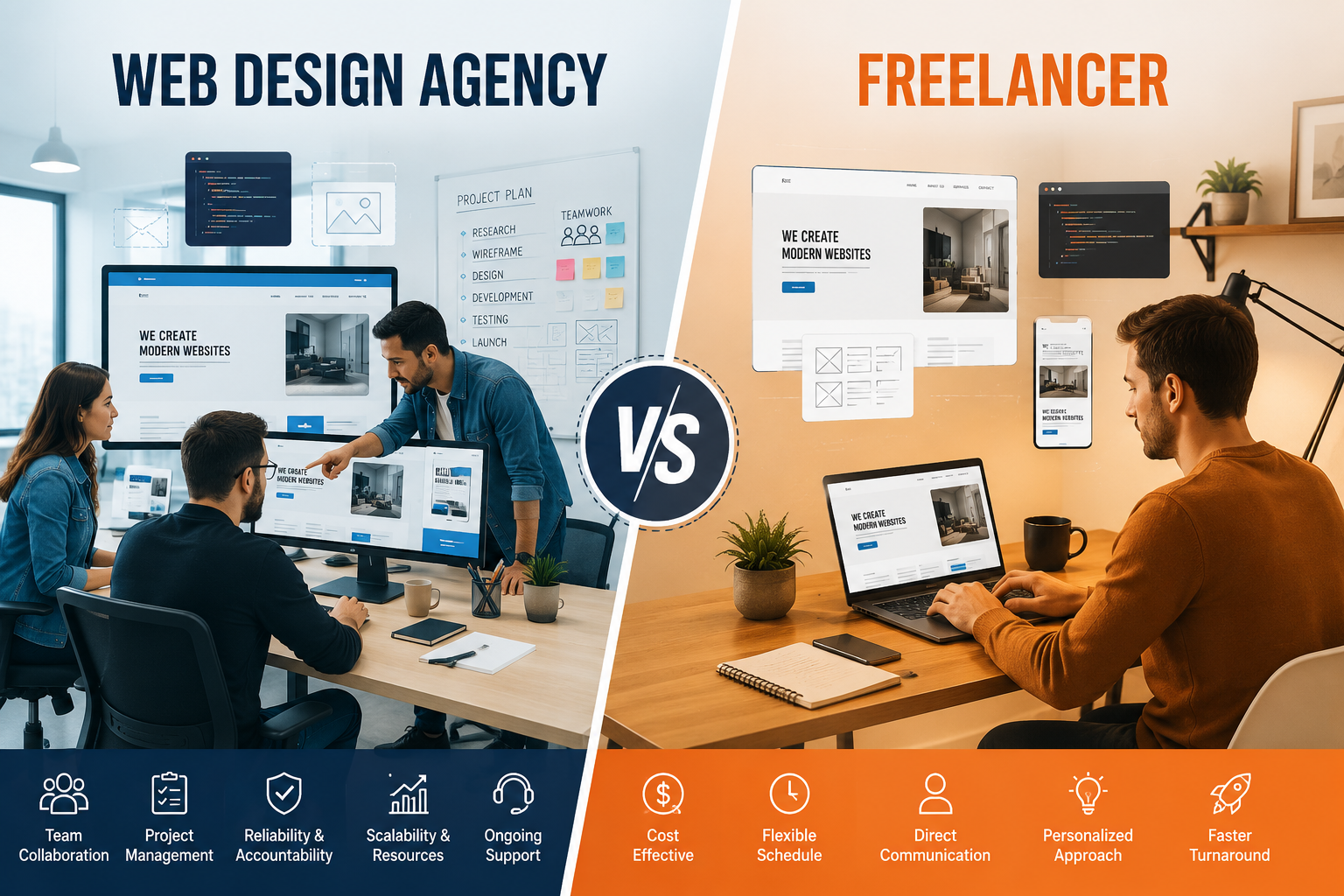
If you’re building or rebuilding a website, you’ve got three real options: hire a web design agency vs freelancer or build it yourself on a platform like Wix or Squarespace. Each route can produce a good result and each can go badly wrong if it’s mismatched to your budget, timeline, or how much ongoing support you’ll actually need.
This guide gives you a straight, no-spin comparison so you can pick the option that fits your business, not just the cheapest quote you got last week.
The Verdict, At a Glance
| Agency | Freelancer | DIY (Wix/Squarespace) | |
| Typical UK cost | £3,000–£15,000+ | £800–£4,000 | £0–£300/year |
| Timeline | 6–12 weeks | 2–6 weeks | 1–5 days |
| Best for | Established businesses, complex sites, brand-critical projects | Solo founders, very early-stage, or simple one-page sites | |
| Ongoing support | Formal contract, retainer options | Informal, depends on the individual | Self-managed, platform support only |
| Biggest risk | Cost creep, slower turnaround | Availability, single point of failure | Limited flexibility, generic look |
| Scalability | High | Medium | Low–Medium |
If you want the fuller cost picture across all three routes, including hidden extras like hosting and copywriting, see our full website cost breakdown.
Web Design Agency: Cost, Speed, Quality, Risk
Cost
Agencies typically charge more because you’re paying for a team a project manager, designer, developer, and often a strategist or copywriter rather than one person’s time. In the UK, a professional agency-built business website usually runs from £3,000 to £15,000, with bespoke e-commerce or highly custom builds going well beyond that.
Speed
Because more people are involved and work runs through structured stages (discovery, design, development, review, handover), agency projects typically take 6 to 12 weeks. That’s slower than a freelancer, but the process usually includes built-in checkpoints for feedback and revisions, which reduces the chance of costly surprises later.
Quality
This is where agencies tend to earn their fee. You get a documented portfolio to review before you commit, a proper contract covering deliverables and timelines, and critically project management that keeps things moving even if one team member is on leave or leaves the company. Agencies also tend to be stronger on technical foundations: accessibility, SEO structure, and performance optimization, because these are built into their standard process rather than left to individual judgement.
Risk
The main risks with agencies are cost creep (scope changes get expensive) and slower turnaround if you need something to live quickly. Agencies also vary hugely in quality a flashy pitch doesn’t guarantee a fast, responsive site. Always ask to see live client sites, not just portfolio screenshots.
Freelance Web Designer: Cost, Speed, Quality, Risk
Cost
A freelance web designer in the UK typically charges £800 to £4,000 for a small business site, depending on experience, location, and complexity. This is the sweet spot for many small businesses that want a custom, professional-looking site without agency overheads.
Speed
Freelancers are usually faster to start and finish often 2 to 6 weeks because there’s no internal handoff between departments. You’re dealing with one person who both designs and builds.
Quality
Quality varies more widely than with agencies, simply because you’re relying on one person’s skill set across design, development, copywriting instincts, and SEO basics. A great freelancer can rival agency output at a fraction of the cost. Always ask for a portfolio of live, working sites (not just mockups) and check reviews or references before committing.
Risk
The single biggest risk is availability. Freelancers get ill, go on holiday, take on other clients, or occasionally disappear mid-project. There’s no backup team to pick up the work. A solid contract covering payment milestones, revision rounds, and what happens if either party needs to exit is non-negotiable, even for a “simple” project. Also confirm what handover looks like: will you get full access to the code, hosting, and domain, or does the freelancer retain control?
DIY Website Builders: Cost, Speed, Quality, Risk
Cost
Platforms like Wix, Squarespace, and Shopify are the cheapest route by far typically free to build, with ongoing plan costs of roughly £10–£30 a month. This is the obvious appeal when comparing Wix vs hiring a designer.
Speed
You can have a basic site live in a few days, sometimes hours, using templates.
Quality
This is the trade-off. Templates are easy to spot, customisation is limited to what the platform allows, and most builders top out on flexibility once your business needs to get more specific custom booking flows, integrations, or non-standard layouts. SEO and performance are workable but rarely best-in-class out of the box.
Risk
The risk isn’t failure it’s ceiling. A DIY site can genuinely work well for a very early-stage business, a portfolio, or a simple one-pager. But scalability is limited: if your business grows and you need more functionality, you may end up rebuilding from scratch rather than extending what you have.
When NOT to Hire an Agency (An Honest Take)
Agencies are not always the right answer, and it’s worth saying so plainly:
- If your budget is under £2,000, an agency engagement is likely to feel rushed or restricted, and you’ll get better value from a good freelancer.
- If you need something live this week, an agency’s structured process will feel like the wrong tool go freelance or DIY.
- If your site is genuinely simple, a one-page site, a holding page, a personal portfolio paying for an agency’s project management and strategy layer is overkill.
- If you’re still validating your business idea, spending heavily on a website before you know your offer or audience is a common early-stage mistake. Start lean, then invest once you have traction.
An agency earns its cost on complexity, brand stakes, and long-term scalability not on every website, every time.
Decision Framework by Budget
Under £500 DIY. Use a builder like Wix or Squarespace. Fine for testing an idea, a personal brand, or a simple local business presence.
£500–£3,000 Freelancer. This is the most common range for small businesses that want something custom and professional without agency overheads. Prioritise freelancers with a strong portfolio and clear contract terms.
£3,000–£8,000 Freelancer or small agency. At this level, compare a strong solo freelancer against a small agency team. The decision often comes down to how much ongoing support and project management you want built in versus managing revisions yourself.
£8,000+ Agency. For multi-page sites, e-commerce, bespoke functionality, or anything brand-critical, the team structure, formal process, and accountability of an agency typically justifies the cost.
Questions to Ask Either Way
Whichever route you choose, ask these before signing anything:
- Can I see your portfolio, including live sites I can visit myself?
- What does the contract cover deliverables, timeline, payment milestones, and what happens if things go wrong?
- How many rounds of revisions are included, and what happens beyond that?
- What does handover actually include full code access, hosting login, domain ownership, CMS training?
- What ongoing support is available after launch, and at what cost?
- How will the site handle growth, new pages, e-commerce, integrations if my business scales?
Getting clear answers here protects you far more than chasing the lowest quote.
Can You Start DIY and Upgrade Later?
Yes and for many businesses, this is a sensible path. Start with a DIY builder to get online quickly and cheaply while you validate your offer, then move to a freelancer or agency once you have real traffic, revenue, or specific functionality needs that the builder can’t support. The main cost of this route is some rebuilding work later, but that’s often a fair trade for speed and low risk early on.
FAQs
Is a freelancer cheaper than an agency? Generally, yes. Freelancers typically charge £800–£4,000 for a small business site versus £3,000–£15,000+ for an agency, mainly because you’re paying for one person’s time rather than a full team.
What happens if my freelancer disappears? This is the single biggest freelancer risk. Protect yourself with a contract that specifies payment milestones tied to deliverables (never pay in full upfront), and confirm early who owns the code, hosting, and domain. If a freelancer vanishes mid-project, having your own hosting and domain accounts means you can hand the work to someone else rather than starting from zero.
Can I start DIY and upgrade later? Yes. Many businesses start on a builder like Wix to get live quickly, then move to a freelancer or agency once they need more functionality or a more distinctive brand presence. Expect some rebuild cost when you make that switch, but it’s a reasonable trade-off for early speed.
Leave a Reply