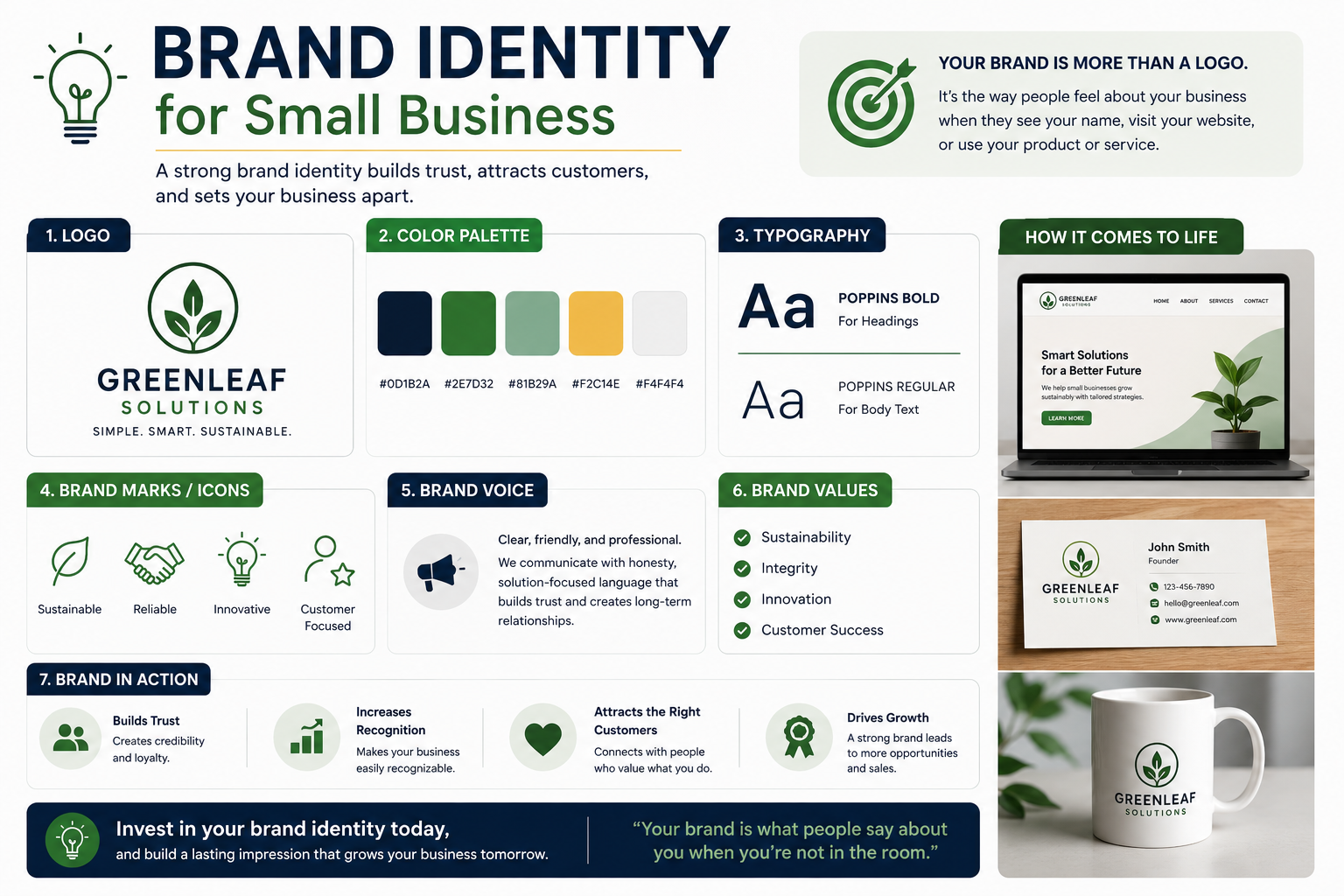
If you’ve just registered your company, you’ve probably had at least one conversation about brand identity for small business ” that left you more confused than when it started. Brand strategists will happily sell you a 40-page brand book. Agencies will quote you £8,000–£15,000 before you’ve sold a single product. And somewhere in the middle of all that, you just need a logo that doesn’t look like it was made in 2009 and some files you can actually use.
Here’s the good news: a small business doesn’t need a full corporate identity system on day one. It needs six specific assets, built properly, in the right file formats. Everything else can wait until you’ve got revenue to justify it.
This guide covers exactly what those six assets are, what they realistically cost in the UK whether you DIY, hire a freelancer, or go to an agency, what to deliberately skip early on, and the file formats you should never leave a designer’s inbox without.
The 6 Brand Identity Assets a Small Business Actually Needs
1. A primary logo (plus a secondary/icon version)
Your main logo, plus a simplified mark or icon version for small spaces a favicon, an app icon, a social profile picture. Trying to squeeze a full wordmark logo into a 32x32px circle rarely works, which is why the icon version matters more than people expect.
2. A colour palette
Not just “our brand colour is blue.” You need a primary colour, one or two secondary colours, and a neutral (usually a dark grey or near-black rather than pure black) each with hex, RGB, and CMYK values so print and digital always match.
3. Typography
Two fonts, typically: one for headings, one for body text. They should be licensed for commercial use (this trips people up constantly a font that’s free for personal use isn’t automatically free for your business) and available as web fonts if they’ll appear on your site.
4. A one-page brand guideline
Not a 40-page brand bible a single page covering logo usage (including what not to do), colour codes, fonts, and spacing rules. This is what stops your Instagram intern from stretching the logo or using it on a clashing background.
5. Logo files in the right formats
Covered in detail below, but in short: vector files for anything that gets printed or resized, and web-ready PNGs for everything else.
6. Basic social media templates
A handful of on-brand templates for the platforms you’ll actually post to not fifteen platforms you’ll never touch. Two or three reusable Canva or Figma templates covers most small businesses.
That’s it. Everything beyond this tone-of-voice documents, full pattern libraries, animated logo stings, bespoke iconography is genuinely useful eventually, but it’s not what makes a new business look credible. It’s what an established business adds once the basics are working.
What It Actually Costs (UK, 2026)
Pricing for brand identity work varies enormously, and a lot of that variation is more about positioning than quality. Here’s a realistic breakdown across the three routes most small businesses consider.
| Route | Typical UK cost | What you get | Best for |
| DIY (Canva Pro, Looka, Fiverr templates) | £0–£150 | Logo + basic colour/font choices, self-assembled | Pre-revenue, testing an idea, very tight budgets |
| Freelance designer | £300–£1,200 | Most new small businesses and startups | |
| Small design agency | £1,500–£4,000 | Full identity above plus social templates, stationery, sometimes a short brand strategy phase | Businesses with funding, or a specific rebrand need |
| Larger/branding agency | £5,000–£15,000+ | Strategy workshops, extensive guidelines, multiple concept rounds, ongoing brand support | Established businesses with a marketing budget and a genuine strategic need |
A sensible rule of thumb for a new small business: a freelancer or small studio, at £300–£1,200, will cover the six assets above properly. You’re not underpaying for corner-cutting at that range you’re paying a fair price for a smaller scope of work. The £10k+ agency projects are pricing in strategy work, market research, and stakeholder workshops that a five-person startup usually doesn’t need yet.
What to Skip Early On
It’s tempting to want “everything” upfront, especially if you’re the kind of founder who likes things done properly. Resist it. These are the things worth deliberately postponing:
- A full brand strategy document. Useful once you know your customers well; premature when you’re still finding them.
- Custom illustration or iconography sets. Nice to have, expensive to commission, and easy to add later without touching your logo or colours.
- Print stationery beyond a business card. Letterheads, compliment slips, and branded invoices matter for some B2B businesses but most small businesses do this digitally now.
- Motion/animated logo versions. Genuinely lovely for video intros, genuinely unnecessary before you’re making regular video content.
- A rebrand “just in case.” If your current name and logo aren’t actively costing you customers or causing confusion, a rebrand is a distraction, not a growth lever. Save it for when there’s a clear trigger a merger, a pivot in what you sell, or a name that’s become a genuine liability.
The File Formats You Must Receive
This is the part that catches people out most often, because a bad set of files doesn’t show its cost until months later, when you need to resize a logo for a pull-up banner and discover all you have is a blurry PNG from a Word document.
Ask your designer for:
- Vector files AI, EPS, or PDF, so your logo can scale to any size (a billboard or a pin badge) without losing quality
- SVG the modern web-friendly vector format, ideal for your website and app
- PNG with transparent background high resolution, for use over photos or coloured backgrounds
- A colour and reverse (white) version of the logo, so it works on both light and dark backgrounds
- The font files or licence details even if you never open a design tool again, whoever builds your website will need these
If a designer only hands you a JPG, ask for the rest. It’s a completely standard request, not an awkward one.
A Real Example: What a Small Brand Kit Looks Like in Practice
At MDOB, a recent small business brand-kit project for a new local retailer covered exactly this scope: a primary and icon logo, a four-colour palette with full colour codes, two licensed fonts, a one-page usage guide, and a folder of properly exported SVG, EPS, and PNG files, plus three social templates sized for Instagram. The whole thing was delivered inside two weeks, without a strategy workshop or a 40-page brand book in sight because the client didn’t need one yet. That’s the level most new businesses should be aiming for.
If you want a broader look at how scope and price design work generally, our graphic design services page covers the full range, from single-asset jobs to ongoing brand support.
FAQs
How much is a logo in the UK? A standalone logo from a freelance designer typically runs £150–£500, though most small businesses are better served commissioning the fuller starter package (logo, colours, fonts, guideline, files) for £300–£1,200, since the incremental cost over a logo alone is small.
What files should a designer give me? At minimum: vector files (AI, EPS, or PDF), an SVG for web use, high-resolution transparent PNGs, both a full-colour and a reverse/white version of the logo, and the font files or licence information. If any of these are missing, ask for them before the project closes.
When should I rebrand? Rebrand when there’s a clear business reason you’ve changed what you sell, merged with another company, or your current name is actively causing confusion or reputational drag. Don’t rebrand out of boredom with your own logo; that’s rarely a good enough reason on its own, and it’s worth revisiting once you’re clearer on where your business is headed.
Ready for a Brand Starter Package?
If you’re setting up a new business and want the six essentials done properly without paying agency-strategy prices for a startup-stage need our brand starter package covers exactly the scope in this guide: logo, colours, fonts, guideline, files, and social templates, delivered as a complete kit.
Leave a Reply