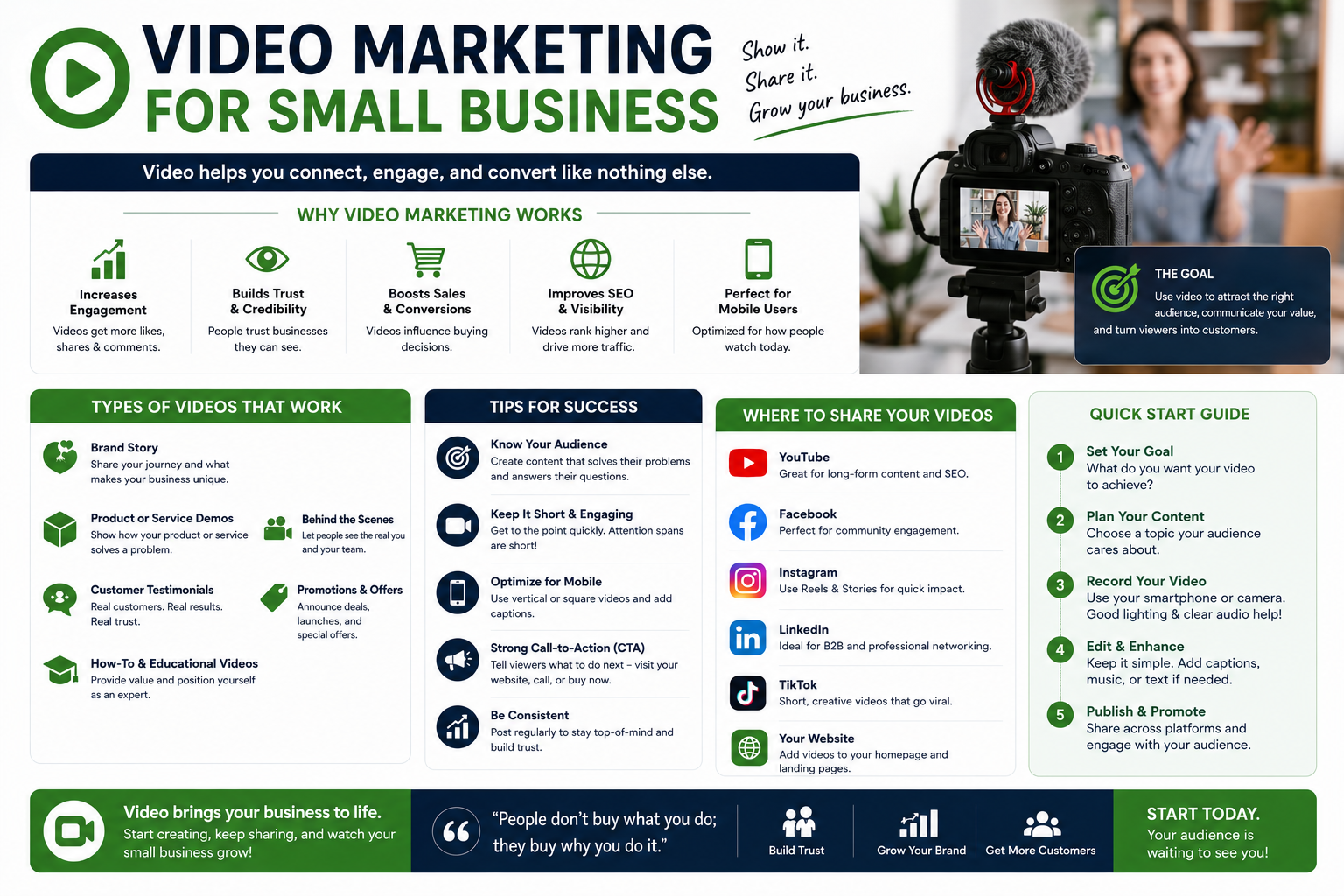
Short-form video stopped being optional a while ago. It’s now the format most small businesses lean on to get found, build trust, and turn browsers into customers and the businesses that treat it like a system, not a scramble, are the ones seeing the return.
Why short-form video, and why now
The adoption numbers make the case on their own. Among businesses using short-form video as a core marketing tactic, small businesses lead every other size bracket by a wide margin: 70% of small businesses and just 22% of medium-sized businesses have adopted short-form video as one of their crucial marketing strategies. Large enterprises, weighed down by approval chains and brand committees, lag furthest behind.
That’s not a coincidence. Short-form video rewards speed and authenticity over production polish, which is exactly the terrain small businesses can win on. The broader video numbers back this up: 91% of businesses now use video as a marketing tool, and 93% consider it an important part of their strategy, with HubSpot’s 2026 data ranking short-form video as the highest-ROI content format of any type, cited by 49% of marketers.
The engagement gap is just as stark. Short-form videos generate roughly 2.5 times more engagement than long-form content on social platforms, and on the buying side, 63% of people say they’d rather learn about a product through a short video than a blog post, infographic, or sales call. Cost has also stopped being the barrier it used to be: AI-assisted editing tools have pushed production costs down considerably, which is part of why small businesses that couldn’t previously justify a video budget are now showing up in the numbers.
Put simply: your customers are already scrolling past short video content dozens of times a day. The only question is whether some of it is yours.
Content pillars for small businesses
Trying to “make videos” without a plan is how most small business accounts stall out after two weeks. A pillar system fixes that a handful of repeatable formats you can shoot on rotation, so you’re never starting from a blank page.
1. Behind-the-scenes. How the product gets made, how a service call actually goes, what a normal Tuesday looks like in the shop. This is the easiest pillar to sustain because it needs zero scripting just a phone rolling while you work.
2. Customer transformations and testimonials. Before/after results, a quick customer reaction on camera, a walkthrough of a problem you solved. Social proof performs disproportionately well in short form because it’s inherently visual.
3. Educational quick-tips. A 30-second answer to a question you get asked constantly. This pillar builds authority and is highly searchable people actively search platforms like TikTok and YouTube Shorts for exactly this kind of content.
4. Product or service spotlights. One feature, one use case, one angle per video rather than trying to cover everything at once.
5. Founder or team personality. Faces build trust faster than logos. A quick opinion, a reaction to industry news, or a simple introduction humanizes the brand.
A good starting cadence is roughly 40% behind-the-scenes, 25% educational, 20% social proof, 15% product spotlights adjusted once you see which pillar actually performs for your audience.
Filming with just a phone
You do not need a camera rig to start. Every major platform algorithm treats phone-shot vertical video as native content in some cases it performs better than obviously polished footage because it doesn’t read as an ad.
A few things matter far more than equipment:
- Light beats gear. Film facing a window or under even, diffused light. A $20 clip-on light solves 90% of “my videos look amateur” complaints a new camera won’t.
- Stabilize simply. A cheap phone tripod or even propping the phone against something steady removes the shakiness that makes viewers scroll past in the first second.
- Shoot vertical, shoot wide, shoot long. Always frame for 9:16 from the start rather than cropping horizontal footage later. Over-film a 90-second raw take gives an editor room to find the best 20 seconds; a tight 20-second take gives them nothing to work with.
- Capture the hook separately. Since videos over 60 seconds see sharply declining engagement, and 31–60 second clips are the sweet spot for most marketers, film 2-3 alternate opening lines for every piece of content. The hook the first one to two seconds decides whether anyone watches the rest, and it’s the cheapest thing to A/B test since it costs nothing but a second take.
- Batch by pillar, not by day. Film all your behind-the-scenes clips in one block, all your tips in another. Context-switching between formats is what kills momentum.
A basic smartphone, a $20-40 light, and a $15 tripod covers the vast majority of small business short-form content. Save equipment upgrades for after you have a cadence you can actually sustain.
Editing: DIY tools vs outsourcing costs
This is the stage where most small businesses either stall out or overspend. Here’s how the real options break down.
DIY editing. Apps like CapCut, InShot, and Adobe Premiere’s mobile app now handle captions, trending audio syncing, and basic color correction with templates built for exactly this format. Realistic time cost: 30-60 minutes per finished clip once you know the app, longer while you’re learning. This route costs nothing but time, and it’s the right call if you’re posting once or twice a week and want full creative control.
Freelance per-video editing. For businesses posting more consistently, hiring it out starts making sense. Current market rates for short-form content are wide but fairly consistent across sources: beginner editors charge $25 to $75 per video, intermediate editors $75 to $200, and senior editors $200 to $500 for a finished short-form clip, while basic Reels and TikTok-style cuts from freelancers on marketplaces like Upwork commonly run $15-$40 per hour.
Monthly retainers. Once you’re publishing multiple times a week, per-video pricing stops making sense and a retainer usually works out cheaper and more consistent. Monthly retainers for short-form content commonly range from around $500 for a basic package of a few videos up to $5,000 or more for premium agency packages handling 10-40+ videos a month, with dedicated packages built specifically around short-form volume typically sitting toward the lower-middle of that range.
Agency or dedicated editor. For businesses running a genuine content engine, daily posting, multiple platforms, ongoing testing, a dedicated editor or small agency team removes the bottleneck entirely. This costs more per month but far less per finished video at volume, since you’re not paying a per-clip markup on every single piece.
Honest advice: start DIY to learn what actually resonates with your audience, then move to a monthly package once you know your pillars and just need consistent output. Jumping straight to an expensive retainer before you know what works usually means paying for polish nobody asked for.
The repurposing workflow
The single biggest efficiency gain in short-form video isn’t shooting more, it’s squeezing more out of what you already shot.
The workflow runs like this: one batch filming session produces a single longer “pillar” piece, a 3-5 minute video, a longer interview, and a full walkthrough. That pillar gets cut into 6-10 shorter vertical clips, each with its own hook and caption treatment, then adapted slightly per platform: TikTok favors raw and fast-paced, Instagram Reels rewards a slightly more polished edit and on-screen text, YouTube Shorts performs well with a clear spoken hook since autoplay-with-sound is more common there.
Every clip gets tracked watch-through rate, saves, and shares matter more for short-form than raw view counts, since they’re the signals platforms use to decide whether to push a clip further. Whatever performs best feeds directly back into planning the next batch shoot, so the system improves every cycle instead of starting from zero each time.
This is also why batching beats daily filming for most small businesses: one two-hour shoot every couple of weeks can realistically produce a month of content once it’s run through the repurposing pipeline.
Posting cadence that’s actually sustainable
Consistency beats intensity. A realistic cadence for most small businesses:
- Starting out: 3 posts per week on your primary platform. Enough to build a pattern without burning out.
- Established: 4-6 posts per week across your top 1-2 platforms, drawing from the repurposing workflow above rather than fresh filming every time.
- Content engine stage: Daily posting, usually only sustainable once editing is outsourced or handled by a dedicated team member.
Pick one platform to be genuinely good at before spreading across three. Most small businesses see better results doing four solid Reels a week than one mediocre post each on Reels, TikTok, and Shorts.
Measuring what actually matters
Vanity metrics are tempting to chase but rarely predict revenue. Watch-through rate tells you whether the hook and pacing are working. Saves and shares are the strongest signals that content resonated enough for someone to act on it, and they’re also the signals platforms weight most heavily when deciding whether to extend a video’s reach. Clicks to your bio link or website matter more than any of the above if lead generation is the actual goal.
Set a simple monthly review: pull your top three and bottom three performing clips, note what’s different about the hook, length, and topic, and adjust the next batch shoot accordingly. This is the step most small businesses skip, and it’s the difference between a channel that plateaus and one that compounds month over month.
FAQs
How often should I post short-form videos? Three times a week is a reasonable floor for building momentum without burning out. Once you have a repurposing workflow in place, 4-6 times a week across your main platform becomes achievable without additional filming.
Phone or camera do I need to upgrade? No. A modern smartphone with decent lighting outperforms a nicer camera with bad lighting almost every time. Prioritize a simple light and a stabilizer before considering camera gear.
What does editing cost per video? DIY costs nothing but time. Freelance per-video editing for short-form content typically runs $25-$500 depending on the editor’s experience and the edit’s complexity, while monthly packages for consistent volume generally start around $500 and scale up from there depending on how many videos you need per month.
Get consistent output without doing it all yourself
If filming feels manageable but editing is the bottleneck, a monthly editing package takes that piece off your plate entirely footage in, platform-ready clips out, on a schedule you can count on. Explore video editing packages →
Leave a Reply