If you run a small business, you’ve probably had this thought at 11pm at least once: “Why can’t people find us on Google?”
You’re not alone. Most small business owners know SEO matters, but nobody ever explains it in plain English it’s all jargon, contradictory blog posts, and agencies trying to sell a £2,000-a-month retainer before you’ve even worked out what SEO actually means for your business.
This guide is different. It’s the one we wish existed when we started doing this ourselves. By the end, you’ll understand exactly how small business SEO works in 2026 including how AI Overviews and AI search have changed the game and you’ll have a 90-day plan you can follow with or without hiring help.
How Google Works, in 60 Seconds
Before the tactics, the basics because everything below only makes sense once this clicks.
Google’s job is to answer a searcher’s question as well as possible. To do that, it:
- Crawls the web, following links from page to page to discover content.
- Indexes what it finds, storing a version of each page in its enormous library.
- Ranks pages for a given search by working out which ones best match what the searcher wants using hundreds of signals, but mostly boiling down to relevance, quality, and trust.
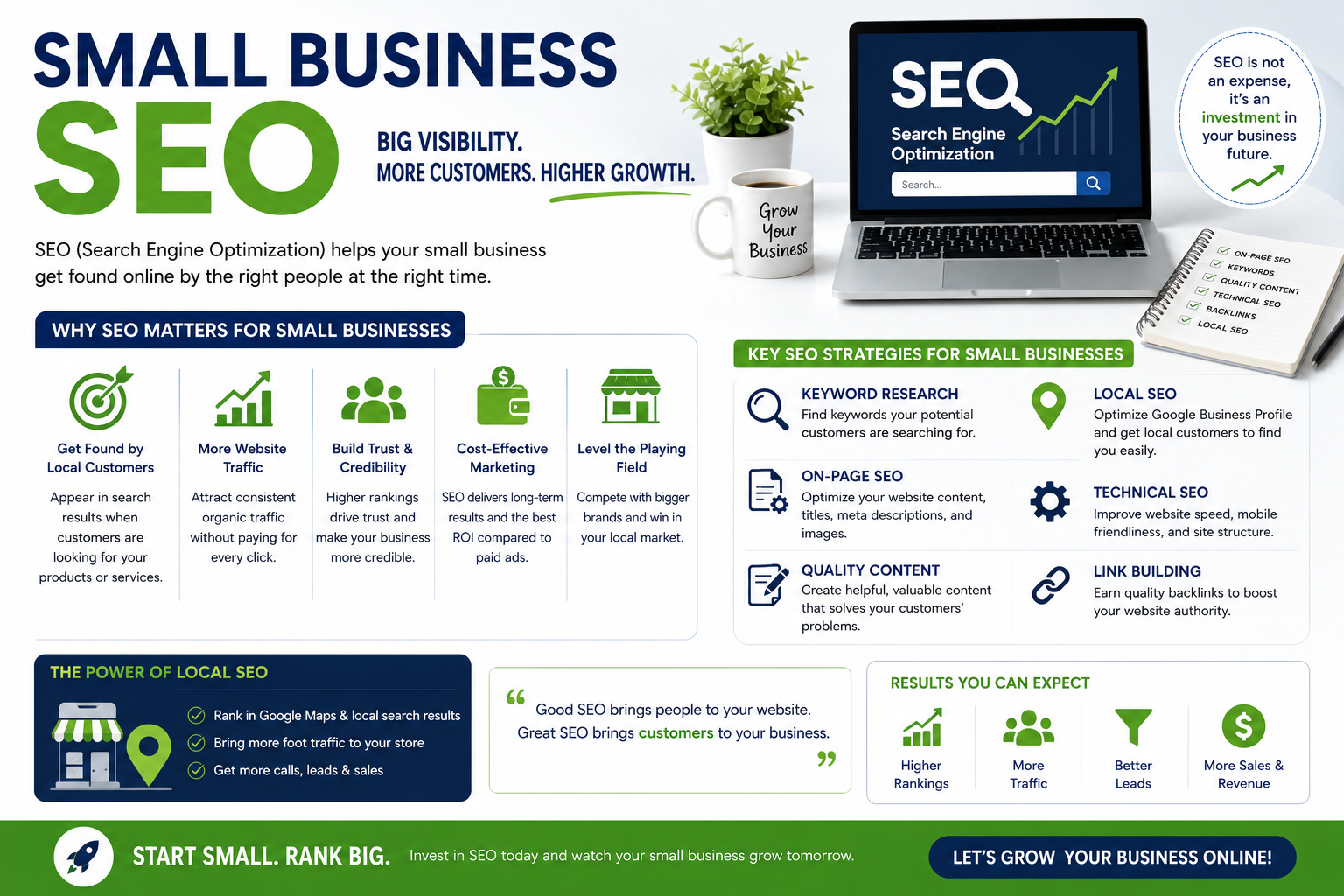
Small business SEO is simply the practice of making it as easy as possible for Google to find your site, understand what it’s about, and trust it enough to show it to people nearby who are searching for what you sell. That’s it. Everything else in this guide is detailed on those three steps.
One more thing worth knowing early: Google doesn’t rank websites, it ranks pages. Your homepage competing for every keyword is one of the most common small business SEO mistakes you need different pages built for different searches, which is exactly what content clusters (more on this below) solve.
Keyword Research: Finding What People Actually Search For
Keyword research is where most DIY SEO goes wrong not because it’s technically hard, but because owners guess instead of check. You think people search “plumbing company,” but the data might show they search “emergency plumber near me” ten times as often.
How to do it properly:
- Start with intent, not volume. Every keyword falls into one of four buckets: informational (“how does a boiler pressure valve work”), navigational (“Bosch boiler manual”), commercial (“best boiler brands 2026”), and transactional (“boiler installation quote Manchester”). A small business site needs content across all four, but your money pages should target commercial and transactional intent.
- Use free tools first. Google’s own autocomplete and “People also ask” boxes are free keyword research.
- Think in questions, not just phrases. “SEO for small business” and “how much does SEO cost for a small business” are different searches with different answers required.
- Go local wherever relevant. “Small business SEO” is a different, much more competitive search than “small business SEO Leeds” or “SEO consultant near me” and for most local businesses, the local variant is where the real revenue lives.
- Group keywords into clusters, not a flat list. A cluster is one pillar topic (like this guide) surrounded by supporting articles that each answer one specific sub-question. This structure is what search engines and increasingly AI answer engines use to understand that your site has genuine depth on a subject, not just one lucky page.
A simple rule for small businesses with limited time: pick five to ten keyword themes that map directly to what you sell, build one strong page per theme, and resist the urge to chase every keyword idea a tool spits out.
A word on search volume. A keyword with fifty searches a month but obvious buying intent (“boiler installation quote Salford”) is usually worth more than one with five thousand searches a month and vague intent (“boilers”). Volume tells you how many people search; it tells you nothing about how many of them are ready to buy from you. Weigh volume against intent and against how realistic it is that you’ll actually rank, especially in year one.
Competitor gap analysis is a shortcut worth taking. Look at the two or three competitors who consistently outrank you and note which topics they cover that you don’t. You’re not copying them you’re identifying blind spots in your own content plan that real searchers clearly care about, since those competitors have presumably already done some of the research legwork for you.
On-Page SEO: Making Each Page Work Harder
On-page SEO is everything you control directly on a given page. Get this right and you’re doing 50% of the job before you’ve built a single backlink.
The essentials, in order of impact:
- Title tag. The single most important on-page element. Include your primary keyword close to the front, keep it under roughly 60 characters, and write it for a human first; a title that gets clicked beats a title that’s merely “optimised.”
- Meta description. Doesn’t directly affect rankings, but it’s your advert in the search results. A clear benefit plus a reason to click (like “including a free calculator” or “with a 90-day plan”) outperforms a stuffed, robotic sentence every time.
- One H1 per page, matching the topic and ideally containing your primary keyword.
- Logical H2/H3 structure. Break the page into scannable sections this helps readers, helps Google understand the page’s scope, and increasingly helps AI systems extract and cite the right chunk of your content.
- Content depth. Thin, generic pages don’t rank in 2026. Answer the question completely, cover related subquestions, and avoid padding Google’s helpful content systems are specifically built to spot filler.
- Internal links. Link from this page to related pages on your site (and get relevant pages linking back). This is free, entirely within your control, and one of the most underused levers in small business SEO.
- Image alt text. Describe the image for people who can’t see it, and where natural, include a relevant keyword. Don’t force it.
- URL structure. Short, readable, keyword-relevant URLs (/services/seo-services/ beats /page?id=4471).
A quick gut check: if you removed your business name and location from a page, could a stranger tell exactly what it’s about and why it’s better than the ten other pages ranking above it? If not, that’s your starting point.
Don’t skip the author and “last updated” details. A named author with real credentials, and a visible “last updated” date, are small touches that quietly signal E-E-A-T Experience, Expertise, Authoritativeness, and Trust to both Google and human readers. A page that’s obviously been refreshed recently, written by someone who plausibly knows the subject, will consistently be trusted more than an anonymous page dated three years ago, even if the underlying content is similar.
Technical SEO Basics (Without the Overwhelm)
Technical SEO sounds intimidating, but for a small business site, there are really only a handful of things worth checking regularly.
- Site speed. Slow-loading pages lose both rankings and customers. Compress images, avoid bloated page builders, and test with Google’s PageSpeed Insights.
- Mobile-friendliness. The majority of searches happen on mobile, and Google evaluates your mobile version first. If your site isn’t comfortable to use on a phone, fix that before anything else on this list.
- HTTPS. Your site should load securely (padlock in the browser bar). This is now table stakes, not a bonus.
- XML sitemap. A file that lists all your important pages so Google can find them efficiently. Most website platforms generate this automatically worth confirming yours exists and is submitted in Search Console.
- No broken links or 404s on key pages. Broken internal links waste crawl budgets and frustrate visitors.
- Duplicate content. Common on small business sites with near-identical service pages for each location. Make sure each page has genuinely unique content, not a find-and-replace of the town name.
- Structured data (schema markup).. It won’t guarantee rich results, but it removes ambiguity and ambiguity is the enemy of ranking well.
Core Web Vitals, Google’s specific metrics for loading speed, interactivity, and visual stability, are worth a mention here too. You don’t need to memorise the thresholds most site speed tools will simply tell you “pass” or “fail” against them but if you’re failing badly, that’s usually a template or plugin bloat issue worth fixing before you invest heavily in new content, since a slow page undermines every other improvement you make to it.
You don’t need to become a developer. You need to run a free audit periodically, fix what’s flagged as high-priority, and not let small issues pile up into big ones. For most small business sites, technical SEO is a once-a-quarter checklist, not a daily job.
Local SEO: The Fastest Win for Most Small Businesses
If you serve customers in a specific area, local SEO is very likely where you should focus first. It’s less competitive than national SEO and converts at a much higher rate.
The core pillars of local SEO:
- Google Business Profile (GBP). This is non-negotiable. Claim it, verify it, and fill in every field: categories, opening hours, services, photos, and your service area. An incomplete or unverified profile is one of the most common reasons a genuinely good local business doesn’t show up in the map pack.
- Consistent NAP. Your Name, Address, and Phone number should match, word for word, everywhere they appear online your website, GBP, directories, social profiles. Inconsistency quietly erodes trust signals.
- Reviews. Volume, recency, and your responses all matter.
- Local citations. Listings on directories relevant to your industry and area (trade bodies, local chambers of commerce, industry-specific directories) reinforce that you’re a real, established local business.
- Location pages, if you serve multiple areas but written with genuinely local detail (landmarks, specific services relevant to that area, local case studies), never a copy-pasted template.
- Local content, like posts about local events, area-specific guides, or projects completed nearby. This is a light lift that consistently pays off in local map pack visibility.
For most small businesses, a properly optimised Google Business Profile with a steady flow of genuine reviews will outperform months of generic national SEO effort.
Content Strategy: Clusters, Not Random Blog Posts
Publishing blog posts at random is one of the most common ways small businesses waste time on content. A content cluster approach fixes this.
The idea: build one comprehensive pillar page (like this guide) covering a broad topic, then support it with several focused cluster articles that each answer one specific question in depth, This tells search engines and AI systems summarising the web that your site has genuine, structured expertise on the topic, not a scattergun of disconnected posts.
Practical tips:
- Plan clusters around what your customers actually ask before, during, and after buying from you.
- Publish consistently rather than in bursts a steady drumbeat beats ten posts in one month followed by silence.
- Update older content rather than always creating new pages. A two-year-old guide refreshed with current information often outperforms a brand-new post.
- Match content format to intent: a buying guide for commercial searches, a how-to for informational ones, a comparison page for people deciding between options.
Backlinks: Why Other Sites Linking to You Still Matters
another site vouching for you.
For small businesses, chasing thousands of backlinks isn’t realistic or necessary. A handful of relevant, genuine links usually outperforms a large pile of low-quality ones. Realistic approaches include:
- Local press and community sites sponsoring a local event, being featured for a community contribution, or commenting as an expert source.
- Supplier and partner websites many businesses have a “trusted partners” or “our suppliers” page and will link to you if asked.
- Industry directories and trade bodies relevant to your sector.
- Digital PR is a genuinely useful resource, original piece of research, or newsworthy story that journalists or bloggers want to reference.
- Guest content on relevant, reputable sites in your industry (not link farms quality over quantity, always).
Avoid anything that promises “500 backlinks for £50.” Link schemes like this can actively damage your site and, at worst, trigger a manual penalty. If it sounds too easy, it almost always is.
Measuring What’s Working: Search Console and Beyond
You can’t improve what you don’t measure. Two free tools cover almost everything a small business needs:
- Google Search Console (GSC). Shows you exactly which searches bring people to your site, your average position for each, your click-through rate, and any technical issues Google has flagged. This is the single most useful free tool in all of SEO.
- Google Analytics. Shows what happens once visitors land which pages they view, how long they stay, and whether they convert.
What to actually look at monthly:
- Total clicks and impressions (are you being seen more, even before you’re being clicked more?)
- Average position for your priority keywords
- Which pages are gaining or losing traffic
- Any manual actions or security issues flagged in GSC
[Google Search Console screenshot walkthrough]
This is exactly the process we use ourselves. We track our own Search Console growth month by month as this site’s cluster of guides builds out impressions and rankings climbing in real time as we publish. We’ll be showing that data transparently as this guide ages, because we think a site teaching SEO should be able to show its own results, not just describe the theory.
How AI Overviews and AI Search Are Changing SEO
The biggest shift in search since mobile-first indexing has been the rise of AI-generated answers directly in the results AI Overviews, AI chat assistants, and answer engines that summarise the web rather than simply listing links to it.
- Being cited matters as much as being clicked. AI systems pull from pages that clearly, directly answer a question. Clear structure, direct answers near the top of a section, and genuine depth all increase your odds of being the source an AI answer draws from.
- Fewer, better clicks. Some casual, purely informational searches now get answered without a click at all. This makes commercial and local intent where people still need to book, buy, or call someone even more valuable to target.
- E-E-A-T matters more, not less. Experience, Expertise, Authoritativeness, and Trust are exactly what separates a generic AI-generated answer from a business people actually choose to buy from. Real photos, named authors, genuine case studies, and transparent results (like the Search Console growth we mentioned above) are harder to fake and increasingly what wins.
- Structured content wins. Clear headings, direct answers, and well-organised FAQs are easier for both humans and AI systems to extract cleanly which is exactly why this guide, and every guide in this cluster, is built the way it is.
The takeaway isn’t “AI has broken SEO.” It’s that the fundamentals of genuine expertise, clear writing, real trust signals now matter more, because AI systems are specifically built to detect and reward exactly that.
Your 90-Day DIY SEO Plan
If you’re doing this yourself, here’s a realistic, sequenced plan.
Days 1–14: Foundations
- Claim and fully complete your Google Business Profile
- Set up Google Search Console and Google Analytics
- Run a free technical audit and fix critical issues (speed, mobile, broken links)
- Confirm your NAP is consistent everywhere it appears online
Days 15–30: Research and structure
- Do proper keyword research and map five to ten core topics to your services
- Plan your first content cluster (one pillar, three to five supporting articles)
- Audit existing pages against the on-page checklist above and fix the worst offenders
Days 31–60: Build and publish
- Rewrite or create your core service pages with proper on-page SEO
- Publish your first two to three cluster articles
- Start a simple, consistent review-request process for customers
- Identify five realistic backlink opportunities (suppliers, local press, directories) and reach out
Days 61–90: Measure and refine
- Review Search Console data: what’s gaining impressions, what’s stuck
- Update or expand your weakest existing pages rather than only creating new ones
- Publish two to three more cluster articles
- Reassess: what’s working, what isn’t, and where hiring help would save you the most time
When to Do It Yourself vs When to Hire Help
It’s entirely possible to make real progress following the plan above.
Hiring help tends to make sense when:
- You’ve done the basics above and plateaued
- Your time is worth more spent serving customers than learning technical SEO
- You’re in a competitive market where consistent content and technical work is a full-time job in itself
- You want a content cluster built and maintained at a pace you can’t sustain alone
A good SEO partner should be transparent about what they’re doing and why, show you real data rather than vague promises, and be upfront that SEO is a compounding, months-long investment not a switch that flips overnight.If you’d rather have this done properly than do it yourself, our SEO services are built around exactly the process in this guide.
Related Guides in This Series
This pillar guide is the anchor for our full small business SEO cluster. For deeper detail on any single step above, see:
- Keyword research for small businesses, step by step
- The complete on-page SEO checklist
- Local SEO and Google Business Profile optimisation
- A beginner’s guide to technical SEO audits
- Realistic, safe link building for small businesses
- How to read Google Search Console like a pro
FAQs
How long does SEO take to work? Most small business sites start seeing measurable movement in three to six months, with meaningful results building over six to twelve months. SEO is a compounding investment rather than an instant switch early technical fixes and Google Business Profile work tend to show results fastest, while competitive keyword rankings take longer.
Can I do SEO myself? Yes, particularly the foundational work: Google Business Profile, on-page basics, technical fixes, and consistent content following the plan in this guide. The main trade-off is time DIY SEO is entirely achievable, but it competes with the time you’d otherwise spend running your business.
How much should I spend on SEO? This varies hugely by industry and competitiveness, but as a general guide, small businesses typically invest anywhere from a few hundred to a few thousand pounds a month when hiring help, or the equivalent in time if doing it themselves. The right amount depends on how competitive your market is and how quickly you need results.
Is SEO dead because of AI? No but it has changed. AI Overviews and AI search have shifted some purely informational searches away from clicks, but commercial and local searches (the ones that actually drive bookings and sales) remain highly click-driven. The fundamentals behind good SEO genuine expertise, clear content, real trust signals are exactly what AI systems reward too, so strong SEO practice is arguably more valuable now, not less.
We offer a free mini-audit that flags your biggest quick wins in plain English no jargon, no pressure. Request your free mini-audit →
Leave a Reply