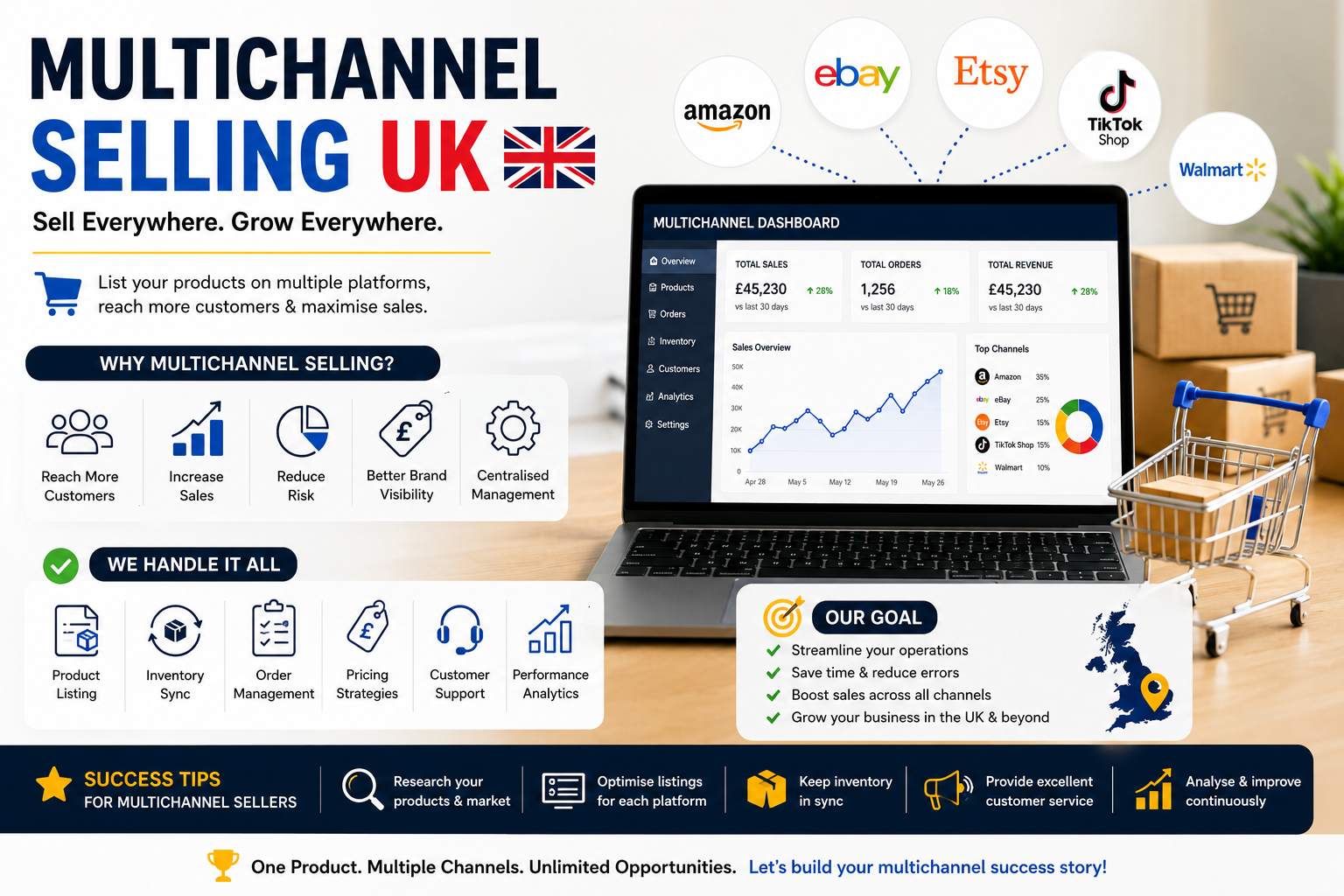
If you’re only selling on one marketplace, you’re leaving money on the table but the moment you add a second or third channel, a new problem shows up: keeping stock, orders and pricing straight across all of them. Multichannel selling UK sellers who get this right can double or triple their reach without doubling their workload. Get it wrong, and you’re looking at overselling, angry customers, and suspended seller accounts.
to hand the whole thing to someone else.
Why Sell on Multiple Channels at Once
Each marketplace brings a different type of buyer. Amazon shoppers want speed and trust signals (Prime, reviews, fast dispatch). eBay buyers are often hunting for value, used goods, or niche/collectable items. Etsy shoppers are looking for handmade, vintage or personalised products and are generally less price-sensitive. Your own store (Shopify, WooCommerce, etc.) gives you the margin and the customer data the marketplaces won’t share with you.
Sellers who want to sell on Amazon and eBay at the same time and ideally Etsy and their own store too aren’t chasing novelty. They’re spreading risk. A single-channel seller is completely exposed if that platform changes its algorithm, raises fees, or suspends the account for a policy breach that wasn’t even their fault. Multichannel sellers can absorb that hit and keep trading.
The catch is operational complexity. The same SKU now needs a listing on four platforms, each with its own formatting rules, category structure and fee model. Stock needs to be accurate across all of them in near real time, or you’ll sell an item on eBay that a customer already bought on Amazon ten minutes earlier. This is where most sellers either invest in multichannel ecommerce management tools, or start looking at outsourcing.
Channel Fee Comparison: Amazon vs eBay vs Etsy vs Your Own Store
Fees vary by category, subscription tier and whether you’re using fulfilment services, so treat the figures below as general guidance rather than an exact quote for your account. Always check current rates before pricing stock.
| Channel | Typical Selling Fee | Monthly/Subscription Cost | Payment Processing | Notes |
| Amazon UK | ~8–15% referral fee (category-dependent) | £25/month (Professional plan) | Included in referral fee | FBA storage/fulfilment fees apply separately if used |
| eBay UK | ~4–12% final value fee (category-dependent) | Free to ~£25+/month (shop subscription tiers) | Included via Managed Payments | Lower cost of entry; shop subscription reduces per-item fees |
| Etsy | 6.5% transaction fee + £0.16 listing fee per item | No mandatory subscription (optional Plus plan) | ~4% + £0.20 payment processing | Listing fees add up fast at volume |
| Own store (Shopify etc.) | 0% marketplace commission | ~£25–£90+/month platform fee | ~2% + £0.20 card processing | Highest margin, but you own all the traffic acquisition cost |
Suggested image alt text: “UK marketplace fees compared Amazon eBay Etsy”
The general pattern: your own store protects margin best but costs the most in marketing effort; Amazon delivers volume but takes the biggest cut; eBay sits in the middle and
Inventory Sync Tools That Actually Work
Overselling is the single most common reason multichannel sellers get suspended or leave customers furious. The fix is a listing tool that treats one central stock number as the source of truth and pushes updates out to every channel automatically.
Tools we’ve used and recommend for UK sellers, roughly in order of complexity:
- Linnworks a strong choice once you’re managing hundreds of SKUs across several marketplaces plus your own store; handles order consolidation, stock sync and shipping in one dashboard.
- ChannelEngine built for sellers who want tight, near-real-time sync across a large number of marketplaces, including newer ones like TikTok Shop.
- Sellbrite (now part of GoDaddy) a lighter-weight option, good for sellers moving from a single channel to three or four without a huge tech budget.
- Ecomdashsolid mid-market inventory and order management, works well alongside Shopify.
- SKU IQ a lower-cost bridge tool, useful for smaller catalogues that mainly need Shopify-to-marketplace sync rather than full multichannel management.
At MDOB, our store-handling team runs client accounts through a combination of these platforms depending on catalogue size and channel mix, rather than committing every client to one system regardless of fit. The right tool depends on SKU count, order volume, and how many channels you’re actually running a 50-SKU Etsy-and-eBay seller doesn’t need the same stack as a 2,000-SKU Amazon-plus-own-store operation.
If you haven’t set up your own store yet and are only using marketplaces so far, it’s worth reading our separate guide on getting a store running properly before you add more sales channels on top.
A Practical Multichannel Workflow
Here’s roughly how the workflow should look once it’s running properly:
- Central stock ledger. One system (your inventory tool, or a well-maintained spreadsheet if you’re very small) holds the true stock count for every SKU.
- Push, don’t pull, listings. Create and edit listings from the central tool where possible, so titles, images and pricing stay consistent across channels instead of drifting apart.
- Sync stock in near real time. As soon as an item sells anywhere, the count updates everywhere else ideally within minutes, not hours.
- Order consolidation. Pull orders from every channel into a single queue for picking, packing and dispatch, so your warehouse process doesn’t change depending on where the sale came from.
- Reconcile fees and payouts weekly. Because payout schedules and fee structures differ by channel, reconcile at least weekly so a pricing mistake on one platform doesn’t go unnoticed for a month.
- Review channel performance monthly. Not every product performs the same on every channel some SKUs will do far better on Etsy than Amazon, for example, and it’s worth pruning listings that underperform rather than leaving dead stock live everywhere.
Should you add TikTok Shop? It’s worth testing if your products are visual, impulse-buy friendly, and suit short-form video content but treat it as an experiment layered on top of a working core setup, not a replacement for Amazon or eBay. Fees and logistics requirements are still evolving, so don’t overcommit stock to it before you’ve seen real conversion data from your own catalogue.
When to Outsource Multichannel Selling
There’s a point usually somewhere around 200–300 orders a month across channels, or whenever a seller starts missing dispatch times and getting stock counts wrong where doing this manually stops being sustainable. The signs are familiar: listings going stale because there’s no time to update them, stock discrepancies causing cancelled orders, and hours lost every week just reconciling what sold where.
This is exactly the gap our A-Z store-handling service is built to clonse. Rather than you managing five different dashboards, our team runs the full operatio listing creation and optimisation across Amazon, eBay, Etsy and your own store, inventory sync so you never oversell, order consolidation and dispatch coordination, and ongoing fee and performance monitoring so pricing stays profitable on every channel. You keep the stock and the brand; we handle the day-to-day multichannel machinery.
FAQs
Which marketplace is cheapest? For low-cost, low-margin items sold in volume, eBay with a shop subscription is often the cheapest option once you factor in reduced final value fees. For handmade or niche items sold in smaller volumes, Etsy’s per-listing model can work out cheaper than Amazon’s referral fees. Your own store has the lowest per-sale cost but shifts the expense to marketing and traffic generation instead.
How do I avoid overselling across channels? Use a single inventory tool as your source of truth rather than updating stock manually on each platform. Sync stock levels in near real time, build in a small safety buffer for fast-moving items, and reconcile actual warehouse counts against your system regularly daily if volume is high, weekly at minimum otherwise.
Is TikTok Shop worth it for UK sellers? It can be, particularly for visually appealing or trend-driven products, but it works best as an addition to an already-stable Amazon/eBay/Etsy setup rather than a starting point. Test with a limited product range and modest stock commitment before scaling it up.
Ready to stop juggling dashboards? See how our A-Z store-handling service manages Amazon, eBay, Etsy and TikTok Shop for you inventory, listings, orders and all.
Leave a Reply