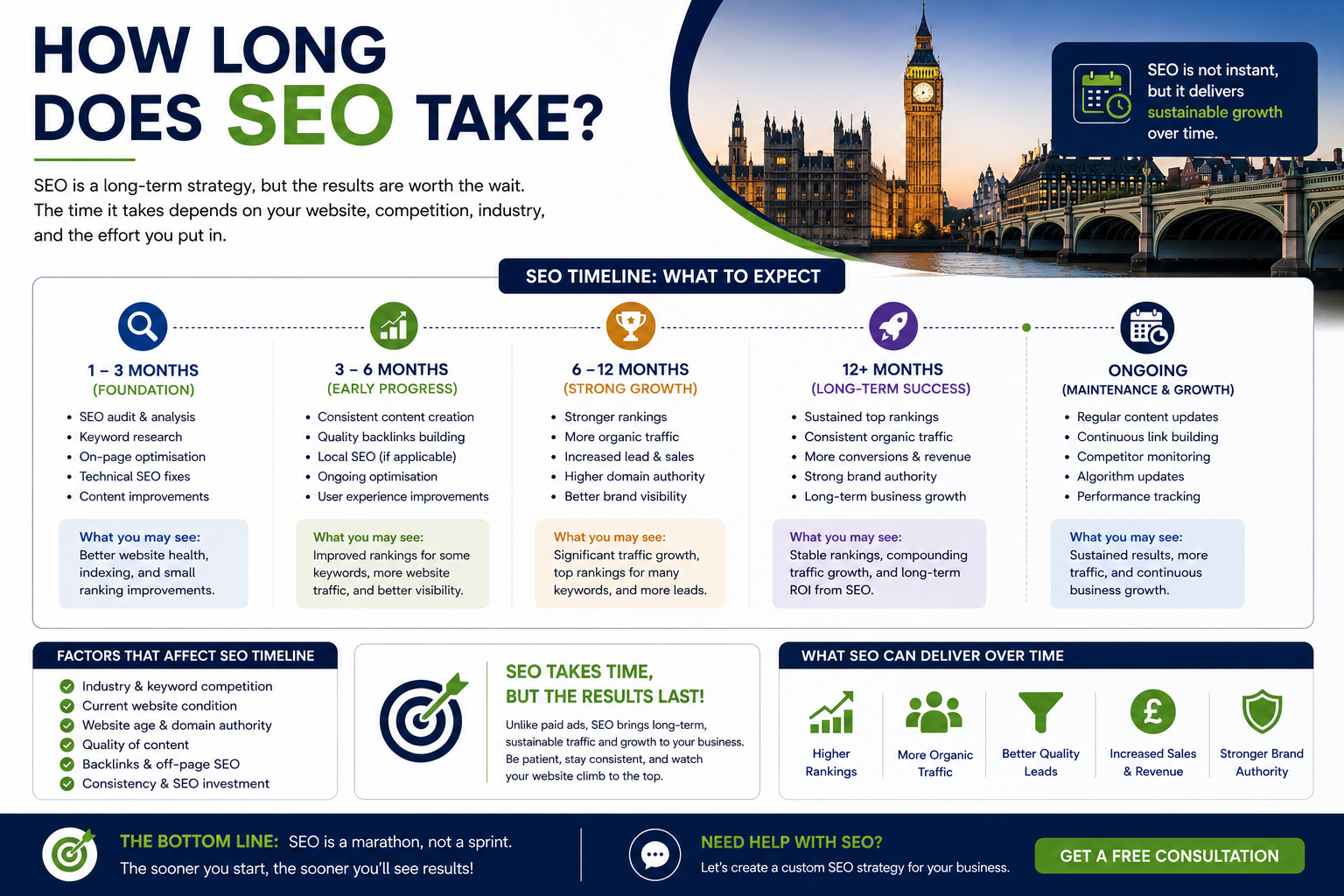
Short answer: expect your first meaningful movement in 36 months, and real, revenue-moving traffic in 612 months. If someone promises page-1 rankings in 30 days, that’s not SEO it’s a red flag (more on that below).
That range isn’t a hedge. It’s what actually shows up in ranking data across most industries and competition levels. SEO is slow for structural reasons: search engines need to discover your pages, trust your site, and watch how people respond to it over time before they’ll rank you above competitors who’ve already done that work. There’s no shortcut around that trust-building process only ways to speed it up or slow it down.
This guide breaks down what happens month by month, the variables that move the timeline in either direction, why a brand-new site behaves differently than an established one, and how to tell a legitimate agency from one selling you a fantasy.
The Month-by-Month SEO Results Timeline
Every site is different, but this is the pattern that shows up again and again once technical issues are fixed and content starts publishing consistently.
| Month | What’s Typically Happening | What You’ll See |
| 1 | Technical audit, fixes, keyword research, content planning | Little to no visible change this is foundation work |
| 2 | First content published, on-page optimization rolled out | Pages start getting indexed; maybe a few impressions in Search Console |
| 3 | Content velocity builds, early backlinks acquired | Some keywords enter positions 50–100; impressions climb |
| 45 | Google reassesses the site as a whole, not just individual pages | Movement into positions 2050 for easier terms; a few long-tail wins |
| 6 | First real evaluation point | Measurable organic traffic increase; some page-1 rankings for lower-competition terms |
| 7–9 | Compounding phase older content matures, authority builds | Traffic growth accelerates; rankings for competitive terms start appearing |
| 10–12 | Momentum phase | Meaningful lead/revenue impact; rankings stabilize and start defending themselves |
The key thing to notice: the curve isn’t linear. It’s closer to a hockey stick flat for a while, then it bends upward. Most of the disappointment people feel with SEO comes from judging month 3 as if it should look like month 9.
Why “How Long Does SEO Take” Doesn’t Have One Answer
The variables below are what actually determine whether you land at month 4 or month 14.
Domain authority. A site with years of history and existing backlinks starts the race further down the track. A brand-new domain starts from zero trust, regardless of how good the content is.
The sandbox effect. Many new or newly re-optimized domains go through a period often the first few months where Google seems to suppress rankings even for decent content, as if testing whether the site sticks around. This isn’t officially confirmed as a discrete algorithm feature, but the pattern is consistent enough that most SEOs plan around it. If your timeline estimate doesn’t account for this, it’s probably too optimistic.
Competition level. Ranking for “best accounting software” and ranking for “bookkeeping services in [small city]” are different jobs. The more commercially valuable and contested a keyword, the longer and more content/link-intensive the climb.
Content velocity. Sites that publish consistently and keep publishing after the first few wins tend to compound faster than sites that do a burst of content and stop. Search engines reward sustained signals of a maintained, growing resource over a one-time content dump.
Indexing speed. Pages have to be crawled and indexed before they can rank at all. Technical issues broken sitemaps, crawl errors, slow load times, thin content that looks low-value can delay indexing by weeks, which pushes the entire timeline back before it even starts.
Link acquisition. Backlinks remain one of the strongest ranking signals, and they’re also the slowest to build safely. A site earning a handful of relevant, quality links per month will outperform one with none but that process itself takes months to show up in rankings.
New Site vs. Established Site: Different Clocks
A brand-new domain is starting from nothing. No backlink profile, no crawl history, no trust signals. Expect the full 6–12 month runway before rankings translate into real traffic, and don’t be surprised if the first 2–3 months show almost nothing measurable in Google Search Console beyond indexing.
An established site with existing content and some authority is in a different situation. If the work is more about optimizing what’s already there fixing technical debt, improving content that’s ranking on page 2 or 3, cleaning up cannibalization issues movement can appear in as little as 6–8 weeks, because you’re not building trust from zero. You’re re-triggering signals Google already has some data on.
This is why “how long does SEO take” gets a different answer depending on which site you’re asking about. An agency that gives you one number without asking about your domain’s history isn’t giving you a real estimate.
Red Flag: “Page 1 in 30 Days” Promises
If an agency or freelancer guarantees page-1 rankings within 30 days, treat it as a warning sign, not a selling point. A few reasons this promise doesn’t hold up:
- It’s not physically possible for competitive terms. Trust and authority accumulate over time; there’s no legitimate technique that compresses that into a month.
- It usually means low-competition, low-value keywords. Ranking #1 for a search term nobody uses isn’t a result it’s a talking point.
- It can mean risky tactics. Aggressive link schemes or manipulative techniques can produce short-term spikes followed by penalties that take much longer to recover from than the SEO would have taken to do properly.
- It sidesteps the real question. The point of SEO isn’t a ranking screenshot it’s qualified traffic that converts. A fast fake ranking on the wrong keyword does nothing for revenue.
A trustworthy provider will walk you through a realistic timeline, show you what month-by-month progress actually looks like, and set expectations before taking your budget not after.
If you want a sense of what a realistic plan and timeline look like for your specific site, our SEO services page breaks down how we scope that in the first month.
What Actually Speeds SEO Up
None of these skip the fundamental trust-building timeline, but they compress it where possible:
- Fixing technical issues early so indexing isn’t delayed before content even has a chance to rank.
- Consistent content velocity rather than sporadic bursts this is one of the biggest levers within your control.
- Targeting realistic keyword difficulty first building early wins on lower-competition terms creates momentum and internal linking opportunities for harder terms later.
- Combining SEO with paid search in the interim (see the FAQ below) so you’re not waiting on organic traffic alone to generate leads.
- Digital PR and legitimate link building, which remain some of the highest-leverage ways to build authority faster than content alone.
FAQs
Why is SEO so slow?
Because rankings are fundamentally a trust signal, and trust is built by search engines observing consistent behavior content quality, user engagement, backlinks, site stability over an extended period. There’s no way to fast-forward through that observation window. The sites that seem to “suddenly” rank well are usually sites that did months or years of unglamorous groundwork before the visible payoff.
Can I speed it up with paid ads?
You can’t speed up organic rankings with ads directly Google doesn’t factor ad spend into organic results. But running paid search alongside SEO is a smart way to generate leads during the months before organic traffic matures. Think of it as bridging the gap, not accelerating the SEO itself. Many businesses run both simultaneously, then gradually shift budget toward organic as it starts producing traffic on its own.
When should I consider firing an SEO agency?
Give a legitimate campaign at least 46 months before judging results, since that’s roughly when early movement should be visible in Search Console even if it hasn’t hit your site’s traffic yet. After that point, red flags worth watching for include: no reporting or vague reporting, no visible content or technical work being delivered, no explanation for lack of progress, or continued promises of “next month” without data to back it up. A good agency should be able to show you keyword position changes, indexing status, and content published even if traffic hasn’t caught up yet. If none of that exists by month 6, that’s a legitimate reason to have a serious conversation.
Where Your Timeline Actually Starts
The honest version of “how long does SEO take” is: it depends on where your site is starting from, how competitive your market is, and how consistently the work gets done but 3–6 months for first movement and 612 months for meaningful traffic is the realistic range for most businesses.
If you want a straight answer on what that timeline looks like for your specific site, not a generic estimate, book a strategy call and we’ll walk through your domain’s history, competition level, and a realistic month-by-month plan before you spend a dollar.
Leave a Reply