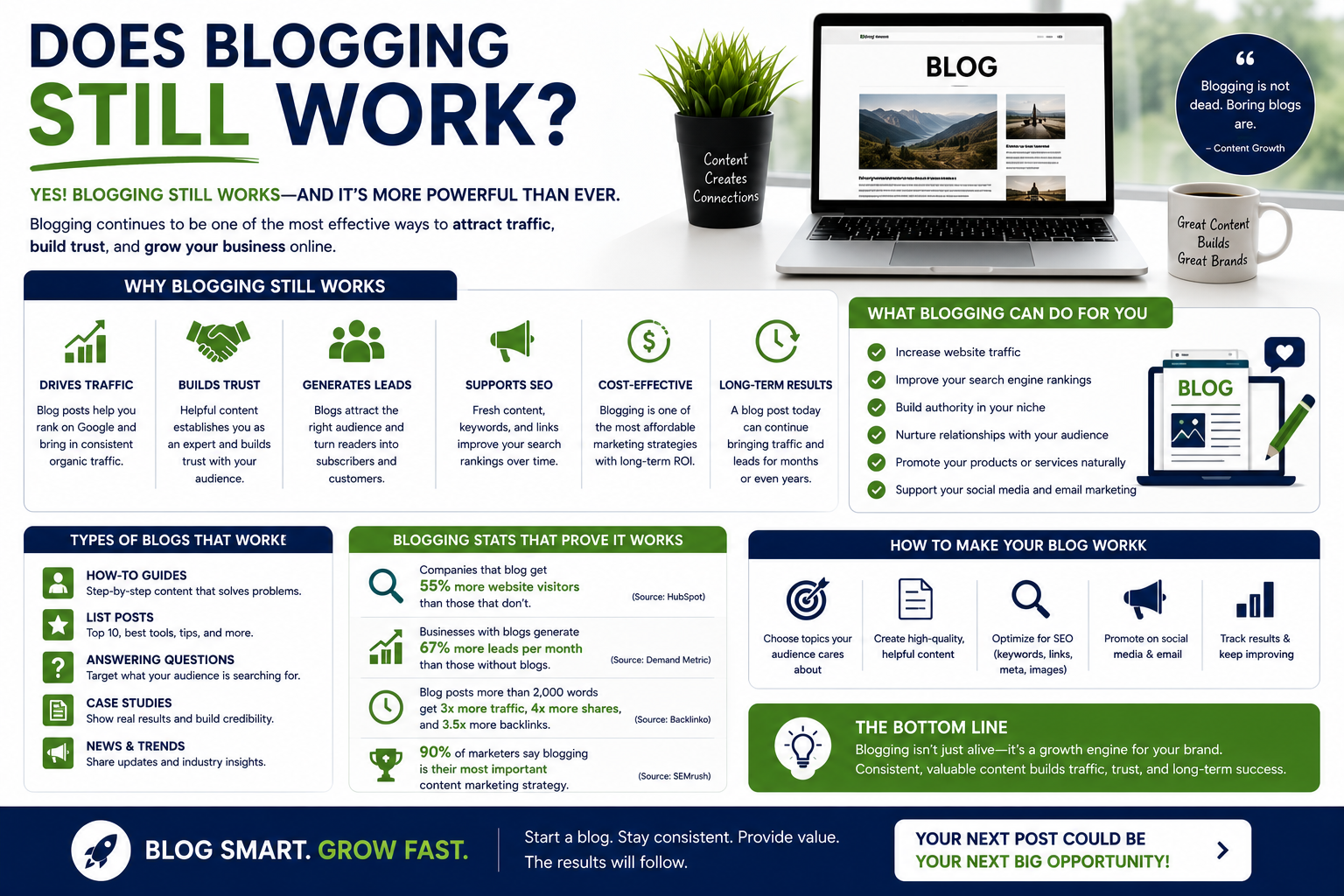
Every few years, someone declares blogging dead. First it was social media. Then video. Now it’s AI Overviews and chatbots answering questions before anyone clicks through to a website. So it’s a fair question to ask in 2026: does blogging still work, or is this another line item you’re paying for out of habit?
The honest answer is: it depends entirely on the kind of blogging you’re doing.But blogging built around topical authority, real experience, and commercial intent is working better than it has in years precisely because so much of the competition has gotten lazy or fully automated.
This isn’t a defense of blogging for blogging’s sake. It’s a look at what changed, what didn’t, and what a business blog needs to look like to actually earn its keep this year.
The AI-Search Reality
Search behavior has shifted. AI Overviews, chat-based assistants, and zero-click answers now absorb a meaningful share of informational queries the “what is,” “how does,” and “why” searches that used to reliably send traffic to blogs. If your content strategy was built entirely around capturing that top-of-funnel volume, you’ve probably felt the pinch already.
But here’s what the panic narrative misses: AI Overviews still have to source their answers from somewhere. Search engines are pulling from content that demonstrates clear expertise, structure, and originality the pillars of what Google calls E-E-A-T (Experience, Expertise, Authoritativeness, Trustworthiness). Thin content that used to rank on keyword density alone is being filtered out of both traditional results and AI-generated summaries. Meanwhile, well-structured, genuinely useful content is getting cited, linked, and critically still clicked, especially by people who are past the “what is this” stage and into the “who should I hire for this” stage.
The shift isn’t away from blogging. It’s away from blogging that treats every article as a standalone bet on a single keyword, and toward blogging that builds a body of interconnected, defensible expertise around a business’s actual specialty.
What Stopped Working
A few tactics that used to move the needle are now actively counterproductive:
- Volume-first publishing. Pushing out three or four generic AI-drafted posts a week, each covering a keyword variation, no longer builds authority it dilutes it. Search engines increasingly evaluate sites on the overall quality and coherence of the content, not just the count of pages.
- Keyword-stuffed, surface-level answers. If a post could have been written by anyone with five minutes and a search bar, it’s competing directly with an AI Overview that can generate the same summary instantly and it will usually lose that fight.
- Orphaned, one-off articles. A blog post with no internal links, no relationship to other content on the site, and no connection to a service page reads as an isolated asset rather than evidence of expertise in a subject.
- Content with no point of view. Posts that just aggregate what’s already been said, without a business’s own data, experience, or opinion, have nothing left to offer once an AI system can produce the same aggregation on demand.
If your blog is stalling, it’s worth being honest about which of these four boxes it’s ticking.
What Works Now
Topic Clusters, Not Random Posts
The single biggest shift in effective business blogging strategy is structural: content built as topic clusters instead of disconnected articles. A cluster is a pillar page covering a broad subject in depth, supported by a network of related posts that each go deep on a subtopic and link back to the pillar (and to each other).
This matters for two reasons. First, it signals topical authority search engines can see that a site covers a subject comprehensively rather than opportunistically. Second, it keeps visitors moving through a site rather than bouncing after one page, which is exactly the kind of engagement signal that correlates with sustained rankings.
A well-built cluster doesn’t need to be huge. Ten to fifteen tightly related posts, organized around one pillar page and cross-linked deliberately, will outperform sixty scattered articles almost every time.
Experience-Led Content
AI content can produce competent summaries. What it can’t produce is a first-hand case study, a specific number from your own client work, a mistake you’ve actually made and fixed, or a screenshot of your own process. That’s the experience layer of E-E-A-T, and it’s the single hardest thing for a competitor human or AI to copy.
Practically, this means every post should include something that could only come from having actually done the work: a real example, a specific result, a named tool with a genuine opinion about it, a photo instead of a stock image. This is also the content that AI Overviews and chatbots are most likely to cite by name, because it’s the content that isn’t already duplicated a thousand times across the web.
Bottom-of-Funnel, Commercial-Intent Posts
Not every post needs to chase broad informational traffic. Some of the highest-ROI posts are narrow, commercially intent-driven pieces: comparisons, pricing breakdowns, “is X worth it for businesses like mine” articles, and posts that address the specific objections a prospect has right before they’re ready to buy.
This is where content ROI becomes measurable rather than theoretical. A pillar post might bring in volume; a bottom-funnel post converts a warm reader into a lead. Pairing the two broad clusters for authority, narrow commercial posts for conversion is what makes a blog defensible as a business investment rather than a nice-to-have.
A Mini Framework
For a sceptical owner deciding whether to keep investing in a blog, a simple filter works:
- Does this post belong to a cluster? If it can’t be mapped to a pillar topic and linked to related posts, reconsider it.
- Does it include something only we know? A number, a story, a screenshot, an opinion is something an AI summarizer can’t manufacture.
- Does it serve a stage of the funnel on purpose?
- Does it link somewhere that matters? Internally to related posts and pillars, and where relevant, to a service page like content writing or SEO services, so authority translates into action.
Run existing posts through that filter. Anything that fails all four is a candidate to rewrite, merge, or retire, not necessarily proof that blogging itself has stopped working.
Proof, Not Just Theory
It’s worth being direct here: this article is part of a content plan built on exactly this logic. It sits inside a defined cluster, links to related pieces further up and down the funnel (see the related reading below), and points toward the commercial pages it’s meant to support. If the framework above holds up, this piece and the plan it belongs to is the demonstration, not just the description.
FAQs
How often should a business blog? Consistency matters more than frequency. One well-researched, cluster-aligned post a week outperforms daily posts with no strategic connection to each other. Most businesses see solid results publishing one to two posts weekly, provided each one has a defined role in a cluster and a funnel stage.
Can AI write my blog? AI can help with drafts, outlines, and research, but posts that are entirely AI-generated with no human experience, editing, or original input tend to underperform both in search rankings and in reader trust. The businesses seeing the best results use AI to speed up production, then add the first-hand detail and judgment that only a human involved in the work can provide.
How long until a blog pays off? Most businesses start seeing measurable traffic and lead movement in three to six months, with compounding returns after month six to twelve as clusters mature and internal links strengthen. Bottom-funnel, commercial-intent posts can produce leads faster, sometimes within weeks, since they target readers who are already close to a buying decision.
Ready to Make Blogging Work for You?
Blogging isn’t dead. Undirected, disconnected, generic blogging is. If you want a content plan built around clusters, real experience, and posts designed to convert, not just rank a managed content plan takes the guesswork out of what to publish and when.
Leave a Reply