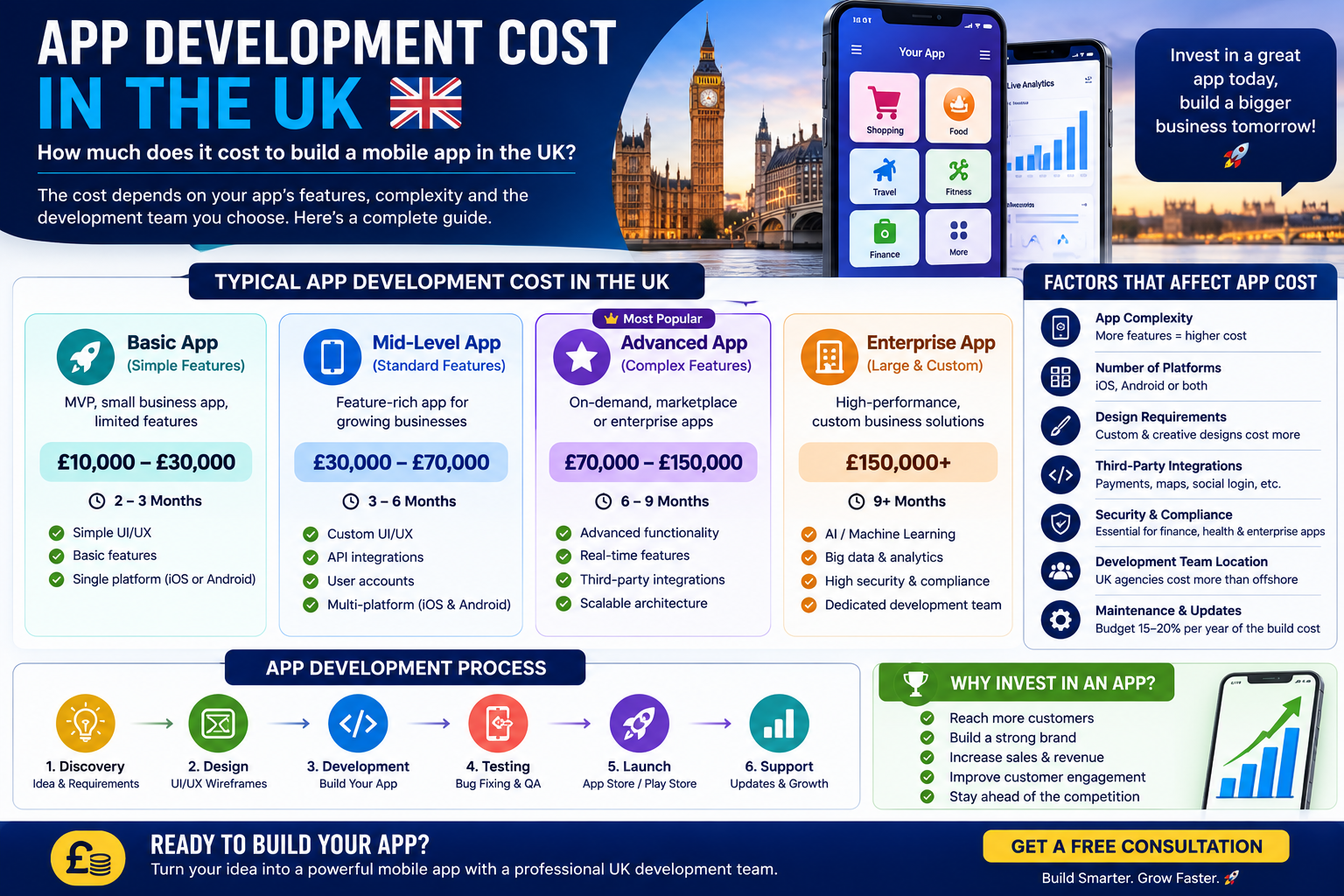
App development pricing in the UK varies wildly because the term “app” covers everything from a single-screen booking form to a multi-platform marketplace with live payments, real-time chat, and a custom backend.
The short answer: in 2026, most UK businesses should budget one of three ranges:
- £8,000–£25,000 for a simple MVP (minimum viable product) a lean, single-purpose app built to test an idea or serve a small user base.
- £25,000–£75,000 for a mid-complexity app multiple user roles, third-party integrations (payments, maps, notifications), and a proper backend.
- £75,000+ for a complex platform think two-sided marketplaces, fintech products, or apps with custom algorithms, heavy data processing, or enterprise-grade security requirements.
Below, we break down exactly what sits inside each band, what pushes a quote up or down, and how to scope a project so you’re not paying for features you don’t need yet.
Cost by App Type: The Real Numbers
These ranges reflect typical UK agency and freelance pricing for 2026, assuming design, development, testing, and basic deployment support are all included.
| App Type | Typical UK Cost | Timeline | Example |
| Simple MVP / single-feature app | £8,000–£25,000 | 6–10 weeks | Booking form, loyalty card, basic content app |
| Mid-complexity app | £25,000–£75,000 | 3–5 months | On-demand service app, fitness app with tracking, e-commerce app |
| Complex platform | £75,000–£150,000+ | 6–12+ months | Marketplace app, fintech app, custom social network |
| Enterprise / regulated app | £150,000+ | 9–18+ months | Healthcare app (NHS-adjacent), banking app, insurance platform |
A few things worth noting about this table. First, these figures typically cover one platform build with cross-platform code reuse (more on that below) building fully separate native iOS and Android apps from scratch usually adds 30–60% on top. Second, none of these numbers include ongoing hosting, App Store fees, or maintenance, which we’ll cover in the hidden costs section further down.
What Actually Drives the Price of an App
Two apps that “sound” identical on a discovery call can end up £40,000 apart once development starts. Here’s what moves the needle.
1. Feature complexity
Every screen, every user flow, and every piece of business logic adds development and testing time. A login screen with email/password is cheap. A login screen with social sign-in, biometric authentication, and multi-factor verification is not.
2. Backend and API requirements
If your app just displays static content, you might not need a backend at all. If it needs to store user data, sync across devices, process payments, or talk to other systems, you need a proper backend servers, databases, and APIs that the app communicates with. This is frequently the single biggest hidden cost in app quotes, because clients focus on what they’ll see (the app’s screens) rather than what powers it behind the scenes.
3. Number of user types and roles
An app with one user type (e.g., a customer-facing loyalty app) is simpler than one with multiple roles customer, driver, admin dashboard, support agent each with different permissions and interfaces. Marketplace and on-demand apps are expensive largely because they’re really two or three apps in one.
4. Third-party integrations
Payment gateways (Stripe, Apple Pay, Google Pay), mapping (Google Maps, Mapbox), push notifications, CRM or ERP integrations, and analytics tools all add setup time, testing, and ongoing dependency management. Each integration is usually a few days to a few weeks of work depending on complexity.
5. Design maturity
A polished, custom UI with animations and a distinct visual identity costs more than a clean, template-based interface using standard design system components. This isn’t a place to cut corners carelessly, though poor UX is one of the most common reasons apps fail to retain users.
6. Platform choice
Building for iOS only, Android only, or both and whether you go native or cross-platform significantly affects cost. We cover this in detail below because it’s often the easiest lever to reduce spend without cutting features.
7. Team location and structure
UK-based agencies typically charge £450–£900+ per day per developer, while offshore teams can be £150–£350 per day. Freelancers sit somewhere in between. Cost isn’t the only consideration here communication overhead, IP protection, code quality, and post-launch support all factor into whether cheaper day rates actually save money overall.
Native vs Cross-Platform: Where the Real Savings Are
One of the biggest cost decisions you’ll make early on is whether to build native apps (separate codebases for iOS and Android, typically Swift and Kotlin) or a cross-platform app (a single codebase, using frameworks like React Native or Flutter, that runs on both).
For most SMEs and founders, cross-platform development is the more cost-effective starting point. Building one shared codebase instead of two separate native apps commonly saves 30–40% on initial development cost, and it also halves the ongoing maintenance burden, since bug fixes and feature updates only need to be written once.
Native development still makes sense in specific situations apps with heavy graphics or gaming requirements, apps that need deep integration with device hardware, or products where performance is a genuine competitive differentiator. But for the vast majority of business apps (booking, e-commerce, content, service marketplaces), cross-platform frameworks are mature enough in 2026 that users won’t notice the difference, and the cost savings are substantial.
For a full breakdown of when native is worth the extra spend and when it isn’t, see our guide on native vs cross-platform app development.
Hidden and Ongoing Costs Most Quotes Don’t Mention
The build cost is only part of the picture. These are the costs that catch founders out after launch:
- App Store fees. Apple charges £79/year for an Apple Developer account; Google charges a one-off $25 (roughly £20) for a Play Console account. Small individually, but easy to forget when budgeting.
- Backend hosting. Depending on user volume, expect anywhere from £30/month for a small app to several thousand pounds a month for a high-traffic platform with heavy data processing.
- Third-party service fees. Payment processors typically take 1.5–3% per transaction; mapping and SMS APIs charge per call or per active user; push notification services often have free tiers that you’ll outgrow quickly.
- Ongoing maintenance. Operating systems update roughly twice a year, and apps need updating to stay compatible, secure, and listed. A reasonable industry rule of thumb is budgeting 15–20% of the original build cost per year for maintenance, bug fixes, and minor updates.
- App Store optimisation and marketing. Building the app doesn’t mean anyone finds it. Screenshots, store listing copy, and ongoing user acquisition are separate line items entirely.
- Data protection and compliance. If you’re handling personal data (which most apps do), UK GDPR compliance, privacy policies, and secure data handling need proper implementation not an afterthought bolted on before launch.
Budgeting for these from day one avoids the common trap of launching an app and then discovering it costs more to run than it did to build.The safest way to control cost isn’t to negotiate a lower day rate it’s to reduce scope intelligently. Here’s how experienced teams do it:
Start with a proper discovery phase. Before any code is written, a good discovery phase (typically 1–3 weeks) maps out user flows, technical requirements, and a prioritised feature list. This sounds like an added cost, but it almost always saves money by catching expensive misunderstandings before development starts rather than mid-build.
Build a true MVP, not a “smaller version of everything.” The point of an MVP is to launch the smallest version of your product that still delivers real value and lets you learn from actual users. That often means launching with one core user flow working brilliantly rather than five flows working adequately.
Use cross-platform frameworks by default. As covered above, this is usually the single biggest lever for reducing cost without reducing functionality.
Phase your integrations. You don’t need every payment method, every notification channel, and every analytics tool on day one. Launch with what’s essential, and add the rest based on real usage data.
Reuse existing design systems. If you already have brand guidelines, a website, or existing digital products, reusing components and design tokens reduces design time significantly compared to starting from a blank canvas.
Get a fixed-scope quote, not just a day-rate estimate. Day-rate estimates can balloon if requirements shift. A clearly scoped fixed-price quote for a defined MVP gives you cost certainty for the first phase, with clear, separate pricing for anything added afterwards.
Example Quote Breakdown
To make this concrete, here’s an anonymised breakdown from a real mid-complexity project we scoped for a UK service-based business a booking and scheduling app with customer and admin roles, calendar sync, and payment processing.
| Phase | Cost | Duration |
| Discovery & UX scoping | £3,200 | 2 weeks |
| UI design (customer + admin) | £6,500 | 3 weeks |
| Cross-platform development | £24,000 | 8 weeks |
| Backend & API development | £9,800 | included above (parallel) |
| Payment gateway integration | £2,400 | 1 week |
| QA & testing | £3,600 | 2 weeks |
| App Store submission & launch support | £1,500 | 1 week |
| Total | £47,000 | ~14 weeks |
This client chose a cross-platform build specifically to keep costs down, and phased out a planned loyalty-points feature to a post-launch update once they had real usage data to design against a good example of scope discipline in practice.
Frequently Asked Questions
What’s the cheapest way to build an app?
The cheapest realistic route is a tightly scoped MVP built cross-platform, focused on a single core user flow, with third-party integrations kept to the essentials at launch. No-code and low-code platforms can go even cheaper (sometimes under £5,000) but come with real limitations around scalability, customisation, and how much of your own IP you actually own worth weighing carefully if the app is core to your business rather than a quick test.
How much does app maintenance cost per year?
Budget roughly 15–20% of your original build cost annually for ongoing maintenance, OS compatibility updates, bug fixes, and minor feature additions. For a £40,000 app, that’s typically £6,000–£8,000 a year, on top of hosting and third-party service fees.
Why do quotes for the same app vary by 10x?
Usually because the agencies are scoping fundamentally different products, even if the client’s brief sounds the same to a non-technical ear. Differences in backend complexity, number of integrations, native vs cross-platform approach, design custom-build vs template use, and where the development team is based can each independently swing price by 30–50%, and they compound. The fix is a detailed discovery phase before comparing quotes otherwise you’re comparing prices, not products.
Get a Clear, Scoped Quote for Your App
Every app is different, and ranges only get you so far. The most reliable way to know what your specific app will cost is a proper scoping conversation with a team that builds these regularly.
Book a free scoping call and we’ll give you a clear breakdown of cost, timeline, and the smartest way to phase your build no obligation, no generic template quote.
Leave a Reply