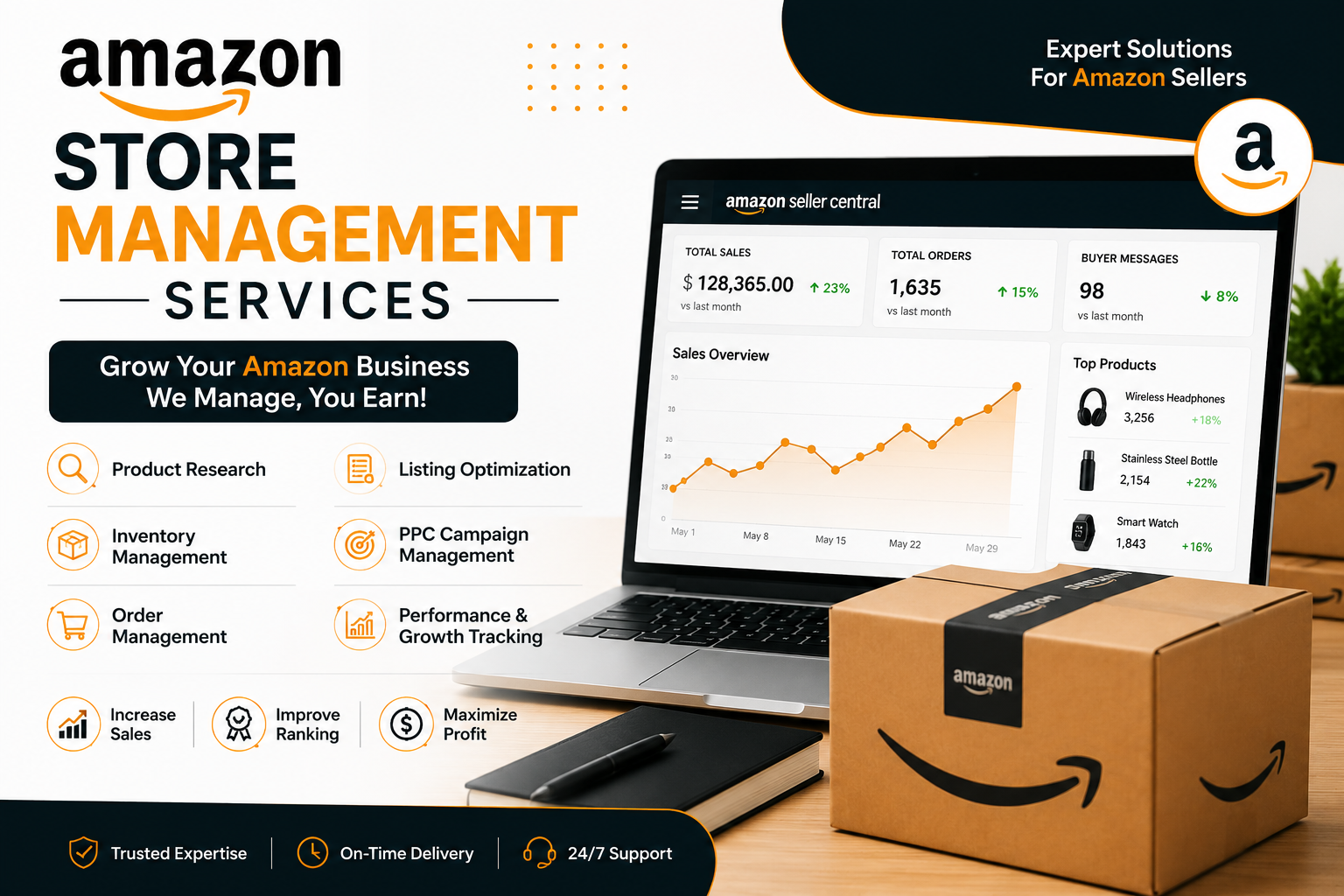
Amazon store management services cover the day-to-day running of a seller’s Amazon account listing optimisation, advertising (PPC), inventory and fulfilment coordination, account health monitoring, and customer service so the brand owner doesn’t have to log into Seller Central every day to keep the store profitable. In practice, it’s the difference between owning an Amazon business and operating one.
That distinction matters more than it sounds. Plenty of sellers who are brilliant at sourcing or manufacturing a product lose margin, rank, and even their account because Seller Central was never designed to be a part-time job. A single missed reply, an unmonitored ACOS, or a stockout at the wrong moment can undo months of growth. That’s the gap amazon account management exists to close.
This guide breaks down exactly what’s included in a typical Amazon store management engagement, how much it realistically costs in 2026, how to weigh an in-house hire against a VA or an agency, and what to look for or avoid when choosing a provider.
What Is Amazon Store Management?
Amazon store management is the ongoing, hands-on operation of a seller’s Amazon storefront across every commercial lever that affects visibility, conversion, and profit typically covering listing optimisation, PPC campaign management, inventory and FBA coordination, account health and compliance, and A+ content and brand presentation.
Unlike a one-off “listing audit” or a single PPC campaign setup, store management is a retainer-based, continuous service. A good provider is in the account weekly (often daily), reacting to Buy Box changes, keyword rank shifts, stock levels, and Amazon’s own policy updates not just setting things up once and walking away.
For UK sellers in particular, this often extends across marketplaces Amazon.co.uk, Amazon.de, Amazon.com, and others which adds VAT, currency, and localisation complexity that a general ecommerce manager may not have handled before.
What’s Included in Amazon Store Management
A genuine ecommerce store management services package should read less like a menu of add-ons and more like a single operating system for the account. Here’s what’s typically inside it.
1. Listing Optimisation
This is the foundation everything else sits on. Listing work covers:
- Keyword research and placement across titles, bullet points, and backend search terms
- Copywriting that balances conversion with Amazon’s indexing rules
- Image and video briefs (main image compliance, lifestyle shots, comparison charts)
- Ongoing testing titles and bullets aren’t “set and forget”; they get revised as competitors and search behaviour shift
Weak listing optimisation is the single most common reason a product with genuine demand still doesn’t sell. If the listing isn’t indexing for the terms customers actually search, no amount of advertising spend fixes that it just gets more expensive to compensate for it.
2. PPC (Sponsored Ads) Management
PPC is where most of the monthly management fee tends to concentrate, because it’s the most time-sensitive part of the account. This covers:
- Campaign structure (Sponsored Products, Sponsored Brands, Sponsored Display)
- Bid management and dayparting
- Negative keyword harvesting
- ACOS (Advertising Cost of Sale) monitoring and targets balancing ACOS against overall account profitability, not just campaign-level performance
- Scaling winning campaigns and cutting underperformers before they bleed budget
A well-run PPC account is checked far more often than once a week. Search term reports shift daily, and a campaign left untouched for ten days can quietly waste a meaningful chunk of monthly ad spend on irrelevant clicks.
3. Inventory & FBA Management
Stockouts and long-term storage fees are two of the fastest ways to lose margin and rank simultaneously. This part of the service covers:
- FBA shipment planning and inbound coordination
- Storage fee monitoring (avoiding aged inventory surcharges)
- Multi-channel and multi-marketplace stock syncing where relevant
A stockout doesn’t just cost the sales you miss during the gap it typically drops organic rank, which takes weeks to recover even after stock is back.
4. Account Health & Compliance
This is the least visible part of the job and the one that matters most when things go wrong. It includes:
- Monitoring account health metrics (ODR, late shipment rate, valid tracking rate)
- Responding to policy violations and suspensions before they escalate
- Managing Brand Registry enforcement (counterfeit reports, listing hijackers)
- Handling A-to-z Guarantee claims and returns disputes
Account suspensions rarely come from one big mistake; they’re usually the accumulation of several small ones that nobody was watching for. This is the area where paying for ongoing oversight tends to pay for itself the moment it’s needed.
5. Buy Box & Pricing Strategy
Losing the Buy Box is often invisible until revenue drops. Management here includes:
- Repricing strategy (automated or rule-based)
- Monitoring competitor pricing and MAP violations
- Coordinating pricing with promotions, Lightning Deals, and Coupons
6. A+ Content & Brand Presentation
For Brand Registered sellers, this covers:
- A+ Content module design and copy
- Storefront build-out
- Brand story and comparison charts that lift conversion rate on already-ranking listings
7. Reporting & Reviews
- Weekly or monthly performance reporting (sales, ad spend, ACOS, conversion rate)
- Review and Q&A monitoring, including flagging review manipulation or policy-violating feedback
8. Multi-Marketplace Coordination
For sellers trading beyond Amazon.co.uk, this covers:
- Listing translation and localisation (not just direct translation search terms differ by market)
- VAT and customs documentation coordination for EU and US fulfilment
- Marketplace-specific compliance requirements (packaging marks, category-specific documentation)
- Currency and pricing strategy per marketplace, since a straight currency conversion rarely reflects local competitive pricing
Expanding into a second marketplace without this coordination is one of the more common ways sellers lose money quickly. A listing that ranks well in the UK can fail entirely in Germany if the backend search terms were never localised, or run into a compliance requirement that simply doesn’t exist domestically.
In-House vs Agency vs Freelance VA
There’s no universally “right” answer here; it depends on order volume, catalogue size, and how much internal capacity already exists. Here’s the honest breakdown.
In-House Hire
Best for: larger catalogues (50+ SKUs) or sellers where Amazon is the primary revenue channel.
- Full-time dedicated attention, deep product knowledge
- Highest fixed cost UK salary for an experienced Amazon specialist typically sits in the £30k–£45k/year range, before National Insurance, benefits, and management overhead
- Single point of failure if they leave, so does the institutional knowledge
- Rarely covers every specialism (PPC, listing SEO, account health) equally well in one person
Freelance VA
Best for: very small catalogues, tight budgets, sellers who mainly need task execution rather than strategy.
- Lowest hourly cost
- Wide variance in quality and reliability
- Usually task-based rather than strategic a VA will action what you tell them, but won’t typically flag an ACOS problem before it costs you money
- Limited accountability if something goes wrong with account health
Agency (Amazon Store Management Agency)
Best for: sellers who want the full scope listings, PPC, inventory, compliance run as one coordinated system, without hiring or managing a team themselves.
- Access to a team with specialists across PPC, SEO, and operations, rather than one generalist trying to cover every discipline
- Processes and tools already built (reporting dashboards, repricing software, compliance monitoring) that would take months to assemble internally
- No holiday cover gaps or recruitment risk the account keeps being watched even when one team member is off
- Retainer cost, but no employment overhead (NI, pension, sick pay, training time)
- The trade-off: less day-to-day control than an in-house hire, and quality varies significantly between agencies which is why the vetting questions later in this guide matter
The practical reality for most small-to-mid sellers is that an agency offers the best ratio of expertise-to-cost, provided it’s the right agency. A single in-house hire, however good, is rarely equally strong at PPC, listing copywriting, inventory forecasting, and compliance monitoring simultaneously those are genuinely different skill sets. An agency structure means those skills sit with different specialists rather than resting on one person’s shoulders.
<!– IMAGE: service-scope wheel infographic alt: “Amazon store management services guide showing tasks and typical costs” —
What Does Amazon Store Management Cost in 2026?
Pricing varies enormously depending on scope, catalogue size, ad spend, and geography and there’s a genuinely wide range depending on who you ask. Here’s an honest breakdown rather than a single headline number.
| Provider type | Typical monthly cost | Notes |
| Freelance VA | £400–£1,200/mo | Task execution only, limited strategic input |
| UK boutique agency | £800–£2,500/mo | Often plus a % of ad spend for PPC management |
| US-based full-service agency | $2,000–$10,000+/mo | Common for larger catalogues, higher ad spend accounts |
| In-house hire (UK, full-time) | £2,500–£3,800/mo (salary equivalent) | Before NI, benefits, recruitment, management time |
A few honest notes on structure:
- PPC fees are often charged separately, either as a flat fee or a percentage of ad spend (commonly 10–20%). Always ask whether a quoted retainer includes or excludes PPC management.
- US agencies charging $2,000–$10,000+/month are common in the market, and that pricing reflects US labour costs and larger catalogue assumptions; it isn’t automatically the benchmark a UK seller with a smaller catalogue needs to match.
- Onboarding/audit fees are common as a one-off at the start of an engagement, separate from the ongoing retainer.
- Cost should scale with catalogue size and ad spend, not just be a flat fee regardless of account complexity be wary of pricing that doesn’t ask about your catalogue at all.
The honest framing: for a seller with a handful of SKUs and modest ad spend, a full US-style $5k/month retainer is disproportionate. For a 200-SKU catalogue running £30k/month in ad spend, a £600/month VA is under-resourced and likely to cost more in missed opportunity than it saves. The right spend is proportional to the account which is exactly why a scoped quote, not a one-size-fee, is the right starting point.
What Actually Drives the Price Difference
Beyond catalogue size, a few factors explain most of the variation in what agencies quote:
- Number of marketplaces. Managing three marketplaces well is closer to three times the work than one not a small add-on.
- Ad spend level. Above roughly £10k/month in ad spend, PPC management becomes a near-daily task rather than a weekly check-in, and pricing usually reflects that.
- Category complexity. Regulated categories (supplements, electricals, children’s products) carry extra compliance overhead that unregulated categories don’t.
- Brand Registry status. Brand-registered sellers unlock A+ Content, Storefronts, and better IP protection tools which also means there’s more for an agency to actively manage.
- Reporting depth. A provider giving weekly, itemised reporting is doing (and charging for) more than one sending a monthly summary.
None of this means the highest-priced option is automatically the best fit, or that the cheapest is a false economy; it means the quote should match your account’s actual complexity, and a provider unwilling to explain why their price is what it is deserves a follow-up question.
When Should You Outsource Amazon Store Management?
Outsourcing tends to make sense when one or more of these is true:
- You’re spending more time firefighting Seller Central than growing the business
- Your ACOS or account health metrics have been drifting and you haven’t had time to dig into why
- You’re expanding into new marketplaces (EU, US) and don’t have the localisation expertise in-house
- A stockout, suspension, or hijacked listing has already cost you sales and you don’t want a repeat
- You want to scale ad spend but don’t have confidence managing it at a larger budget
When NOT to Hire an Agency (Honestly)
Outsourcing isn’t always the right call, and a good provider should tell you that plainly rather than sell regardless:
- If you’re pre-product-market-fit. If the product itself isn’t converting at any price or ranking position, no amount of listing polish or PPC management fixes a demand problem. Fix the product-market fit first.
- If your catalogue is under 5 SKUs and margins are thin. A retainer fee can outweigh the incremental gain until the catalogue grows.
- If you want to learn the platform yourself first. Some founders benefit from running the account manually for a few months to understand the mechanics before handing it over. It makes you a much better client to an agency later, because you’ll know what good management actually looks like.
- If your inventory or supply chain isn’t stable yet. No management service can compensate for a product that’s out of stock more often than it’s in stock.
Choosing an Amazon Store Management Agency: Questions to Ask
Not all agencies are equal, and the market has a wide range of quality behind similar-sounding pitches. Questions worth asking before signing anything:
- Who will actually be working on my account day-to-day is it a named specialist, or does it rotate?
- What’s included in the retainer, and what’s billed separately (PPC ad spend %, design work, marketplace expansion)?
- Can I see Seller Central access logs or reporting, so I know what’s actually being done week to week?
- What’s your process when account health drops or a suspension risk appears?
- Do you have experience in my specific category regulated categories (supplements, electricals, toys) have extra compliance steps.
- What happens if I want to leave is there a lock-in contract, or a reasonable notice period?
Red Flags to Watch For
- Guarantees of specific sales figures or “guaranteed Page 1 ranking” no legitimate agency can guarantee this, since Amazon’s algorithm and competition are outside anyone’s control
- No clear reporting cadence, or reporting that only shows vanity metrics (impressions) without ACOS, conversion rate, or profit
- Long lock-in contracts with no visibility into account access
- Pricing that doesn’t scale with catalogue size or ad spend a flat fee regardless of account complexity is a sign of a templated service, not a tailored one
Do Agencies Guarantee Sales?
No legitimate agency can guarantee specific sales figures, and it’s worth being cautious of any that do. What a good agency can reasonably commit to is process: consistent PPC optimisation, listing improvements based on data, proactive account health monitoring, and transparent reporting. Sales outcomes depend on factors outside any agency’s control too competitor activity, Amazon’s algorithm changes, seasonality, and the underlying demand for the product itself.
How MDOB’s A-to-Z Store Handling Works
Our approach to amazon store management services is built around one idea: a seller shouldn’t need to log into Seller Central at all if they don’t want to. That’s the literal meaning of “A to Z” in our service name from the first listing optimisation pass through to fulfilment, advertising, and account health monitoring, it’s handled as one coordinated system rather than a bundle of separate add-ons.
In practice, that means:
- A named specialist (not a rotating pool) who knows your catalogue and category
- Weekly reporting that shows the numbers that actually matter ACOS, conversion rate, Buy Box percentage, account health score not just impressions
- Proactive account health monitoring, so compliance issues are caught before they become suspensions
- Scoped pricing based on your actual catalogue size and ad spend, not a flat fee that assumes every account is the same
If you want the fuller picture of everything under our ecommerce umbrella beyond Amazon specifically, see our ecommerce services overview. And if you’re ready to see what handling your account would actually look like, our A-to-Z store handling services page has the full scope and next steps.
<!– IMAGE: cost comparison table (as chart) placed above; also available as standalone graphic –>
Frequently Asked Questions
What does an Amazon agency do daily?
On a day-to-day basis, an agency managing your account is typically checking PPC performance and adjusting bids or negative keywords, monitoring inventory levels against sales velocity, checking Buy Box status and repricing where needed, and scanning account health metrics for early warning signs. Listing optimisation, A+ content, and strategic reviews tend to happen on a weekly or monthly cycle rather than daily, since those changes need time to show results before the next iteration.
How much does Amazon store management cost?
Costs range from roughly £400–£1,200/month for a freelance VA doing task execution, £800–£2,500/month for a UK boutique agency, and $2,000–$10,000+/month for larger US-based full-service agencies with PPC management often billed separately as a percentage of ad spend. The right figure depends on catalogue size, ad spend, and how many specialisms (PPC, listings, compliance, multi-marketplace) are included in the scope.
Is it worth it for small sellers?
It depends on catalogue size and where the time cost is actually landing. For a very small catalogue (under 5 SKUs) with thin margins, a full retainer can outweigh the benefit a scoped, lighter-touch service or a VA for specific tasks may make more sense. Once a seller is spending several hours a week firefighting listings, PPC, or account health issues, outsourcing usually pays for itself in time recovered alone, even before accounting for the performance uplift a specialist can bring.
Do agencies guarantee sales?
No legitimate agency guarantees specific sales figures, since outcomes depend on factors like competition, Amazon’s algorithm, and the underlying product demand none of which any provider controls. What a credible agency should commit to is process: consistent optimisation, transparent reporting, and proactive account health management. Treat any guarantee of exact sales numbers or “guaranteed ranking” as a red flag.
Ready to hand over the day-to-day? From listings to fulfilment, our team can run your Amazon account end-to-end. Request a store-handling quote →
Leave a Reply