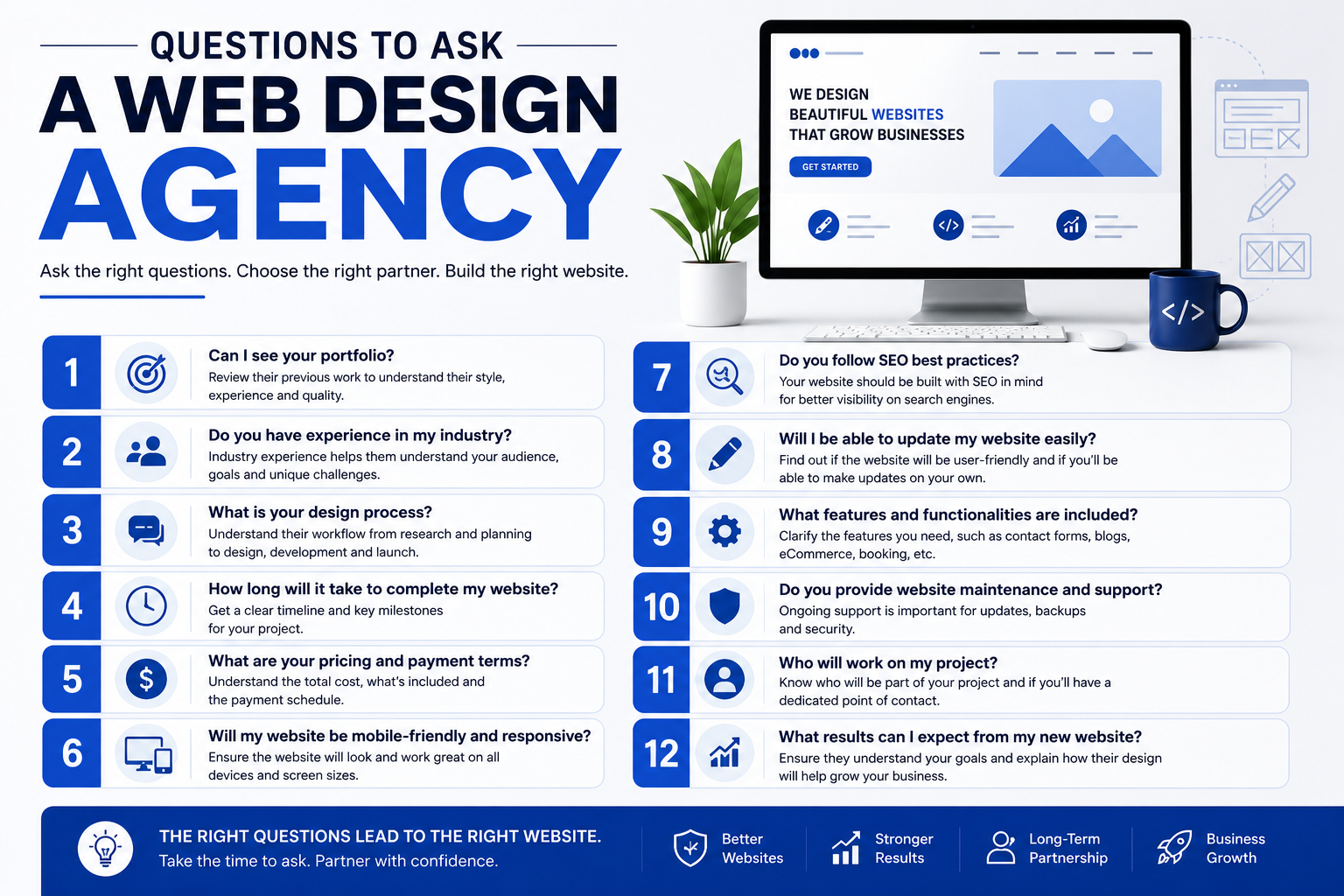
Shortlisting a web agency usually comes down to a pitch deck, a portfolio, and a gut feeling. That’s not enough. The difference between a website that earns its keep for five years and one you’re rebuilding in eighteen months often comes down to a handful of questions you never thought to ask until the contract is signed and it’s too late.
Below are the 12 questions we’d want answered if we were sat on the other side of the table, choosing between agencies for our own business. For each one, we’ve included what a competent answer sounds like and, in the interest of transparency, how we’d answer it ourselves.
If you’ve already read our guide on how to choose a web development company, this article goes one level deeper: it’s the actual script for your discovery calls.
1. Can I see examples of work similar to mine not just your best work?
Every agency has three or four showcase projects they lead with. Ask instead for a project close to your size, sector, and budget. A big agency’s flagship e-commerce build tells you nothing about how they’ll treat a five-page brochure site with a modest budget.
A good answer looks like: the agency names two or three comparable clients, explains what made the project difficult, and is happy for you to speak to the client directly.
2. Who actually owns the code and the content once the project ends?
This is the single most overlooked question in the entire hiring process, and the one most likely to cost you later. Some agencies build on proprietary platforms, keep the source files, or license the site to you rather than sell it outright meaning if you ever want to leave, you’re starting from zero.
A good answer looks like: full ownership of code, content, and assets transfers to you on final payment, in writing, with no ongoing licence fee to keep the site running.
3. What CMS will the site run on, and can I actually use it myself?
A beautiful site you can’t update without calling the agency every time isn’t a website it’s a subscription. Ask for a live demo of the content editing screen during the sales process, not after you’ve paid.
A good answer looks like: a widely supported CMS (WordPress, Webflow, or similar), a short training session included as standard, and a written guide you can hand to a new staff member in future.
4. What happens after launch is support included, and for how long?
Websites break. Plugins go out of date, forms stop firing, hosting renewals get missed. Find out exactly what’s covered in the weeks after launch and what kicks you into a paid support contract. covering bug fixes at no extra cost, followed by a clearly priced, optional support plan with
a stated response time.
5. Is there a support SLA, and what does it actually guarantee?
“Support included” means very little without a number attached to it. Ask what happens if the site goes down on a Friday evening who do you call, and how fast will they respond?
A good answer looks like: a written service level agreement stating response times by severity (e.g. site-down issues acknowledged within a few hours), not just a vague promise of “priority support.”
6. How is SEO handled is it included, or a separate line item?
Every agency will tell you they “do SEO.” Ask what that means in practice: technical foundations (page speed, structured data, clean URLs) versus ongoing content and link-building, which is a A good answer looks like: technical SEO best practice is built into every site by default at no extra charge, and ongoing SEO strategy is offered as a clearly scoped, separately priced service not implied for free.
7. What’s the full cost, including things I haven’t thought to ask about?
Domain renewals, hosting, SSL certificates, stock imagery licences, third-party plugin fees, email these add up and are a common source of “surprise” invoices six months in.
A good answer looks like: an itemised quote covering the build fee plus a clear, separate breakdown of any recurring third-party or hosting costs, so there’s nothing hidden in the small print.
8. What are the payment terms, and is a deposit required?
Reasonable agencies stage payments against delivery milestones. Be cautious of anyone asking for full payment upfront, or conversely, anyone unwilling to take any deposit at all (which can signal cash-flow problems).
A good answer looks like: a modest deposit to secure the project slot, followed by staged payments tied to milestones (design approval, development complete, launch), with the final balance due at go-live.
9. What’s the realistic timeline, and what could delay it?
Agencies routinely underquote timelines to win the pitch. Ask what typically causes projects to run late the honest answer is almost always “waiting on the client for content and feedback,” which tells you a lot about how organised the process is.
A good answer looks like: a realistic week-by-week timeline with named milestones, plus an honest acknowledgement that delays usually come from content and feedback turnaround with a plan for managing that.
10. Who will I actually be working with day to day?
Sales calls are often run by a founder or account director who then hands you off to a junior team once the contract is signed. Ask who your named point of contact will be for the duration of the project.
A good answer looks like: one named project lead for the full build, with visibility into who else (designer, developer) is working on your project and how you can reach them.
11. Can I see a recent client reference I can contact directly?
Testimonials on a website can be curated or, occasionally, fabricated. A genuine agency will happily connect you with a recent client for an unscripted conversation.
A good answer looks like: at least one direct introduction to a client from the last six months, not just a written quote pulled from the homepage.
12. What happens if I want to leave partway through, or after launch?
This is the question that separates agencies confident in their own work from those relying on lock-in. Ask what exit looks like at every stage mid-project and post-launch.
A good answer looks like: a written cancellation clause covering work completed to date, full handover of files and access on request, and no penalty or held-hostage assets if you choose to move your hosting or support elsewhere.
How we answer these at MDOB
We get asked most of these questions on nearly every discovery call, so our answers are settled policy rather than sales talk: full code and content ownership on final payment, a defined post-launch warranty, a written support SLA, itemised pricing with no hidden recurring fees, and a named project lead for every build. If you’d like to see our answers to all 12 in detail, see how we approach website development for businesses like yours.
Red flags to walk away from
- Vague ownership terms, or reluctance to confirm in writing that you’ll own the code and content outright.
- No fixed point of contact you’re passed between different people with no continuity.
- Full payment requested upfront, with no staged milestones.
- “SEO included” with no explanation of what that actually covers.
- No post-launch support period, or a support contract you’re pressured into signing before you’ve seen the finished site.
- Unwillingness to provide a direct client reference you can contact yourself.
- No written exit terms if leaving isn’t addressed, assume it will be difficult.
A printable version of this checklist all 12 questions on one sheet is included below so you can bring it to your next agency call.
FAQs
Should I pay a deposit? A modest deposit to secure your project slot is standard and reasonable. What to avoid is paying the full amount upfront, or an agency asking for a deposit so large it removes any incentive for them to deliver on time.
Who owns the website afterwards? You should. On final payment, a reputable agency transfers full ownership of the code, design files, and content to you, with no ongoing licence fee required just to keep the site live.What support should be included? At minimum, a defined warranty period after launch (commonly 30–90 days) covering bug fixes at no extra cost. Beyond that, ongoing support should be optional, clearly priced, and backed by a written response-time commitment not an open-ended promise.
Ask us all 12 book a call. Get in touch and we’ll answer every question above, on the record.
Leave a Reply