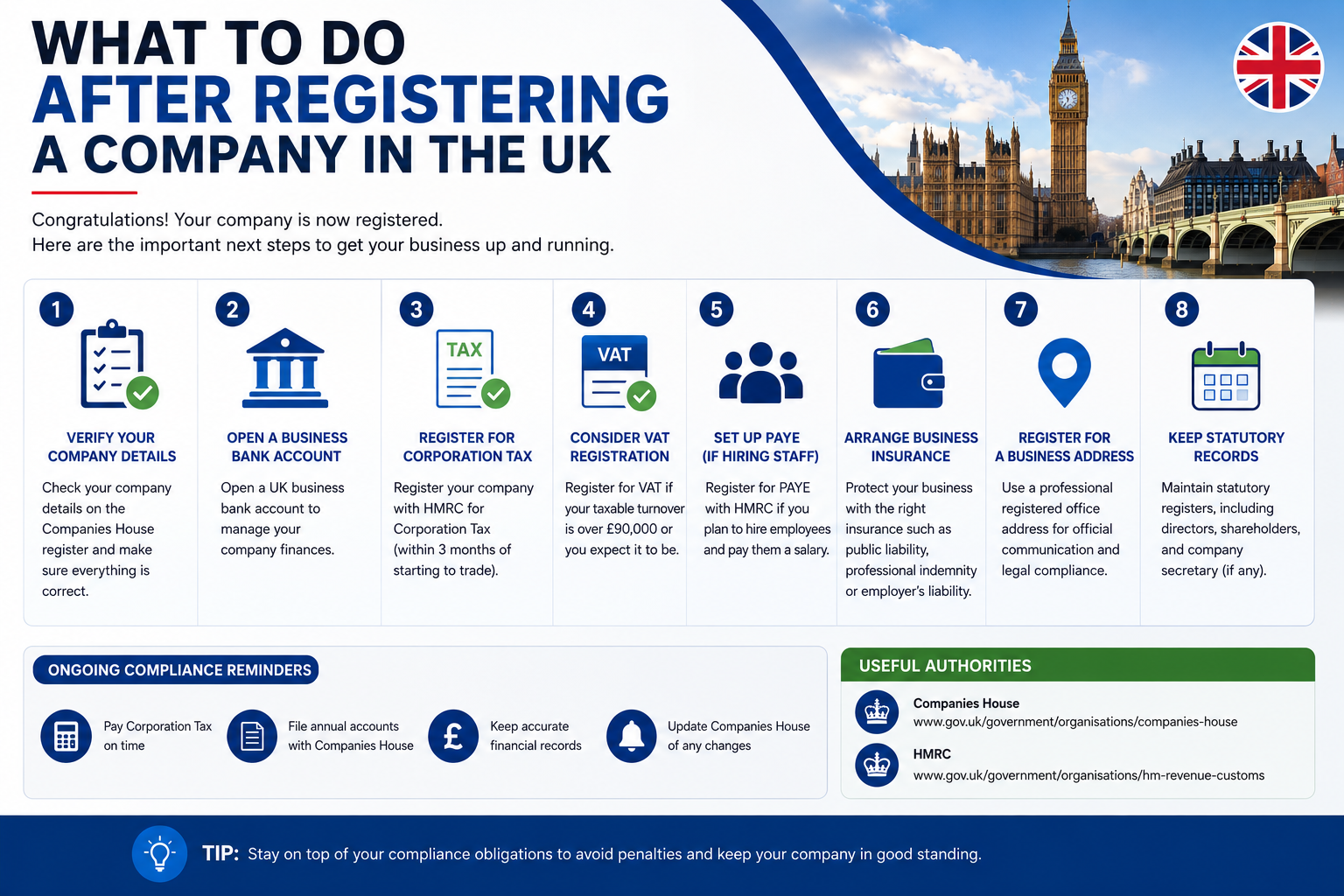
Companies House has confirmed your incorporation, you’ve got a certificate with your company number on it, and now what?
Registering the company is the easy part. What actually determines whether your first year runs smoothly is what happens in the weeks immediately after: getting your tax registrations right, opening the correct accounts, protecting the business, and setting up the systems that keep you compliant. Miss one of these steps and you’re looking at penalties, cash flow problems, or a scramble to fix things retrospectively.
This checklist runs in deadline order. The things with a clock already ticking come first, followed by the things that matter for running the business day to day, and finishing with getting your new company actually visible to customers.
1. Register for Corporation Tax (within 3 months of trading)
This is the deadline that catches out more new directors than any other, mainly because people confuse it with incorporation. It isn’t the same thing.
Companies House incorporating your company does not automatically register you for Corporation Tax activity although HMRC will post you a Unique Taxpayer Reference (UTR) within a couple of weeks of incorporation regardless of whether you’re trading yet. The clock that actually matters starts when your company becomes active: your first sale, your first invoice, hiring your first member of staff, buying stock, or renting premises.
From that point, you have 3 months to formally tell HMRC the company is active and register for Corporation Tax. This applies even if you don’t expect to owe any tax in year one HMRC still wants the notification, and penalties can apply if you miss the window.
If you’ve incorporated but you’re not trading yet, you don’t need to do this step but make a note of the date you do start trading, because that’s when the clock begins.
2. Open a business bank account
Do this before you take a single payment from a client or supplier. Keeping business and personal money in the same account is a common early mistake, and it causes real problems: messy bookkeeping, difficulty proving expenses, and for a limited company it can blur the legal separation between you and the business that limited liability is supposed to protect.
Most banks will ask for your certificate of incorporation, your company number, and proof of identity/address for each director. Digital-only business banks tend to be fastest for a brand-new company with no trading history; traditional high-street banks can take longer but may suit you better if you’ll need lending or merchant services early on.
3. Register for PAYE (if you’ll employ anyone including yourself)
If you plan to pay yourself or anyone else a salary through the company, you need to register as an employer with HMRC and set up PAYE before the first payday. This includes many sole director/shareholder setups where the director takes a small salary alongside dividends, a very common structure for tax efficiency, but one that still requires PAYE registration.
Registration needs to happen before your first payroll run, and ideally with enough lead time that your payroll software or accountant has everything set up correctly from month one.
4. Understand the VAT threshold and decide whether to register early
You’re only legally required to register for VAT once your taxable turnover crosses £90,000 in any rolling 12-month period (not your accounting year HMRC checks month by month, looking back over the trailing 12 months). Cross it, and you generally have 30 days from the end of that month to notify HMRC.
Even if you’re nowhere near that figure, it’s worth deciding early whether voluntary registration makes sense for you. If most of your customers are VAT-registered businesses themselves, charging VAT costs you nothing competitively and lets you reclaim VAT on your own setup costs accountancy fees, equipment, your new website build, and so on. If you’re selling mainly to the public, voluntary registration usually isn’t worth it until you’re closer to the threshold.
5. Set up your bookkeeping and record-keeping system
By law, a limited company must keep accounting records for at least 6 years, along with details of assets, liabilities, stock, and any money owed to or by the company. Trying to reconstruct this from a shoebox of receipts eight months in is painful and avoidable.
Set up cloud accounting software (or hand this to an accountant from day one) so that every invoice, receipt, and bank transaction is captured as it happens. This isn’t just about Companies House and HMRC compliance, it’s the difference between knowing whether your business is actually profitable and guessing.
6. Sort out business insurance
Insurance isn’t always a legal requirement on day one, but the exception is important: if you employ anyone, Employers’ Liability Insurance is a legal requirement almost immediately once you take on staff, with fines possible for going without it.
Beyond that legal minimum, most new companies should also consider:
- Professional indemnity insurance if you give advice, designs, or services that a client could claim against
- Public liability insurance if clients, customers, or the public visit your premises or you visit theirs
- Cyber insurance increasingly relevant as soon as you’re handling customer data online
Don’t leave this until after your first client contract is signed. Many commercial clients will ask for proof of cover before they’ll work with you.
7. Note your ongoing Companies House deadlines
Three dates go in the calendar the moment your company exists:
- Confirmation statement: due at least once every 12 months, confirming your company’s details (directors, shareholders, registered office, etc.) are up to date with Companies House.
- Annual accounts: your first accounts are due 21 months after incorporation (a longer window than the usual 9-month rule, to give new companies breathing room). After that, it’s 9 months after your accounting reference date.
- Corporation Tax return (CT600): due 12 months after your accounting period ends, with any tax owed paid 9 months and 1 day after the period ends.
Set calendar reminders now Companies House penalties for late accounts start automatically and increase the longer you leave it.
8. Register your domain name
Now for the part that actually gets customers finding you. Your company name is protected at Companies House, but that doesn’t stop someone else registering the matching .com or .co.uk domain and a mismatched domain name is a small but real credibility hit for a brand-new business.
Register the domain that matches (or closely reflects) your company name as early as possible, along with the obvious variants and, if relevant, social handles. This is a five-minute job that’s easy to forget in the rush of the first few weeks and painful to fix later if someone else gets there first.
9. Build a website
A registered company with no website is invisible to most of the customers looking for it. Whether that’s a simple one-page site confirming who you are and how to get in touch, or a full e-commerce build, this is usually the point where “I’ve started a company” turns into “I have a business people can actually find.”
At minimum, a new company website needs to answer three questions fast: who you are, what you do, and how to contact or buy from you. Everything beyond that booking systems, online stores, portfolios can be layered on as the business grows.
10. Get set up to trade online (if relevant)
If you’re selling products or taking bookings, this is where the domain and website come together into something that actually generates revenue: payment processing, an online store, or a booking system connected to your new business bank account. Getting this working early means you’re not scrambling to build it once orders start coming in you’re ready for them from day one.
Your post-incorporation checklist, in order
- Register for Corporation Tax (within 3 months of trading)
- Open a business bank account
- Register for PAYE, if employing anyone
- Decide your VAT position (threshold: £90,000)
- Set up bookkeeping and record-keeping
- Arrange business insurance
- Diarise your confirmation statement and accounts deadlines
- Register your domain name
- Build your website
- Get set up to trade online
Download the printable version of this checklist to keep on your desk for the first few months.
FAQs
When must I register for Corporation Tax? Within 3 months of your company starting to trade or becoming active not from the date of incorporation.Registering late can lead to HMRC penalties even if no tax is actually owed yet.
Do I need insurance immediately? Not always by law, but Employers’ Liability Insurance is a legal requirement as soon as you employ anyone. Professional indemnity and public liability aren’t always mandatory but are expected by most commercial clients, so it’s worth arranging before you sign your first contract.
When do I file accounts? Your first set of annual accounts is due 21 months after incorporation. After that, it’s 9 months after your accounting reference date each year. Your confirmation statement is separate and due at least once every 12 months.
From incorporation to a live website in 30 days one team.
We handle the company formation and the website, so nothing falls through the gap between “legally registered” and “actually trading.” [Get a quote →]
Related services: Company Formation · Website Development
Leave a Reply