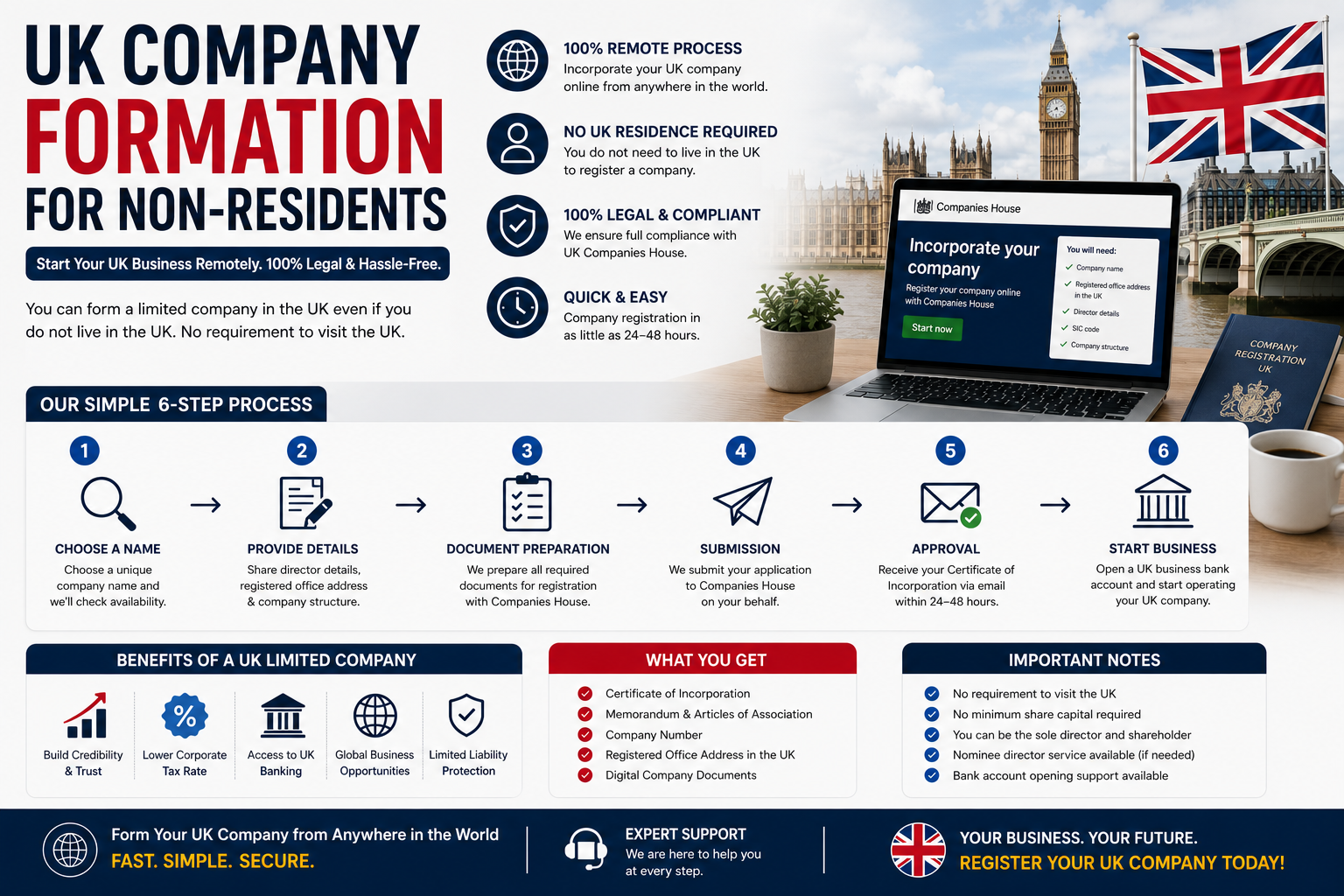
Yes, non-residents can own and direct a UK limited company. There is no requirement to live in the UK, hold a UK visa, or even set foot in the country. Founders in Pakistan, the UAE, India, Nigeria, Bangladesh, and the US register UK companies every week, mainly to unlock Stripe, PayPal, and Amazon accounts, and to trade under the credibility of a UK Ltd. The one hard requirement is a UK registered office address; everything else is paperwork and identity verification you can complete from your laptop.
This guide walks through exactly how the process works in 2026, including the identity verification changes that came into force in November 2025, what banking actually looks like for a non-resident director, and what you genuinely owe in UK tax if you don’t live there.
Why Overseas Founders Choose a UK Ltd
For founders outside the UK, a UK limited company usually isn’t about relocating it’s about access and credibility.
Payment processor access. Stripe, PayPal, and similar processors are far more reliable for a UK Ltd than for many home-country business entities, particularly for founders in markets where these processors restrict or don’t fully support local companies.
Marketplace access. Amazon, Etsy, and similar platforms often treat a UK-registered seller more favourably than an individual overseas account, especially for reaching UK and EU customers.
No local shareholder or director rule. Unlike some jurisdictions that require a resident director or local shareholder, the UK places no nationality or residency restriction on who can own or direct a company. A single overseas founder can be the 100% shareholder and sole director.
Speed and cost. Companies House can incorporate a company within 24 hours once the application is correctly filed, and the government filing fee is a fraction of what many other jurisdictions charge.
Global perception. A “.co.uk” or “Ltd” suffix carries weight with international clients and suppliers that a sole-trader registration back home often doesn’t.
None of this makes a UK company a substitute for proper tax and immigration advice in your home country. More on that below but for founders building an online business, agency, or e-commerce brand aimed at UK/EU/US customers, it’s usually the fastest credibility upgrade available.
The Legal Requirements: What You Actually Need
Companies House the UK’s company registrar sets out the core requirements for forming a limited company, and the list is shorter than most people expect:
- A UK registered office address. This is the one requirement every non-resident founder must solve, since it has to be a physical UK address (not your home address abroad), and it appears on the public register. As of the current ECCTA reforms, registered office addresses can no longer be PO Boxes; they must be a genuine address where documents can be delivered and received.
- At least one director. The director does not need to be a UK resident or citizen.
- At least one shareholder. Can be the same person as the director, and does not need to be UK-resident.
- A “people with significant control” (PSC) declaration. Anyone owning more than 25% of shares or voting rights must be identified.
- A company name that isn’t already taken and doesn’t infringe existing trademarks.
- Standard Industrial Classification (SIC) code(s) describing what the business does.
- Memorandum and Articles of Association usually the standard templates are fine for straightforward companies.
That’s the entire legal bar. Notice what’s absent: no requirement to visit the UK, no requirement for a UK bank account to incorporate, and no nationality restriction on directors or shareholders. The registered office is genuinely the only piece that requires a UK-based service, which is why formation agents that bundle a registered office address are the standard route for overseas founders rather than an obstacle to route around.
A service address is a related but separate concept; it’s the address Companies House publishes for each director and PSC instead of their home address, protecting personal privacy. Most non-resident founders use their formation agent’s address for this too, rather than publishing a home address abroad on the public register.
Identity Verification for Overseas Directors: What Changed in 2025–2026
This is the part of UK company formation that has genuinely changed, and it’s worth being precise about the dates, because a lot of content online is already out of date.
Since 2018, Companies House ran on a self-certification model where you typed in your name and address, and nobody checked. The Economic Crime and Corporate Transparency Act 2023 (ECCTA) ended that.
From 18 November 2025, identity verification became mandatory for every newly appointed director and every new PSC, and for every new company incorporation. This is live, current law, not a future change. If you’re incorporating a new company today, you (and any co-director or PSC) must complete identity verification as part of that process.
Existing directors and PSCs people who were already on the register before 18 November 2025 are in a 12-month transitional window. Their effective deadline is tied to their company’s next confirmation statement date, with a hard backstop of 18 November 2026 for everyone still unverified.
How verification actually works for someone outside the UK: you have two routes.
- GOV.UK One Login, done directly yourself you upload a passport or other biometric ID and complete a facial-matching check via a smartphone app, entirely remotely. No UK visit required.
- Via an Authorised Corporate Service Provider (ACSP) typically your formation agent, who is registered with Companies House and AML-supervised, and who verifies your identity on your behalf as part of the formation package.
For most overseas founders, route two is simpler: your formation agent runs the identity check as part of onboarding (biometric passport scan plus a liveness/selfie check) and files the confirmation to Companies House alongside your incorporation.
One more date worth flagging honestly: identity verification for presenters and third-party agents themselves (i.e., the formation agents and accountants who file on your behalf) was originally expected in spring 2026 but has been pushed back, with Companies House now targeting “no earlier than November 2026.” This doesn’t affect you as a founder directly; it affects whether your formation agent needs ACSP registration to keep filing for clients. It’s worth asking any agent you use whether they are ACSP-registered, since this becomes non-negotiable as the rollout completes.
Bottom line for a founder in Lagos, Dubai, Karachi, or Dhaka right now: you will go through identity verification either yourself via One Login or through your agent as ACSP before or during incorporation. It adds a short step, not a barrier. A passport with a biometric chip and a smartphone camera is all it takes.
Step-by-Step: Forming a UK Company From Abroad
Here’s the practical sequence, assuming you’re doing this entirely from outside the UK.
1. Choose your company structure. The overwhelming majority of overseas founders want a private company limited by shares (Ltd) simple, single or few shareholders, limited liability. Unless you have a specific reason otherwise, this is the default.
2. Pick and check your company name. Search the Companies House register for availability, and separately check if the name isn’t a registered UK trademark in your sector passing the registrar’s check doesn’t mean it’s legally safe to trade under.
3. Arrange your UK registered office address. This is where a formation agent or registered office service provider comes in. You’re paying an annual fee for a compliant UK address that receives your statutory mail and (often) scans and forwards it to you.
4. Complete identity verification. Either directly via GOV.UK One Login, or through your ACSP-registered formation agent as part of their onboarding.
5. Prepare your incorporation documents. Memorandum of Association (standard template), Articles of Association (standard “Model Articles” cover most straightforward companies), director details, shareholder details and share allocation, PSC declaration, and SIC code(s).
6. File with Companies House. Done online, either directly through the Companies House portal or via your formation agent’s system. Standard online incorporation is typically same-day to 24 hours once the filing is accepted.
7. Receive your Certificate of Incorporation. This includes your company number and confirms your date of incorporation this is the document banks, Stripe, and other providers will ask to see.
8. Register for Corporation Tax with HMRC. You have three months from starting to trade to notify HMRC this is separate from Companies House incorporation and is a common step overseas founders forget.
9. Set up your bank account and payment processing. Covered in detail below, since this is usually the step that trips people up.
None of steps 1–8 require a UK visit. Step 9 is where non-resident founders sometimes hit friction, but it’s very solvable with the right approach.
Banking & Payments for Non-Resident Directors
This is usually the real question behind “can I form a UK company from abroad” founders want the company so they can access UK/international payment rails.
Traditional UK high-street banks (Barclays, HSBC, Lloyds) are historically difficult for non-resident directors without a UK address and often want an in-person meeting; this is the friction point that puts many overseas founders off, and it’s largely unnecessary now given the alternatives.
Digital business accounts built for this exact situation are the practical route for most non-resident founders:
- Wise Business accepts non-resident UK company directors and gives you a UK account number and sort code, plus multi-currency holding a strong fit if you’re invoicing internationally.
- Revolut Business and similar UK e-money institutions have comparable onboarding for overseas-directed UK companies.
Stripe UK is usually the actual end goal for founders chasing this setup, since it lets you accept card payments as a UK-registered business. Stripe onboarding for a UK Ltd typically asks for your Certificate of Incorporation, registered office details, director ID, and a UK bank account or Wise Business account to receive payouts which is why banking and Stripe access are really a single connected step rather than two separate ones.
A realistic sequence: incorporate → open a Wise Business (or equivalent) account using your Certificate of Incorporation and verified ID → apply for Stripe UK using that account for payouts. Most non-resident founders can go from “no UK entity” to “live Stripe account” within one to two weeks when the paperwork is in order.
(For a full walkthrough of bank and payment processor options for non-resident founders, see our dedicated banking guide.)
Taxes: What Non-Residents Actually Owe
This is the section where precision matters most, and where a lot of blog content gets sloppy. Here’s the honest breakdown.
Corporation Tax is based on where the company is managed and controlled, not where the director lives. A UK-incorporated company is normally a UK tax resident and pays UK Corporation Tax on its worldwide profits, regardless of the director’s personal residency. The current rate structure has a small profits rate for lower profit bands and a main rate for higher profit bands, with marginal relief in between always checking the current HMRC rates for the specific financial year, since these are reviewed periodically.
. This is separate from Companies House incorporation and is one of the most commonly missed steps by overseas founders, who assume incorporation alone covers their tax obligations.
Annual accounts and a Company Tax Return (CT600) are required every year, regardless of whether the company made a profit, and regardless of where the director lives.
VAT registration becomes mandatory once UK taxable turnover crosses the current threshold, or can be done voluntarily below it relevant if you’re selling to UK customers directly.
Your personal tax position is a separate question from the company’s. As a non-UK-resident director, you are not automatically liable for UK personal income tax simply by holding UK directorship what matters is whether you draw a salary or dividends from the UK company, whether you’re UK tax resident under the Statutory Residence Test, and what your home country’s tax rules say about foreign company income.
Double taxation is the practical risk to plan for. If your home country also taxes worldwide income or company profits, you could in principle face tax in both the UK and your home jurisdiction on the same income. The UK has double taxation treaties with most major economies including Pakistan, the UAE (in specific respects), India, Nigeria, Bangladesh, and the US which generally allow tax paid in one country to be credited against tax owed in the other, rather than paid twice. The exact mechanics depend on your specific treaty and your personal tax residency, so this is genuinely a situation where a qualified accountant familiar with your home country’s tax rules, not a formation agent should confirm your position before you start trading at volume.
The one-line summary: incorporating in the UK creates a UK tax filing obligation for the company every year, and a separate question about your personal tax exposure at home. Treat these as two distinct conversations, and don’t assume that because you don’t live in the UK, the company owes nothing.
The Biggest Mistake: Confusing Incorporation With Immigration
This deserves its own section because the confusion is common and the consequences of getting it wrong (assuming a route into the UK that doesn’t exist) can be serious.
Forming a UK company gives you zero immigration status. It does not grant a visa. It does not grant the right to enter, live, or work in the UK. It does not, by itself, support a visa application. Directors and shareholders of UK companies who are not UK/EU nationals still need whatever visa their purpose in the UK would normally require a Standard Visitor visa for short trips, or a work/business visa route if they intend to actually work in the UK in person.
There is a genuine, separate UK visa route, the Innovator Founder visa for people who want to relocate to the UK to run an innovative business, but that is a distinct Home Office immigration application with its own endorsement, funding, and business-plan requirements. Registering a Companies House Ltd does not feed into it automatically, and the two processes should not be conflated.
If your goal is purely: “I want a UK company to access Stripe, sell internationally, and look credible to clients” incorporation alone solves that, and you never need to set foot in the UK. If your goal is “I want to eventually live and work in the UK” that’s an immigration question, and you should speak to an immigration adviser, not a company formation agent, about the correct visa route.
Costs & Packages
Pricing for overseas founders typically breaks into three layers:
1. Companies House filing fee a modest government fee for the incorporation itself, whether filed directly or through an agent.
2. Formation agent package fee covers preparing and filing your incorporation documents, and usually bundles the registered office address and often the identity verification step. Basic packages cover just the paperwork; more complete packages add mail scanning/forwarding, a service address for directors, and sometimes company secretarial support (confirmation statement filing, for example).
3. Ongoing annual costs include your registered office/service address renewal, your annual confirmation statement filing, and (if you use an accountant) annual accounts and Corporation Tax return preparation.
What tends to separate a good package for overseas founders from a bare-bones one is what happens after incorporation: do you get a registered office that’s actually monitored and forwarded, is your identity verification handled as part of onboarding rather than left to you to figure out alone, and is there support getting your Wise/Stripe setup working since for most founders in this audience, the company itself is the means, not the end goal.
This is the gap our Company Formation service is built around: formation, registered office, and where the founder needs it the initial site or store build, bundled as one package rather than three separate vendors. Most generic formation agents (the “£12 company in 24 hours” model) stop at the Certificate of Incorporation and leave you to solve banking, Stripe, and your actual online presence on your own.
What Our Clients Say
We work with overseas founders on this exact setup regularly, company formation, registered office, and the banking/Stripe follow-through. One recent client, a founder based in the UAE, summed up the process after using our formation and setup service: the paperwork was handled end-to-end without a single UK visit, and the follow-through on getting banking and payments working was what made the difference versus a bare-bones formation agent.
Frequently Asked Questions
Can I open a UK company without visiting the UK? Yes. Incorporation, identity verification, banking, and Stripe onboarding can all be completed remotely. Nothing in the process requires being physically present in the UK.
Does forming a UK company give me a visa or immigration status? No. Incorporating a UK Ltd has no bearing on your immigration status. It does not grant a visa, and it is not, by itself, a pathway to one. If you want to relocate to the UK, that’s a separate conversation with an immigration adviser about routes like the Innovator Founder visa.
Can I get a UK Stripe account as a non-resident director? Yes, generally. Stripe UK onboarding asks for your Certificate of Incorporation, registered office details, verified director ID, and a UK (or UK-capable) bank account such as Wise Business for payouts. Most founders get this working within one to two weeks of incorporating.
What taxes do I pay as a non-resident director? The company itself pays UK Corporation Tax on its profits (registration with HMRC required within three months of trading) regardless of where you personally live. Your personal tax exposure on salary or dividends drawn from the company is a separate question, governed by your personal tax residency and any double taxation treaty between the UK and your home country.
Do I need a UK bank account? Not to incorporate, but you’ll need one (or a UK-capable account like Wise Business) to actually receive payments, pay Corporation Tax, and satisfy Stripe/payment processor onboarding requirements. Digital-first business accounts are the practical route for non-resident directors, since traditional high-street banks can be slow or restrictive without a UK address.
This guide is for general information only and does not constitute tax, legal, or immigration advice. Rules referenced here particularly Companies House identity verification deadlines and Corporation Tax rates are subject to change; always confirm current requirements on GOV.UK or with a qualified adviser before filing.
Ready to form your UK company? Message us on WhatsApp. We form UK companies for overseas founders every month, and we’ll walk you through the registered office, identity verification, and getting your Stripe account live, from start to finish.
Leave a Reply