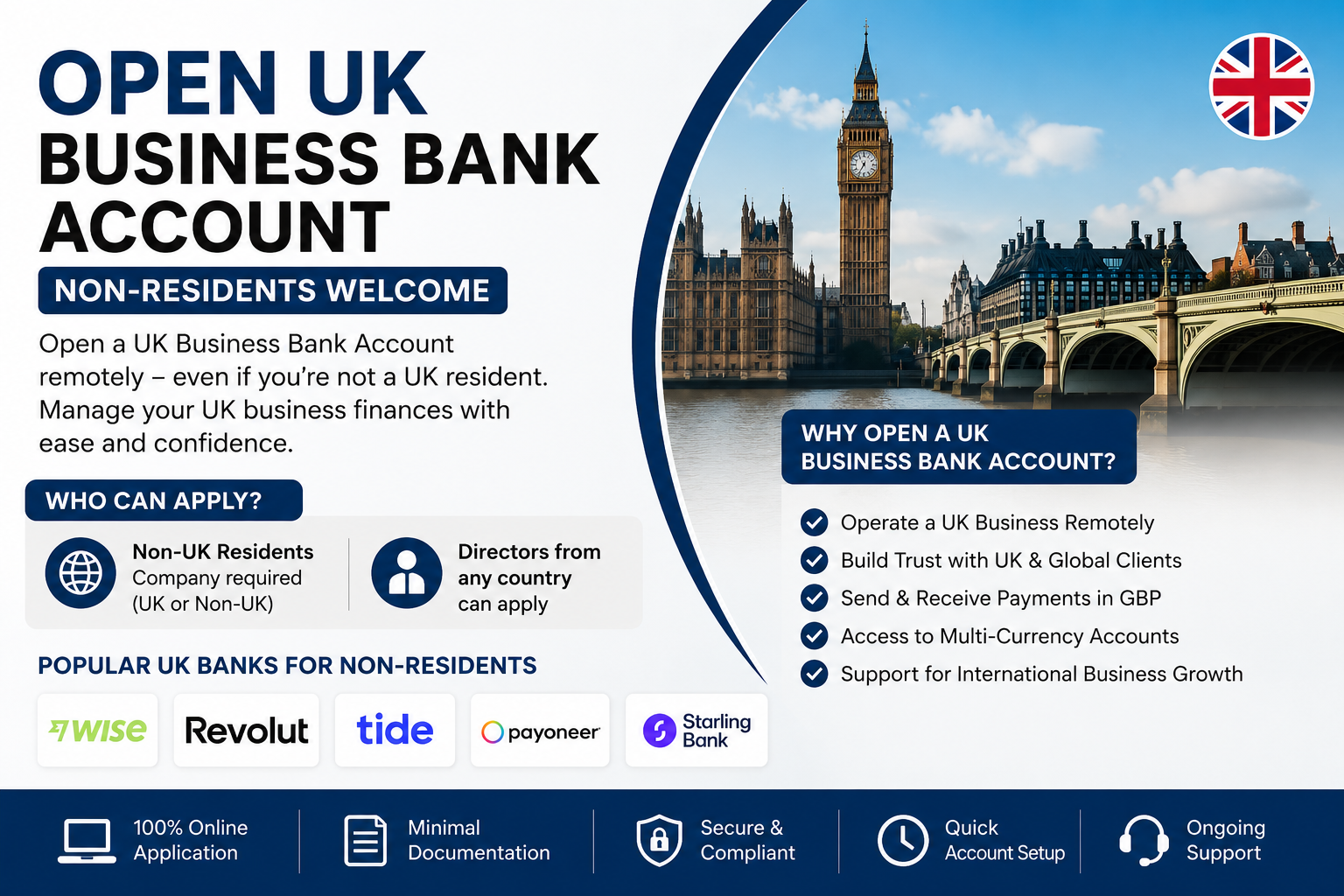
If you’ve incorporated a UK company from abroad, you’ve probably already hit this wall: you call up a high-street bank, you get through the first few questions fine, and then they ask where you live. The answer isn’t London, Manchester, or anywhere in the UK and the conversation ends there.
Here’s the honest version, up front, so you don’t waste weeks chasing the wrong option.
Traditional high-street banks (Barclays, HSBC, Lloyds, NatWest) are genuinely hard for non-residents. Most still expect at least one director with a UK residential address, and many want an in-person branch visit before they’ll open a business account. If you’re running your company entirely from outside the UK, this route is slow, uncertain, and often ends in rejection regardless of how strong your paperwork is.
Electronic money institutions (EMIs) and digital banks are the realistic route. Wise Business, Revolut Business, Payoneer, and similar providers were built to onboard people who don’t fit the traditional mould remote directors, international founders, businesses with no UK office. They verify you digitally, they’re used to overseas applicants, and for most non-resident founders they’re where an actual working account comes from.
That said, “EMI” isn’t a single category with one set of rules. Each provider sets its own eligibility list by country of residence, business type, and risk appetite, and those lists change. What worked for a friend’s Dubai-based company last year might not apply to your Nigeria-based one this year. Treat every provider’s stated policy as a starting point to verify, not a guarantee.
What You Need Before You Apply
Regardless of which provider you approach, the basics are the same, and getting them in order before you start the application saves you from the most common rejection triggers.
An incorporated UK company. You need a live Companies House number. A UK Ltd is the standard vehicle sole traders and non-UK-registered entities are turned away by most of the providers covered here. If you haven’t incorporated yet, this has to come first; no bank or EMI will open a business account for a company that doesn’t legally exist yet.
A UK registered office address. This is a legal requirement for the company itself, separate from where the director lives. Formation agents typically provide this as part of a package.
Proof of identity for every director and person with significant control (PSC). A passport or national ID, plus supporting verification. Since the Economic Crime and Corporate Transparency Act (ECCTA) identity verification rules took effect, this step has tightened for all directors, including those based overseas expect it to be checked more rigorously than it might have been a couple of years ago.
Proof of address. This is where it gets provider-specific. Some ask for a UK address; most of the digital providers will accept an overseas utility bill, bank statement, or rental agreement instead. Confirm this detail with your chosen provider before you submit anything, because it’s one of the most common places an application stalls.
A clear description of what your business actually does. Vague or generic business activity descriptions are a red flag in KYC/AML screening. If your company invoices software clients in the US and holds a UK entity for tax and credibility reasons, say exactly that.
A business website or online presence, where possible. It’s not always mandatory, but it materially speeds up verification; a provider can look you up and confirm the business is real rather than relying purely on the documents you’ve submitted.
If you’re still finalising the company itself, a formation service that bundles registered office, director service address, and banking guidance in one package removes a lot of this friction worth a look if you haven’t incorporated yet: company formation for non-resident founders.
UK Business Banking Options for Non-Residents, Compared
There’s no single “best” answer here the right choice depends on where you live, what currencies you’re paid in, and whether you ever plan to visit the UK. Here’s how the main options stack up.
Wise Business is usually the first stop for non-resident founders, and for good reason. It’s built around multi-currency accounts, gives you local account details in GBP, EUR, USD and others, and its onboarding is entirely digital no branch visit, no UK address requirement for the applicant. It isn’t a bank in the traditional sense (it’s an EMI), which matters for how your funds are protected, covered below. Pricing is typically a free tier plus a one-off fee to unlock features like direct debits.
Revolut Business offers fast remote onboarding and a broad feature set, but eligibility is more conditional than Wise’s: the company generally needs to be registered in the UK or EEA, and the applicant’s country of residence has to appear on Revolut’s supported list. Some sources report acceptance across 30-plus countries; others note a residency requirement tied to at least one director or beneficial owner. Given that inconsistency, check Revolut’s current eligibility list directly for your specific country before assuming you’ll qualify.
Payoneer is a strong option if your core need is receiving international payments from marketplaces, freelance platforms, or overseas clients rather than running day-to-day UK business banking. It’s historically more flexible on residency than bank-style accounts, and doesn’t always require a formally registered company to get started, though a registered UK entity strengthens your application if you have one.
Tide sits in a slightly odd spot. It explicitly does accept non-UK-resident directors of a properly registered UK company, and plenty go through every week but it also applies enhanced due diligence, and some reports describe a stricter residency stance than Wise or Payoneer for applicants with no operational ties to the UK at all. Its accounting integrations (Xero, QuickBooks) and expense tools are genuinely useful if you clear onboarding.
Traditional high-street banks remain the hardest route and typically the slowest expect requests for an in-person branch visit and a UK-resident director, with decisions taking weeks rather than days. Some formation packages include an introduction letter that can help, but it’s not a guarantee.
| Provider | UK company required | Remote onboarding | UK address needed | Best for |
| Wise Business | Yes | Yes | No | Multi-currency, international payments |
| Revolut Business | Yes (UK/EEA) | Yes | Residency-dependent | Fast onboarding, feature bundle |
| Payoneer | Not always | Yes | No | Receiving international/marketplace payments |
| Tide | Yes | Yes, with enhanced checks | No, but scrutiny varies | Accounting integrations, UK-facing operations |
| Traditional banks | Yes | Rarely | Usually yes | Businesses with a genuine UK presence |
Image: UK business bank account options for non-residents compared
A practical note many overseas founders miss: you don’t have to pick just one. It’s common to run a Wise or Revolut account for day-to-day international transactions alongside a second provider for a specific need, like marketplace payouts through Payoneer.
EMI or Bank: Does the Difference Actually Matter?
It’s worth pausing on this because the terminology gets used loosely, and the distinction has real consequences for your money.
A traditional bank takes deposits, lends them out, and (in the UK) covers your balance up to £85,000 under the Financial Services Compensation Scheme if the bank fails. An EMI which is what Wise, Revolut, and Payoneer legally are doesn’t lend your money out. Instead, it’s required to “safeguard” customer funds, typically by holding them in ring-fenced accounts at other institutions or in secure, liquid assets, so they’re kept separate from the EMI’s own operating money. That’s a real protection, but it isn’t the same legal mechanism as FSCS coverage, and the specifics of how each provider safeguards your funds are worth reading rather than assuming.
For day-to-day operating cash paying suppliers, receiving client payments, running payroll this distinction rarely changes anything in practice for most founders. It becomes more relevant if you’re planning to hold significant retained earnings in the account long-term, in which case it’s worth understanding exactly how your specific provider protects that balance. If you’d rather go deeper on formation-side considerations before you even get to banking, our guides on choosing a company structure as an overseas founder and on what changed under the latest Companies House ID verification rules cover the pieces that tend to trip people up earlier in the process.
Step-by-Step: How to Apply
1. Incorporate your UK company first. Almost every provider on this list requires a live Companies House registration before you can even start a banking application. Trying to apply in parallel with incorporation usually just creates delays.
2. Gather your documents before you start the online form. Passport, proof of address, business description, and company documents (certificate of incorporation, company number). Having these ready as clean digital scans avoids the single biggest cause of slow processing being asked to resubmit blurry or incomplete uploads.
3. Choose your provider based on your actual use case, not just brand recognition. If you’re mostly invoicing overseas clients in multiple currencies, Wise or Revolut make more sense than a high-street bank. If you’re collecting marketplace or platform payouts, Payoneer may fit better.
4. Complete the application entirely online. For every EMI covered here, this is app or web-based: personal details of the account representative, business details, sector, and the documents above.
5. Expect a verification period, not instant approval. Digital providers commonly review within a day or two; more complex business types or higher-risk sectors can take longer, and some applications get escalated for manual review.
6. Once approved, activate the account and set up your payment details. You’ll get your GBP account number and sort code (or IBAN, depending on provider), which you’ll then connect to invoicing tools, payment processors, and payroll as needed.
Connecting Stripe, PayPal and Other Payouts
For most overseas founders, the UK business account isn’t the end goal it’s the plumbing that lets you get paid. Once you have GBP account details from Wise, Revolut, or another provider, connecting them to Stripe is generally straightforward: Stripe verifies the account is registered to a matching business name and lets you set it as your payout destination. The same logic applies to PayPal business payouts and most UK-facing invoicing platforms.
A couple of things worth checking before you rely on this for real revenue: confirm the specific provider you’ve chosen is listed as a supported payout destination for the platform you’re using, and be aware that EMI accounts (Wise, Revolut) are not classic banks funds are typically safeguarded rather than covered by the Financial Services Compensation Scheme (FSCS) in the same way a traditional bank deposit is, though Tide’s ClearBank-backed accounts do carry FSCS protection. This is a real distinction for larger balances, and it’s worth reading the specific safeguarding terms of whichever provider you pick rather than assuming they’re all equivalent.
Rejection Reasons and How to Fix Them
“We couldn’t verify your address.” The most common single rejection reason for non-residents. Fix: check the specific address documentation the provider accepts before applying some want a utility bill dated within three months, others accept a bank statement or tenancy agreement, and formats vary by country.
“Your business activity description was unclear.” Generic descriptions (“consulting,” “trading,” “services”) trigger extra scrutiny under AML rules. Fix: be specific about what you actually do, who your customers are, and where your revenue comes from.
“Your country isn’t currently supported.” Some providers maintain explicit lists of eligible residence countries, and not every country is on every list. Fix: check the provider’s current eligibility list for your specific country before applying rather than assuming acceptance, and have a second provider in mind as a backup.
“We need additional documentation.” Sometimes this is a genuine request; other times it signals the application has been flagged for a closer look. Fix: respond promptly and completely partial responses tend to extend review times rather than shorten them.
“Declined without a clear reason.” This happens, and providers aren’t always required to explain their decision. Fix: this is exactly why applying to more than one provider in parallel, rather than waiting on one before trying the next, tends to get non-resident founders an active account faster.
A Note on Keeping This Current
Provider eligibility which countries are accepted, what documents are required, whether a UK address is mandatory changes fairly often, and acceptance is ultimately at each provider’s discretion, not something we or any formation agent can guarantee. Always confirm current requirements directly with the provider before relying on any comparison, including this one.
FAQs
Can I open a UK business bank account without visiting the UK? Yes, with a digital provider like Wise Business, Revolut Business, Payoneer, or Tide. Traditional high-street banks are the ones more likely to require an in-person visit.
Is Wise a real bank account? Wise is an electronic money institution (EMI), not a licensed bank. It provides genuine GBP account details (account number and sort code) that work for receiving and sending payments, but your funds are protected through safeguarding rules rather than the FSCS deposit guarantee that applies to traditional bank accounts.
Why was I rejected? The most common reasons are an address the provider couldn’t verify, a vague business activity description, or a country of residence that isn’t currently on that provider’s supported list. Applying to more than one provider at once is usually more efficient than appealing a single rejection.
Do I need a UK business account for Stripe? Not strictly Stripe supports payouts to a range of account types but having GBP account details makes invoicing UK clients, paying UK suppliers, and managing UK tax obligations considerably simpler, and most non-resident founders end up needing one for practical reasons beyond just Stripe.
Still sorting out incorporation, banking, and everything in between? Our formation packages include banking guidance so you’re not figuring out which provider fits your situation from scratch message us on WhatsApp and we’ll walk you through it.
Leave a Reply