longer clearly cheaper even at fairly high profit levels. A limited company still wins on limited liability, credibility with larger clients, and the ability to leave profit in the business to reinvest at a lower tax rate. But the old rule of thumb “go limited once you clear £30–40k” needs to be retired. Below, we show exactly why, with worked numbers for 2026/27.
Not tax advice figures below use HMRC rates confirmed for the 2026/27 tax year (6 April 2026 to 5 April 2027). Always check your specific position with a qualified accountant. This guide is reviewed and updated annually as rates change.
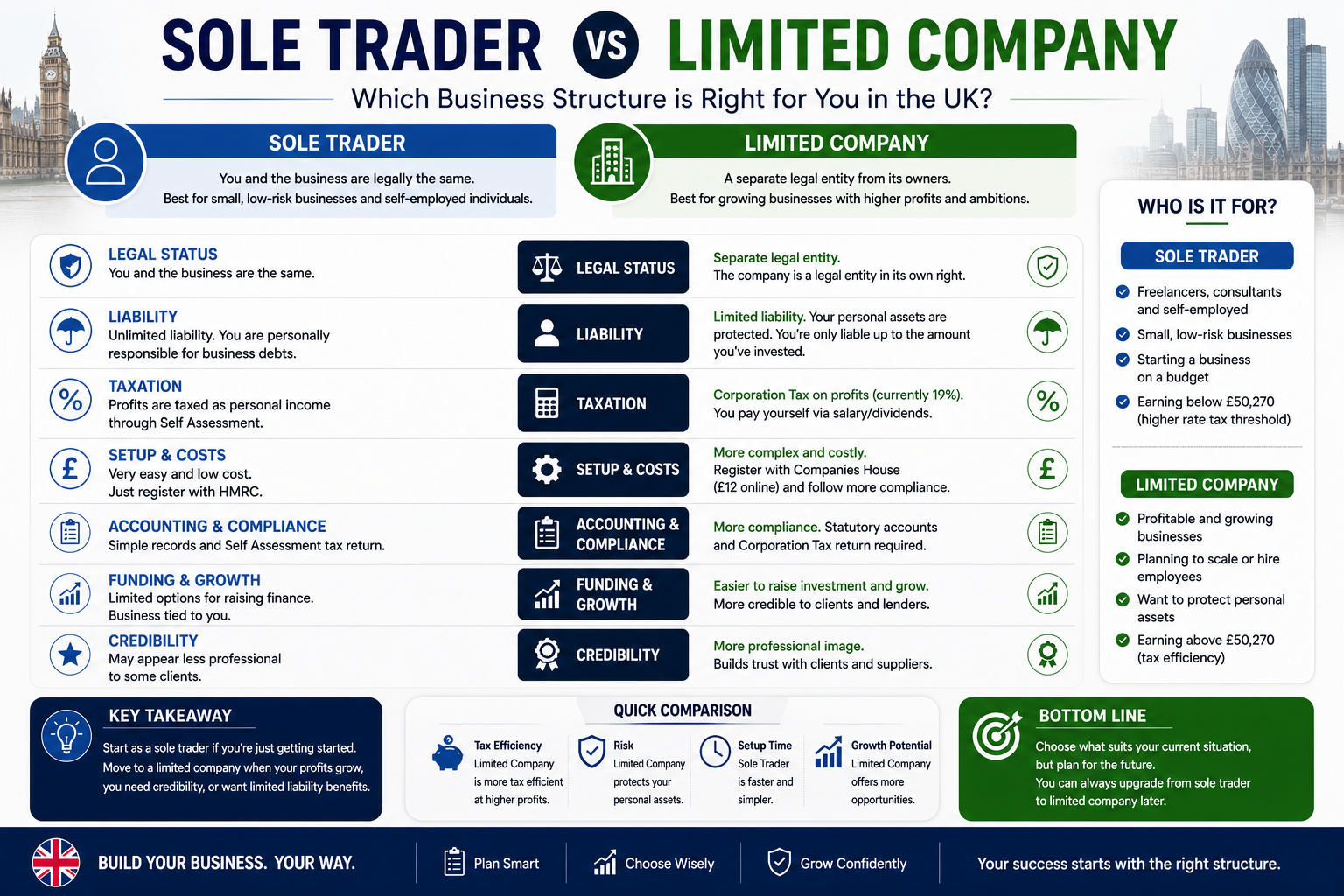
Sole Trader vs Limited Company at a Glance
| Sole Trader | Limited Company | |
| Legal status | You are the business | Separate legal entity |
| Liability | Unlimited personal assets at risk | Limited to share capital (in most cases) |
| Tax on profit | Income Tax + Class 4 NI | Corporation Tax, then Income Tax/NI only on what you extract |
| 2026/27 headline rates | 20% / 40% / 45% Income Tax; 6% / 2% Class 4 NI | 19% (small profits) to 25% Corporation Tax; 10.75% / 35.75% / 39.35% dividend tax |
| Personal allowance | £12,570 tax-free | £12,570 tax-free (via salary) |
| VAT registration | Required above £90,000 turnover | Required above £90,000 turnover |
| Setup cost | Free just register with HMRC | £12–£100+ via Companies House or a formation agent |
| Ongoing admin | Self Assessment return | Confirmation statement, annual accounts, CT600, payroll if salaried, often a dividend voucher trail |
| Typical accountancy cost | £150–£350/year (basic) | £600–£1,800/year |
| Privacy | No public filings | |
| Credibility with clients | Fine for most, weaker for corporate/enterprise clients | Often preferred by agencies, larger clients, and for IR35-adjacent contracting |
| Profit retention | All profit is taxed as yours immediately | Profit can stay in the company, taxed only at Corporation Tax rates |
Why the 2026/27 Numbers Are Different From What You’ve Read Elsewhere
A lot of older guides still tell you that a limited company saves tax once profits pass roughly £30,000–£40,000. That advice was built on dividend tax rates that no longer apply. From 6 April 2026, the basic and higher dividend rates rose two percentage points, to 10.75% and 35.75%, while the dividend allowance stayed frozen at just £500. At the same time, employer National Insurance is still charged at 15% on salary above a £5,000 secondary threshold, and single-director companies can’t claim the £10,500 Employment Allowance that many small employers use to offset that cost.
Put those three things together a slimmer dividend allowance, higher dividend rates, and non-refundable employer NI on the director’s own salary and the tax advantage of extracting all your profit through a limited company has largely evaporated. The worked examples below show this in practice.
Tax Worked Examples: £20k, £40k and £80k Profit
All examples assume: a single director/shareholder with no other income, a salary set at the personal allowance (£12,570 the common approach because it’s free of Income Tax and employee NI), no Employment Allowance (unavailable to single-director companies), all remaining company profit paid out as dividend in the same tax year, and Personal Allowance/Class 4 NI thresholds of £12,570/£50,270 for the sole trader.
£20,000 profit
Sole trader:
- Income Tax on £7,430 above the personal allowance at 20% = £1,486
- Class 4 NI at 6% = £446
- Take-home: £18,068
Limited company:
- Salary £12,570 (no tax/NI due) + employer NI on the slice above £5,000 = £1,136
- Remaining profit before Corporation Tax: £6,295, taxed at 19% = £1,196
- Dividend paid: £5,099; after the £500 allowance and 10.75% basic dividend rate: dividend tax £494
- Take-home: £17,174
Sole trader is ahead by roughly £894.
£40,000 profit
Sole trader:
- Income Tax on £27,430 at 20% = £5,486
- Class 4 NI at 6% = £1,646
- Take-home: £32,868
Limited company:
- Salary £12,570 + employer NI £1,136 (same as above)
- Remaining profit: £26,295, Corporation Tax at 19% = £4,996
- Dividend paid: £21,299; after allowance, taxed at 10.75% throughout (still inside the basic rate band): dividend tax £2,236
- Take-home: £31,633
Sole trader is ahead by roughly £1,235.
£80,000 profit
Sole trader:
- Income Tax: 20% up to £50,270, then 40% on the rest = £19,432
- Class 4 NI: 6% then 2% above £50,270 = £2,857
- Take-home: £57,711
Limited company:
- Salary £12,570 + employer NI £1,136
- Remaining profit: £66,295, which now falls in the marginal relief band (£50,000–£250,000) effective Corporation Tax rate around 21%, giving CT of roughly £13,818
- Dividend paid: £52,476; part falls in the basic band at 10.75%, the rest in the higher band at 35.75%: dividend tax roughly £9,157
- Take-home: £55,890
Sole trader is still ahead by roughly £1,821 and the gap widens further at higher-rate profit levels, because a marginal pound extracted as dividend from a limited company is now taxed more heavily overall (around 27–53% combined, depending on the band) than the same pound taxed as sole trader profit (26–47% combined including Class 4 NI).
What this doesn’t capture
These figures are for full extraction every pound of profit paid out to the owner in the same year. The picture changes if you:
- Leave profit in the company to reinvest, rather than drawing it all out you only pay Corporation Tax (from 19%) until you actually take the money, which is a genuine deferral advantage a sole trader doesn’t get.
- Use employer pension contributions, which come straight out of company profit before Corporation Tax and avoid dividend tax entirely often the single biggest lever available to a director.
- Split income with a spouse who is also a shareholder, using their personal allowance and basic-rate band.
- Sit inside IR35, where most of the historical extraction advantage of a limited company disappears anyway, regardless of these figures.
Where IR35 Fits In
If you’re a contractor working through an agency or directly for one client at a time, IR35 (the off-payroll working rules) can override most of the planning above. If your contract is caught inside IR35, the fee-payer deducts tax and NI roughly as if you were an employee, before you ever see the dividend-extraction advantage a limited company might otherwise offer. In that situation, the choice between sole trader and limited company often comes down to what your client or agency will accept contractually (many will only engage through a limited company or an umbrella company) rather than which structure is more tax-efficient for you personally. If IR35 status is a live question for your work, get a proper status determination before assuming either structure changes your tax position.
Which One Actually Suits You?
The numbers above answer the tax question, but most people end up choosing based on a shorter list of practical points:
- Choose sole trader if: you want the lowest admin burden, your profit is likely to stay in the £15k–£60k range and you plan to draw most of it out as income each year, your work carries limited financial or legal risk, and you don’t need a registered company name for client-facing credibility.
- Choose limited company if: you want to reinvest a meaningful share of profit rather than draw it all out, your work carries real liability exposure, you want to bring in a co-founder or investor down the line, a client or sector expects to contract with a limited company, or you want to build pension contributions through the business as a core part of your tax planning.
Neither choice is permanent, and neither is objectively “better” it depends on what you’re optimising for.
Liability: The Case for Incorporating That Has Nothing to Do With Tax
As a sole trader, there’s no legal separation between you and the business. If the business can’t pay a debt, is sued, or a client dispute goes badly, your personal assets savings, car, in some situations your home are exposed. A limited company is a separate legal person: in ordinary trading circumstances, your liability is limited to the value of your shares. That protection isn’t absolute (directors can still be personally liable for wrongful trading, personal guarantees on loans, or breaches of duty), but it’s real, and it’s the main reason people incorporate even when the tax numbers are close or slightly worse.
This matters most if you:
- Hold contracts with meaningful financial or reputational risk attached
- Work in a field with real professional liability exposure (construction, consulting with financial advice, manufacturing)
- Are taking on debt, leases, or supplier credit in the business’s name
- Want a credible legal entity to bring on a co-founder or investor later
Admin and Costs: What You’re Actually Signing Up For
Sole trader: Register once with HMRC, then file one Self Assessment return a year. Bookkeeping can be a spreadsheet if your affairs are simple. Basic accountancy support runs roughly £150–£350 a year, and many sole traders manage without an accountant at all below the VAT threshold.
Limited company: You’ll register with Companies House, then maintain statutory registers, file an annual confirmation statement, prepare and file annual accounts (even if dormant), submit a Corporation Tax return (CT600) within 12 months of your year end, and pay any Corporation Tax due within 9 months and 1 day. If you take a salary, you’ll need to run PAYE payroll even for a salary of just £12,570 a year. Realistic accountancy fees for a small owner-managed limited company sit around £600–£1,800 a year, more if VAT-registered or if payroll and bookkeeping are outsourced too.
Both structures must register for VAT once taxable turnover crosses £90,000 in any rolling 12-month period (the threshold has been frozen at that level since April 2024) this rule doesn’t favour either structure.
Switching From Sole Trader to Limited Company Later
You don’t have to decide once and stick with it. Most freelancers start as sole traders it’s free, fast, and low-admin and incorporate later once turnover, liability exposure, or a client’s requirements justify it. The process (in outline):
- Register a new company with Companies House
- Open a business bank account in the company’s name
- Transfer (or newly contract) ongoing client relationships into the company
- Move business assets into the company this can trigger tax on any gain, so get advice if assets have appreciated
- Deregister as self-employed with HMRC once you’ve stopped trading as a sole trader
- Re-register for VAT under the new company if applicable (VAT registration doesn’t automatically transfer)
There’s no legal or tax barrier to switching, but it does add one-off cost and admin, so it’s worth planning the timing ideally at your accounting year end rather than mid-year.
FAQs
At what profit is a limited company worth it? On tax alone, under 2026/27 rates, full-extraction limited companies no longer show a clear advantage over sole trader status at £20k, £40k or even £80k of profit the gap actually favours the sole trader at every level modelled above. A limited company becomes more attractive once you plan to retain profit in the business rather than draw it all out, use employer pension contributions, or need limited liability, rather than purely because your turnover has crossed a certain line.
Can I switch from sole trader to limited company? Yes, at any point, and there’s no cap on how long you can trade as a sole trader first. You’ll register a new company, move the business (and usually its assets) across, and deregister as self-employed see the switching section above for the full sequence.
Is a limited company more expensive to run? Yes, generally. Between statutory filings, payroll for even a modest salary, and typically higher accountancy fees, expect to spend several hundred pounds more a year running a limited company than operating as a sole trader with the same turnover.
The Bottom Line
If your main goal is minimising tax on income you plan to take out of the business straight away, 2026/27’s dividend tax rise means a sole trader setup now holds its own at almost every profit level examined here, a real shift from the advice most sites are still repeating. Where a limited company earns its keep is limited liability, reinvesting profit at a lower rate rather than drawing it all out, pension planning, and credibility with certain clients. If any of those apply to you, incorporating can still make sense even though the pure tax maths is closer than it used to be.
If you’ve decided a limited company is right for you, our company formation package handles the Companies House registration, registered office, and initial compliance setup so you can start trading with the right structure from day one.
Leave a Reply