If you’re reading this at 11pm after packing orders, answering “where is my order” messages, and still trying to get next month’s ad budget approved, you already know the problem. The business has outgrown the version of you that does everything.
The question isn’t really “should I outsource ecommerce management ” anymore it’s “which model, for how much, and how do I know it’s actually working.” That’s what this guide covers.
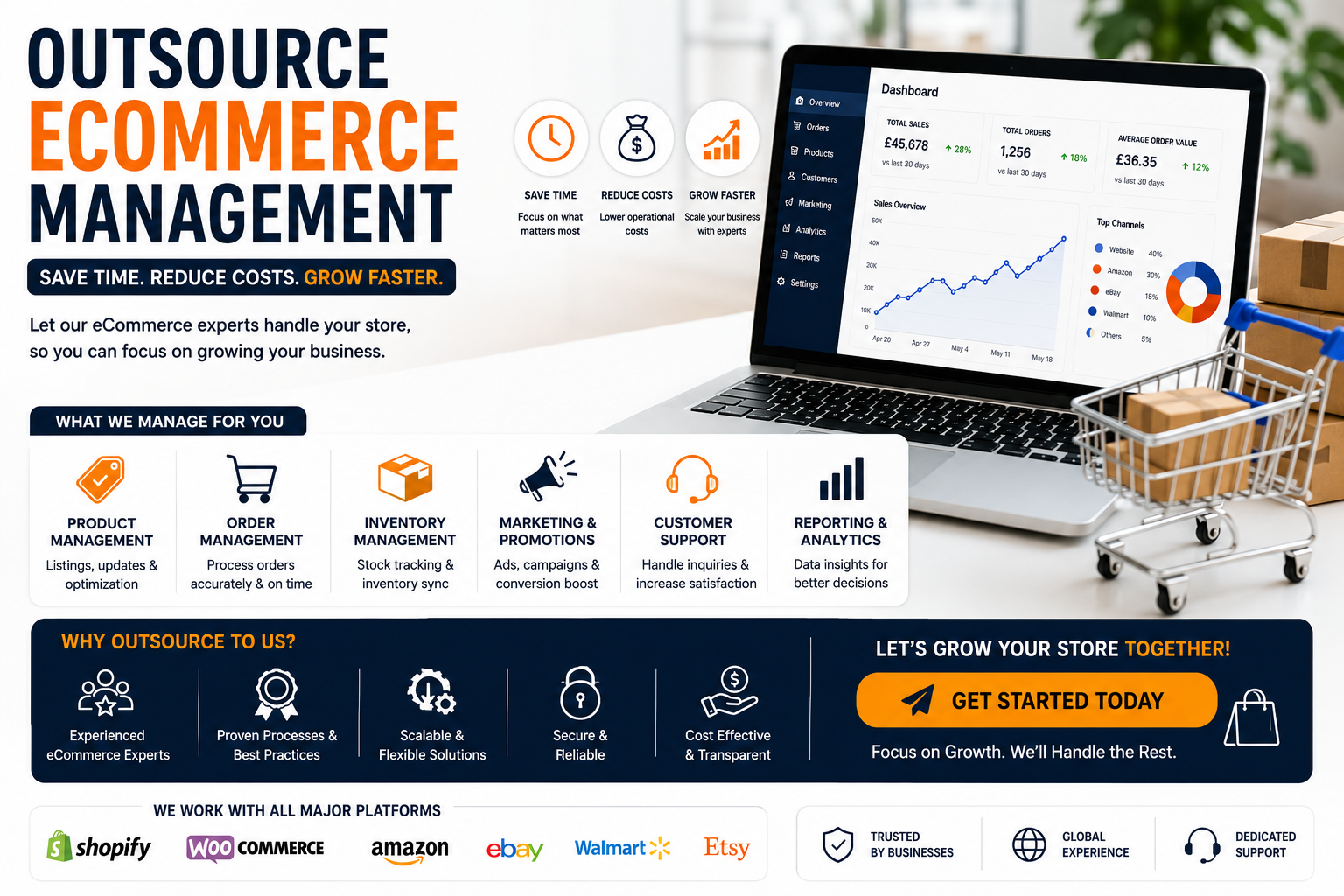
What Can Actually Be Outsourced
Almost every recurring, process-driven task in a store can be handed off. The parts that usually stay in-house are brand strategy, high-level financial decisions, and supplier relationships you’ve built personally; everything else is fair game.
Commonly outsourced functions:
- Order fulfilment pick, pack, ship, tracking updates, carrier exceptions
- Customer service outsourcing pre-sale questions, post-sale support, returns and refunds, review management
- Catalog and listing management new SKU uploads, pricing updates, image and copy edits, marketplace compliance
- Inventory management stock level monitoring, reorder alerts, supplier POs
- Reviews and reputation solicitation, response, flagging policy violations
- Advertising and marketing execution campaign setup, bid management, content calendars (strategy usually stays with you or a specialist)
- Reporting sales, margin, ad spend, and inventory dashboards on a set cadence
A good rule of thumb: outsource the tasks that are well-documented and repeatable first. Anything you can write a checklist for, someone else can execute often better than you, because it’s the only thing on their plate.
The Three Models: VA, Freelancer/Agency, or In-House
There’s no single “right” answer here it depends on volume, complexity, and how much oversight you want to provide.
Virtual Assistant (VA): A single person, usually part-time or hourly, handling defined tasks like customer service replies or listing updates. Cheapest option, but you’re managing the work assigning tasks, checking quality, covering gaps when they’re out sick.
Freelancer / Specialist Agency: One provider or small team covering a specific function (e.g., PPC management, or fulfilment) with more accountability than a VA contracts, SLAs, sometimes reporting built in. Better for a single pain point than for running the whole store.
Full-Service Agency (A-to-Z management): A team that runs multiple or all operational functions under one contract, with a single point of contact, defined SLAs, and regular reporting. Highest cost, but the coordination overhead disappears you’re not stitching together five vendors yourself.
In-house hire: Full control and dedicated attention, but you carry recruiting, training, benefits, turnover risk, and management time. Usually only makes sense once volume justifies a full-time role.
Cost Comparison
Image: Ecommerce outsourcing options and costs compared
| Model | Typical Monthly Cost (USD) | Best For | Oversight Needed |
| Virtual Assistant | $500 – $1,500 | 1–2 defined tasks, low-medium volume | High you manage and QC |
| Freelancer / Niche Agency | $800 – $3,500 | One function done well (e.g., ads or fulfilment) | Medium |
| Full-Service Agency (A-to-Z) | $2,000 – $8,000+ | Multiple functions, want one point of contact | Low SLAs and reporting built in |
| In-house hire | $3,500 – $7,000+ (salary + overhead) | High volume, need dedicated full-time attention | Medium-High you’re the manager |
Costs scale with order volume, number of SKUs, marketplaces covered, and whether customer service needs to be 24/7 or multilingual. Get quotes based on your actual numbers rather than list pricing most agencies price per task volume, not a flat rate.
As a benchmark: management costs typically run 8–15% of revenue for stores under $1M in annual sales, dropping toward 3–6% as volume grows and fixed costs get spread across more orders. If you’re being quoted well above that range without a clear reason (24/7 coverage, multiple marketplaces, complex fulfilment), ask what’s driving the premium.
What Onboarding Should Look Like
A provider who can’t clearly describe their onboarding process is one you should be cautious about it usually means the “process” gets invented as they go, at your expense. Here’s the onboarding sequence we run for new A-to-Z clients, so you know what a properly structured handover looks like:
- Discovery call and access audit we map every system involved (marketplace accounts, inventory tools, shipping software, help desk) and agree who needs what access, with credentials handled through a password manager, not spreadsheets.
- Process documentation review if you have existing SOPs, we adapt them. If you don’t, we document your current process first, before changing anything, so nothing falls through the cracks in week one.
- SLA and KPI agreement response times, fulfilment turnaround, escalation paths, and reporting cadence are put in writing before we touch live orders.
- Shadow period (typically 1–2 weeks) our team runs tasks alongside you or your outgoing process, with you reviewing output before we take full ownership.
- Handover we take primary responsibility for the agreed scope, with an agreed check-in schedule for the first month (usually weekly, moving to the standard cadence after).
- First reporting cycle you receive the first full report at the end of month one, matched against the KPIs set in step 3, so there’s a concrete baseline to evaluate against.
Expect the full onboarding process to take two to four weeks for a single function, longer for full A-to-Z handover across multiple marketplaces.
KPIs That Keep a Provider Honest
Whatever model you choose, don’t outsource on vibe agree on numbers up front and check them on a set schedule. A reasonable starting checklist:
- Response time first response to customer inquiries (target: under 24 hours, often under 4 for higher-tier plans)
- Order fulfilment accuracy and speed % shipped within SLA, error/return rate tied to fulfilment mistakes
- Customer satisfaction CSAT or review sentiment tracked monthly, not just when something goes wrong
- Inventory accuracy stockout frequency, forecast accuracy on reorder timing
- Reporting cadence weekly summary, full monthly report with sales, ad spend, margin, and open issues
- Escalation resolution time how fast a flagged problem (account suspension risk, policy violation, chargeback) gets addressed
Put these in the contract, not just a verbal agreement, and ask for a sample report before you sign anything a provider confident in their process will have one ready to show you.
FAQs
What should e-commerce management cost as a percentage of revenue? Most stores under $1M in annual revenue see management costs land between 8% and 15% of revenue when outsourcing multiple functions. That ratio typically improves to 3–6% as order volume grows, since fixed costs like reporting and account management spread across more orders. Use this as a sanity check on quotes rather than a strict rule heavier customer service loads or complex, multi-marketplace catalogs can push costs higher for good reason.
How is performance actually measured once a provider takes over? Through the KPIs agreed at onboarding response times, fulfilment accuracy, CSAT, inventory accuracy, and escalation resolution tracked against a reporting cadence set in the contract, usually weekly summaries plus a full monthly report. Ask to see a sample report before signing so you know exactly what you’ll be reviewing each cycle.
What’s a normal contract length for e-commerce outsourcing? Three to six months is the most common initial term, long enough for a provider to move past the onboarding curve and show a real trend in the KPIs, but short enough that you’re not locked in if it isn’t working. Month-to-month is more common with VAs and single-function freelancers; longer 12-month terms sometimes come with a discount from full-service agencies, but shouldn’t be the only option offered.
Ready to Hand This Off Properly?
If you’ve read this far, you already know which tasks are eating your week. Our A-to-Z store handling service is built around exactly the onboarding process, SLAs, and reporting cadence described above no guesswork, no vague “we’ll figure it out” promises.
Leave a Reply