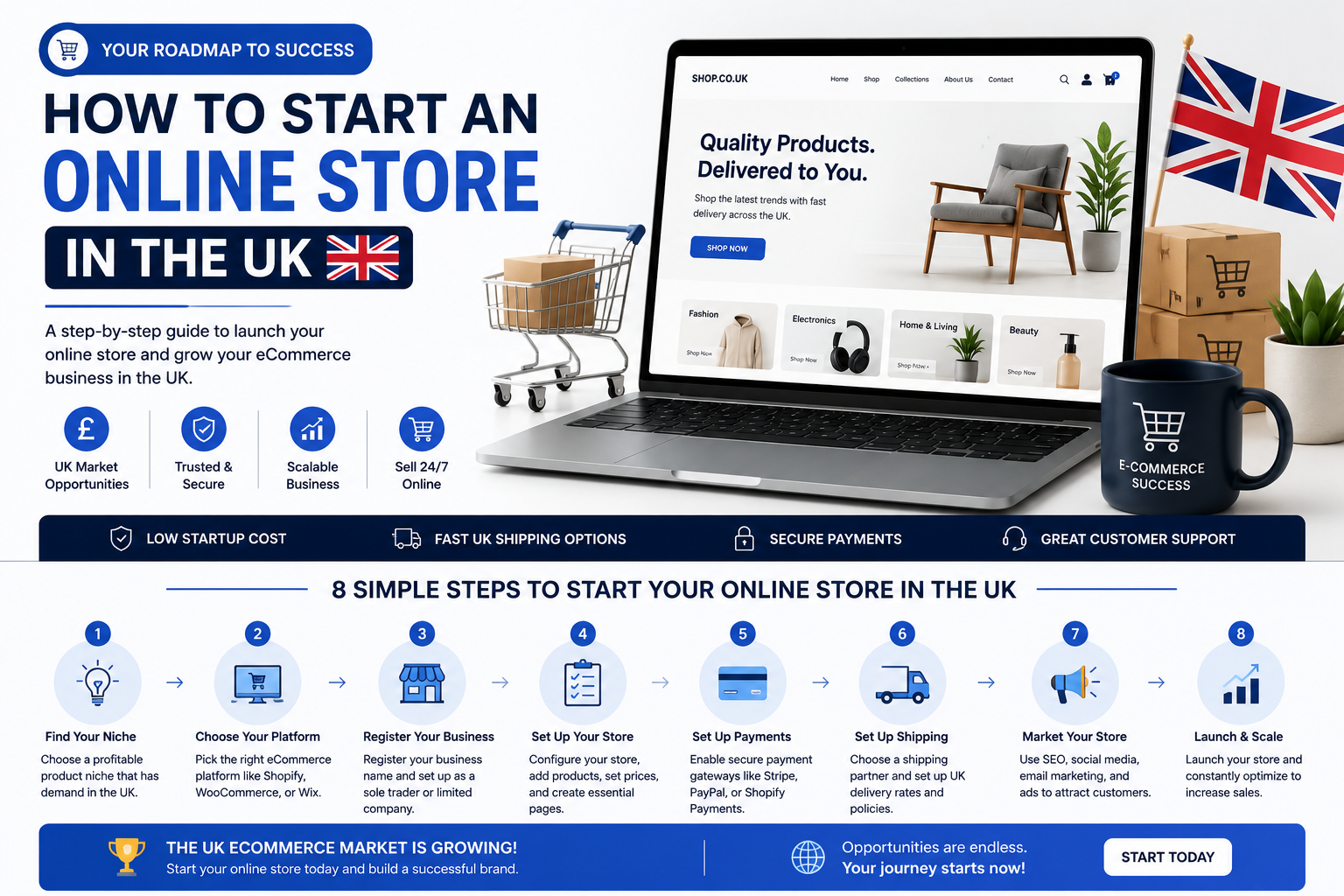
Starting an online store in the UK takes most first-time founders somewhere between six and twelve weeks from idea to first sale if they follow the steps in the right order. Most of the delay isn’t technical. It’s founders building the store before they’ve validated the product, or picking a platform before they understand their tax obligations, and having to unpick decisions three months in.
This guide lays out the ten steps in the order that actually works, based on stores we’ve built and relaunched for UK founders and overseas sellers entering the UK market. You’ll get realistic costs, the legal requirements HMRC and the ICO expect you to meet, and the platform trade-offs nobody mentions in the marketing copy.
The 10-step roadmap:
- Validate your product and pick a niche
- Register your business
- Choose your e-commerce platform
- Set up payments
- Build the store
- Source products and shoot photography
- Set up shipping and returns
- Handle the legal essentials (VAT, T&Cs, GDPR)
- Launch your marketing
- Measure performance and scale
If you’d rather skip ahead to the parts that decide whether the store makes money, jump to choosing a platform, payments, or the full cost summary.
Step 1: Validate Your Product and Pick a Niche
Before anything else before the domain, before the platform, before the logo you need evidence that people will actually pay for what you’re planning to sell online in the UK.
What validation actually looks like:
- Search demand. Use Google Keyword Planner or a tool like Ahrefs to check monthly search volume for your product category in the UK specifically. US or global volume figures are misleading; UK buying patterns and seasonality differ.
- Competitor density. Search your product on Google Shopping and Amazon UK. If there are zero results, that’s often a warning sign (no market), not an opportunity. If there are hundreds of near-identical listings, you’ll need a genuine differentiator price, quality, speed, or brand to compete.
- Margin math before volume. Work out landed cost (product + shipping + import duty if applicable) versus realistic UK retail price. A product that only works at scale is a bad first product.
- Pre-sell if you can. A simple landing page with a “notify me” or small deposit option, driven by £50–£100 of test ads, tells you more in a week than any amount of theorising.
Picking a niche that survives contact with reality:
Broad categories (e.g. “clothing,” “home goods”) are brutally competitive and expensive to advertise into. Niching down a specific style, material, use case, or customer (e.g. “waterproof dog coats for UK winters” rather than “pet accessories”) gives you a defensible position and cheaper, more targeted advertising in the early months.
A good test: can you describe your ideal customer and the specific problem you solve for them in one sentence? If not, the niche probably isn’t tight enough yet.
Step 2: Register the Business
Once you have a validated idea, the next decision is legal structure and it affects your tax bill, your liability, and how seriously banks, suppliers, and payment providers treat you from day one.
Your main options:
| Structure | Best for | Key trade-off |
| Sole trader | Testing an idea, very low initial revenue | Simple and cheap, but no separation between personal and business liability |
| Limited company | Most serious online stores | More admin (Companies House filings, accounts) but personal liability protection and a more credible brand for suppliers and payment processors |
| Partnership | Two or more founders sharing ownership informally | Shared liability between partners; needs a solid partnership agreement |
For most people planning to sell products online in the UK beyond a hobby level, registering as a limited company with Companies House is worth the extra £50 and paperwork. It separates your personal finances from business risk, and most payment gateways and wholesale suppliers prefer dealing with a registered company over a sole trader.
Registration itself takes as little as 24 hours online through Companies House, and costs from £50. You’ll also need to register for Self Assessment (if sole trader) or Corporation Tax (if limited company) with HMRC, typically within three months of starting to trade.
If you want the full walkthrough of company names, registered office addresses, director requirements, and which structure suits different founder situations, we cover that in detail in our guide to company formation in the UK. If you’d rather have this handled for you alongside your store build, our company formation service sets up the entity, registers you with HMRC, and gets your business bank account moving in parallel with the store build so you’re not waiting on paperwork before you can start selling.
Step 3: Choose Your E-Commerce Platform
This is the decision most founders spend too long agonising over, and the one that’s easiest to get wrong in either direction over-engineering with a custom build, or under-investing with a platform you’ll outgrow in six months.
Shopify vs WooCommerce the honest comparison:
| Shopify | WooCommerce | |
| Setup speed | Fast live in days | Slower needs WordPress + hosting configured first |
| Monthly cost | From ~£25/month, rising with apps | WordPress site/content strategyScaling ceiling |
| Technical skill needed | Low built for non-developers | Moderate more moving parts to maintain |
| Design flexibility | Good within themes; harder to fully customise | Very high full control over code and layout |
| Best for | Founders who want to launch fast and focus on sales, not maintenance | Founders with some technical comfort, or an existing WordPress site/content strategy |
| Scaling ceiling | High powers stores from £0 to £100m+ revenue | High, but requires more hands-on management as traffic grows |
Our general recommendation for first-time UK founders: Shopify, unless you already have a WordPress-based content site (a blog, existing SEO traffic) that WooCommerce can plug directly into. Shopify’s UK payment integrations, tax settings, and shipping carrier connections are more turnkey, which matters when you’re trying to get a store live in weeks, not months.
Other options worth knowing about:
- BigCommerce is a solid Shopify alternative, particularly for stores planning heavy B2B or wholesale functionality.
- Wix / Squarespace is fine for very small catalogues (under ~20 products) where design simplicity matters more than e-commerce depth.
- Custom build only worth considering once you have proven revenue and specific functionality no platform supports out of the box. Don’t start here.
Once you’ve picked a platform, you’ll need a domain name (via a registrar like GoDaddy, Namecheap, or directly through Shopify) expect £8–£15/year for a standard .co.uk or .com domain.
Step 4: Set Up Payments
Your payment gateway is the single point of failure that, if it goes wrong, stops every sale dead. Get this configured properly before you launch, not after your first abandoned cart complaint.
Main UK payment gateway options:
- Stripe, the most flexible option, widely integrated with Shopify and WooCommerce, supports cards, Apple Pay, Google Pay, and various buy-now-pay-later providers. Standard UK transaction fee: around 1.5% + 20p for UK cards, higher for international cards.
- Shopify Payments Stripe under the hood, but built into Shopify natively, meaning no third-party account needed and slightly simpler reconciliation.
- PayPal still expected by a meaningful share of UK shoppers as a checkout option alongside card payments; adding it alongside Stripe/Shopify Payments typically increases conversion rather than cannibalising it.
- Klarna / Clearpay buy-now-pay-later options that have become close to standard expectation in UK fashion, beauty, and homeware categories; can meaningfully lift average order value and conversion for the right product types.
What you need before you can go live:
- A UK business bank account (or in some cases a business-friendly account like Wise or Tide, though some gateways prefer traditional banks for larger volumes)
- Company registration details (see Step 2) most gateways ask for your Companies House number
- Verified identity documents for the account owner/director
A practical tip: enable at least two payment methods (typically a card processor plus PayPal, or plus a BNPL option) from day one. Checkout abandonment linked to “my preferred payment method isn’t available” is one of the most common and most avoidable reasons for lost first sales.
Step 5: Build the Store
With platform and payments decided, the actual build usually takes 1–3 weeks for a straightforward catalogue, depending on product count and how much custom design work you want.
Core pages every UK store needs before launch:
- Homepage with clear value proposition above the fold
- Category/collection pages
- Individual product pages
- Cart and checkout (usually templated by the platform, but worth testing thoroughly)
- About page particularly important for UK buyers, who research unfamiliar brands before purchasing
- Contact page with a real UK address and response-time expectation
- Terms & Conditions, Privacy Policy, Returns Policy (covered fully in Step 8)
Mobile-first is non-negotiable. Over 65% of UK e-commerce traffic now arrives on mobile devices, and Google’s indexing and ranking are mobile-first by default. Test every page on a phone before launch not just the homepage.
Site speed matters more than most founders expect. A one-second delay in page load can measurably reduce conversion rates. Compress images (see Step 6), avoid stacking too many third-party apps/plugins, and use your platform’s built-in speed testing tools before adding anything else.
Step 6: Source Products and Shoot Photography
Product presentation is where UK online stores most often let themselves down. Customers can’t touch or try the product photography and descriptions are doing all the persuasion work your shop assistant would otherwise do.
Sourcing considerations specific to UK sellers:
- If importing stock, factor in import duty and VAT at the border, plus realistic lead times 4–8 weeks from many overseas manufacturers is common, longer during peak shipping seasons.
- UK-based suppliers or dropshippers reduce lead time and give you more control over quality, often at a moderate cost premium worth paying in your first six months while you’re still building trust with customers.
- Order samples yourself before committing to inventory. Photograph and test the actual product you’ll be shipping, not the supplier’s marketing images.
Product photography what actually moves conversion:
- White/neutral background shots for the primary product image this is the industry-standard expectation and what most comparison shopping engines require.
- Lifestyle/context shots showing the product in use do more to build desire than technical shots alone.
- Multiple angles a minimum of 4–6 images per product is standard for UK fashion and homeware categories.
- Consistent lighting and colour grading across your whole catalogue inconsistency here reads as unprofessional even when individual photos are technically fine.
You don’t need a professional studio to start. A lightbox (from around £30), a smartphone with a good camera, and natural window light will produce serviceable results for a first launch. Reinvest in proper photography once you have revenue to justify it.
Step 7: Set Up Shipping and Returns
Shipping and returns policy decisions directly affect both your margins and your conversion rate. Get them wrong and you’ll either lose money on every order or lose customers at checkout.
Choosing a shipping approach:
- Royal Mail remains the default for most small UK sellers, reliable, widely trusted by customers, with tracked and untracked options.
- Evri, DPD, and Parcelforce are common alternatives, often cheaper at volume once you’re shipping dozens of parcels a week.
- Free shipping over a threshold (e.g. free over £40) is now close to a customer expectation in UK e-commerce and is worth building into your pricing rather than treating it as a discount.
Distance Selling Regulations what UK law actually requires:
UK consumer law (built on the Consumer Contracts Regulations, which replaced the older Distance Selling Regulations) gives online shoppers specific rights that differ from in-store purchases:
- Customers have a 14-day cooling-off period from receipt of goods to cancel most orders, without needing to give a reason.
- You must give customers a further 14 days to return the goods once they’ve cancelled, and you then have 14 days to refund them once you receive the return (or evidence it’s been sent).
- Certain goods are exempt from the right to cancel including personalised items, perishables, and unsealed items like cosmetics or underwear once opened but this must be clearly stated before purchase, not discovered afterward.
Writing a returns policy that builds trust rather than just covering you legally:
Your returns page should state, in plain language: the return window, who pays return postage, condition requirements for returned goods, and how refunds are processed. UK shoppers actively check returns policies before buying from unfamiliar stores. A vague or hard-to-find policy is a measurable drag on conversion, particularly in fashion and homeware.
Step 8: Handle the Legal Essentials VAT, T&Cs, and GDPR
This is the step founders most often under-invest in, and the one most likely to cause real problems later fines, disputes, or a store forced offline.
VAT threshold and registration:
As of 2026, the UK VAT registration threshold is £90,000 in taxable turnover over a rolling 12-month periodOnce you cross the threshold, registration is mandatory, and you’ll need to charge VAT on applicable sales and file returns, typically quarterly.
Some product categories have different VAT treatments (children’s clothing and most food items are zero-rated, for example), so it’s worth checking HMRC’s current guidance for your specific product category rather than assuming a flat rate applies.
Terms & Conditions:
Your T&Cs should cover, at minimum: order acceptance process, pricing and payment terms, delivery timescales and liability, cancellation and returns rights (linking to your fuller returns policy), and limitation of liability. Generic templates are a reasonable starting point, but should be reviewed against your specific product category regulated products (food, cosmetics, electricals) carry additional requirements.
GDPR and data protection:
If you collect any customer data which every online store does, at minimum through checkout
- ivacy Policy explaining what data you collect, why, and how long you keep it
- Cookie consent on your site (most platforms have built-in or app-based solutions for this)
- Explicit opt-in for marketing emails pre-ticked boxes are not compliant
- Registering with the ICO (Information Commissioner’s Office) if you’re processing personal data as a business the fee is typically £40–£60/year for small businesses, and it’s a legal requirement most first-time founders don’t realise applies to them.
Getting these fundamentals wrong doesn’t just risk fines, it’s one of the most common reasons UK customers abandon an unfamiliar store at checkout, since a missing or thin policy page is an easy trust signal to check.
Step 9: Launch Your Marketing
A finished store with no traffic is just an expensive brochure. Your launch marketing should start before the site goes live, not after.
A realistic first-90-days marketing mix:
- SEO foundations product and category pages structured around real search terms (see Step 1’s validation work), a blog addressing customer questions, and basic technical SEO (site speed, mobile usability, structured data for products).
- Paid social Meta (Facebook/Instagram) ads remain the most accessible starting point for UK D2C brands, with typical minimum viable test budgets from £20–£30/day to gather meaningful data.
- Email capture from day one a simple discount-for-signup pop-up building your list before launch means you have an audience to email the moment you go live.
- Organic social and community particularly effective for niche products with a visual or lifestyle angle (Instagram, TikTok, Pinterest depending on category).
- Marketplace presence listing key products on Amazon UK or eBay alongside your own store can be a fast way to generate early sales and reviews while your own site’s SEO builds more on this in our guide to expanding into UK marketplaces.
Avoid spreading a small budget across five channels at once. Pick two typically SEO plus one paid channel
Step 10: Measure Performance and Scale
Once you’re live and generating sales, the founders who scale successfully are the ones tracking the right numbers from week one, not discovering six months in that their unit economics don’t work.
Metrics worth watching from day one:
- Conversion rate UK e-commerce averages sit roughly between 1.5–3%, varying significantly by category; track yours against your own baseline rather than chasing an industry number.
- Average order value (AOV) and what specifically increases it (bundles, free shipping thresholds, upsells)
- Customer acquisition cost (CAC) versus customer lifetime value (LTV) the single most important ratio for deciding whether to scale ad spend
- Cart abandonment rate UK averages run high (commonly 65–75%), so a functioning abandoned-cart email sequence is one of the highest-ROI things you can set up early
When to scale, and how:
Scale spend only once you have at least 2–4 weeks of stable data showing acquisition cost is comfortably below customer lifetime value not after one good day. Reinvest early profit into the areas that showed the clearest signal in your first 90 days: better photography if product pages are converting poorly, more ad spend if paid channels are profitable, or expanded product range if repeat customers are buying variations of what you already sell.
How Much Does It Cost? Real Numbers
| Item | Typical Cost Range |
| Company registration (Companies House) | £50–£100 |
| Domain name | £8–£15/year |
| E-commerce platform (Shopify/WooCommerce hosting) | £25–£80/month |
| Payment gateway fees | ~1.5–2.9% + 20–30p per transaction |
| Theme/design | £0–£350 one-off |
| Product photography (DIY setup) | £30–£150 |
| Initial stock/inventory | Highly variable £500–£5,000+ typical for a first small run |
| Legal templates (T&Cs, Privacy Policy) | £0–£300 |
| ICO registration | £40–£60/year |
| Launch marketing budget (first 90 days) | £600–£3,000+ |
| Realistic total to launch | £1,500–£8,000+, depending on inventory and marketing scale |
Most first-time founders underestimate the marketing and inventory costs, not the platform costs; the store itself is rarely the expensive part.
Frequently Asked Questions
How much does it cost to start an online store in the UK? A lean launch platform, domain, basic legal templates, and a small first inventory run can be done from roughly £1,500–£2,500. A more fully prepared launch with professional photography, a proper marketing budget, and a larger initial stock order typically runs £5,000–£8,000+. The store platform itself is usually the smallest line item; inventory and marketing spend are where costs vary most.
Do I need a registered company to sell online in the UK? Not legally, in the sense that you can trade as a sole trader without forming a limited company. But most serious sellers register as a limited company (see Step 2) for liability protection and because payment gateways, wholesale suppliers, and business banking are generally smoother with a registered company. Whichever structure you choose, you must register with HMRC (Self Assessment or Corporation Tax) once you start trading.
Do I charge VAT on my online store? Only once your taxable turnover exceeds the current VAT threshold of £90,000 over a rolling 12-month period at which point registration and charging VAT becomes mandatory. Below that threshold, VAT registration is optional. Some product categories have special VAT treatments, so check HMRC guidance for your specific products.
Shopify or WooCommerce for beginners? For most first-time UK founders, Shopify it’s faster to launch, has more turnkey UK payment and tax integrations, and needs less ongoing technical maintenance. WooCommerce makes more sense if you already have a WordPress site with existing content or SEO traffic to build on.
How long until an online store becomes profitable? Highly variable by category and starting budget, but a realistic range for a well-validated, well-marketed store is 3–9 months to consistent monthly profit, assuming the founder is iterating on the metrics in Step 10 rather than waiting passively for traffic to arrive.
Skip the Learning Curve
Every step above is something we build for founders every week: company formation, platform setup, payment integration, product photography, and launch marketing, coordinated as one project rather than ten separate decisions made in isolation.
Skip the 3-month learning curve we build and launch stores end to end. Get a quote →
Overseas founder targeting UK buyers? Message us on WhatsApp → for a faster first conversation across time zones.
Leave a Reply