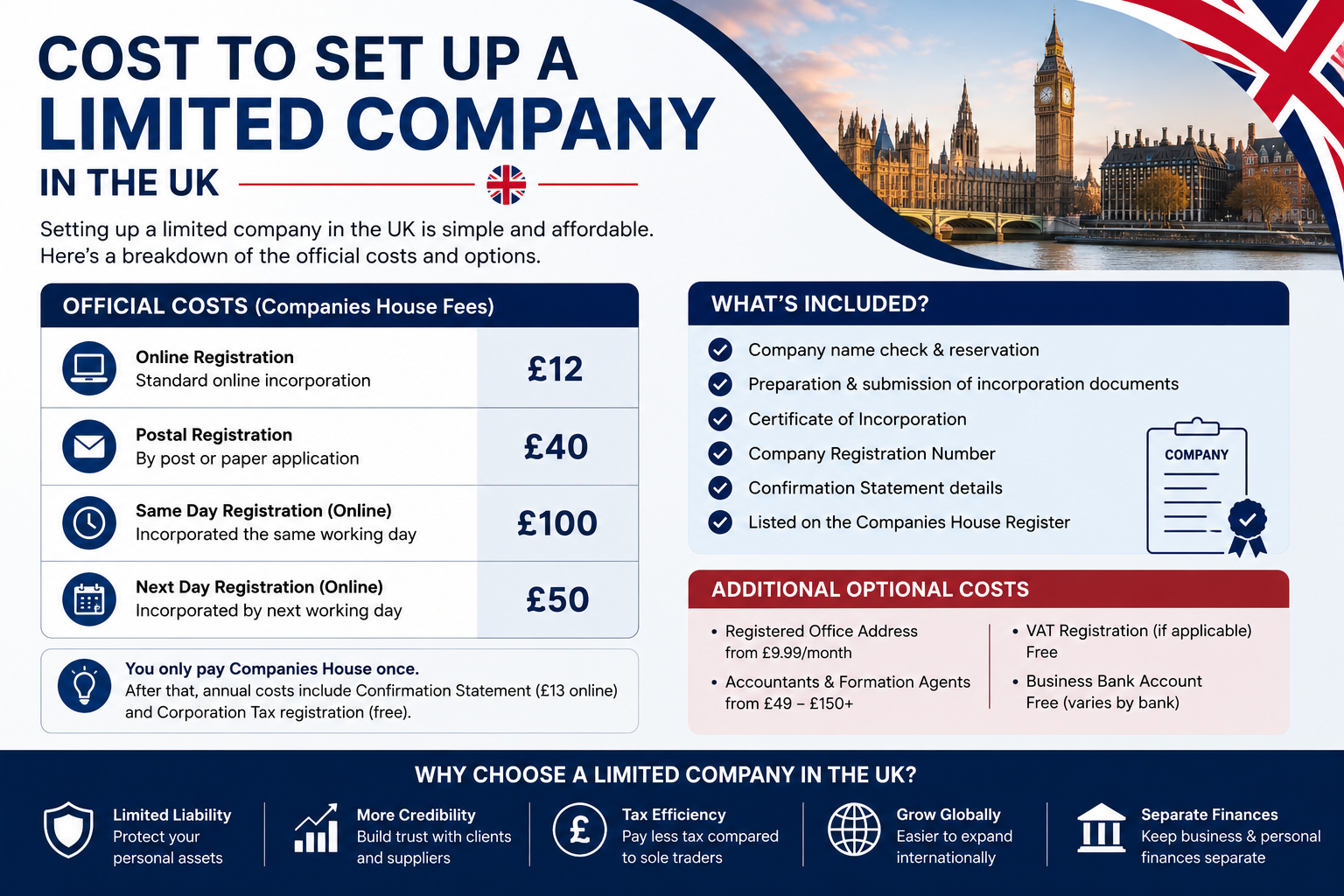
Setting up a limited company in the UK costs £100 if you register directly with Companies House online; that’s the only fee the government requires. But the £100 figure only covers incorporation itself. Once you add a registered office address, basic accounting support, and your first confirmation statement, most new companies end up spending somewhere between £150 and £800 in their first year.
This guide breaks down exactly where that money goes, so you can budget with confidence before you register.
Note on pricing: Companies House increased its fees on 1 February 2026. If you’ve seen “£50 incorporation fee” quoted elsewhere, that’s the old rate it doubled to £100 this year. We’ve used the current, correct figures throughout this guide, sourced directly from the official Companies House fee schedule.
One-Off Setup Costs
These are the costs you’ll face once, at the point of incorporation.
| Item | Cost | Notes |
| Companies House incorporation (digital) | £100 | Statutory fee, mandatory |
| Companies House incorporation (same-day, software) | £156 | Optional upgrade if you need same-day approval |
| Companies House incorporation (paper) | £124 | Rarely worth it slower and more expensive than digital |
| Formation agent service fee | £0–£100+ | Optional; many agents bundle the £100 statutory fee into their package price |
| Registered office address (first year) | £20–£90 | Required if you don’t use a residential or business address you own |
| Director service address | £20–£60 | Optional, keeps your home address off the public register |
| Company name/domain, basic branding | £0–£50 | Optional, not a legal requirement |
| Business bank account setup | Usually free | Some challenger banks charge a monthly fee from month one |
Minimum realistic one-off spend: £100 (DIY, no agent, using your own address) Typical one-off spend with a registered address and light support: £150–£250
Annual Running Costs
Once your company is live, several costs repeat every year regardless of whether you trade.
| Item | Annual Cost | Notes |
| Confirmation statement (digital) | £50 | Mandatory filing, due at least once every 12 months |
| Confirmation statement (paper) | £110 | Avoid unless you have a specific reason to file on paper |
| Registered office address renewal | £20–£90 | If using a third-party provider |
| Director service address renewal | £20–£60 | Optional |
| Basic annual accounts + Corporation Tax return (accountant) | £300–£800+ | Varies heavily by turnover, complexity and region |
| Bookkeeping software (e.g. Xero, QuickBooks) | £120–£300 | Often bundled into accountant packages |
| Corporation Tax | 19–25% of profits | Not a fixed fee scales with what the company actually earns |
| PAYE/payroll (if you employ staff, including yourself) | £0–£300+ | Free if self-managed with basic software; a small monthly fee if outsourced |
Minimum realistic annual cost (dormant or very simple company, self-filed): roughly £50–£150 Typical annual cost with an accountant handling filings: £400–£900+
Two things catch new founders out here. First, the confirmation statement is due every year even if the company hasn’t traded missing it can lead to the company being struck off. Second, “£100–200 to set up” articles often only cover incorporation and quietly leave out the accounting costs that follow within the first 12 months.
DIY vs Formation Agent: Is the Extra Cost Worth It?
Registering directly with Companies House is the cheapest route; you pay exactly £100 and nothing else. It suits founders who are comfortable choosing their own SIC code, drafting a simple memorandum and articles, and handling identity verification themselves (mandatory for all new directors and PSCs from November 2025).
Using a formation agent typically costs somewhere between £50 and £150 on top of the statutory fee, though many agents include the £100 in their headline package price so the extra cost isn’t always obvious until checkout. What you’re paying for is:
- A pre-checked application, reducing the risk of rejection or delay
- A registered office and/or director service address bundled in
- Template documents (shareholder agreements, share certificates)
- Support with the identity verification step
- Sometimes a free business bank account referral or introductory accounting session
For a straightforward single-director company, DIY is perfectly workable and saves money. Where an agent earns its fee is speed, reduced admin risk, and having someone to call if Companies House rejects your filing over a technicality which happens more often since the 2025–26 identity verification rules came in.
Where agents can cost you more than expected: some packages look cheap upfront but charge separately for the registered office address, confirmation statement filing, or accounting referrals in year two. Always check what’s included past the first 12 months before comparing headline prices.
FAQs
Is the £100 Companies House fee a one-off cost? Yes. The incorporation fee is paid once, when the company is formed. It doesn’t recur. The recurring statutory cost is the confirmation statement (£50/year if filed digitally), which is a separate filing, not a renewal of the incorporation itself.
What annual fees does a limited company actually have? At minimum, the £50 confirmation statement. Beyond that, most companies also pay for a registered office address (if not using their own), basic bookkeeping software, and an accountant to prepare annual accounts and the Corporation Tax return realistically £400–£900+ combined for a small trading company.
Are formation agents worth the extra money? For most first-time directors, yes, if the agent bundles a registered address and handles the application correctly the first time.
Get a Transparent, All-In Price
No hidden year-two fees, no “from £X” pricing that leaves out the accounting and filing costs you’ll actually face. See MDOB’s full company formation package pricing
Leave a Reply