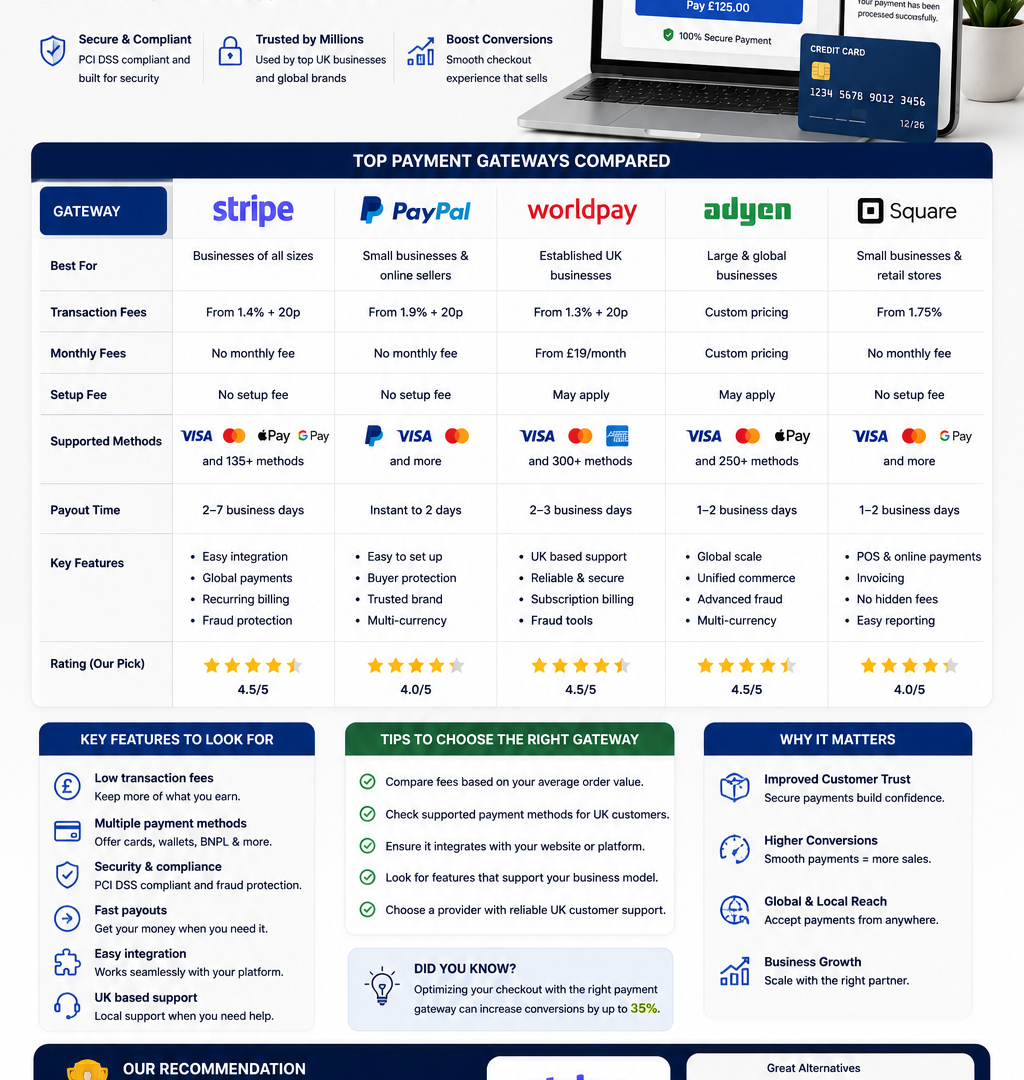
Choosing a payment gateway feels like it should be simple until you actually sit down and compare the fee schedules. Every provider quotes a headline rate, then adds a second rate for international cards, a third for currency conversion, and a few extra lines for chargebacks and payouts that only show up once you’re already signed up.
This guide compares the three gateways most UK store founders shortlist Stripe, PayPal, and Square on the numbers that actually affect your margin: transaction fees, payout speed, chargeback costs, and how each handles Apple Pay, Google Pay, and recurring billing. We’ve worked through a worked example on £5,000/month in sales so you can see real pounds and pence, not just percentages.
UK Payment Gateway Fees Compared (At a Glance)
| Gateway | UK card rate (online) | Non-UK / international cards | Payout speed | Monthly fee | Chargeback fee |
| Stripe | 1.5% + 20p | 2.5%–3.25% + 20p depending on card origin | 2 business days (rolling) | £0 | ~£20 per dispute |
| PayPal | 2.9% + 30p (standard rate; lower tiers available on volume) | +1.29% (EEA) / +1.99% (rest of world) on top of the standard rate | Immediate to PayPal balance; 1 business day to bank | £0 | ~£14 per dispute |
| Square | 1.4% + 25p online · 1.75% flat in-person | 2.5% + 25p online | Next business day | £0 (paid plans available for lower invoicing rates) | Not a fixed published rate handled per case |
All three gateways are free to sign up for and carry no monthly platform fee at the entry tier, so the real decision comes down to your transaction mix, your customers’ locations, and whether you sell in person as well as online. Rates above are correct as of July 2026 and are checked against each provider’s official UK pricing page; we recommend confirming current rates directly with the provider before switching, since these figures are reviewed and updated quarterly on this page.
Stripe UK: Fees, Pros and Cons
Stripe is the default choice for UK software and subscription businesses, and it’s a common choice for founders building a store from outside the UK (more on that below).
Fees: Stripe charges 1.5% + 20p per transaction on UK-issued cards. Cards issued in the EEA are treated as international post-Brexit and cost 2.5% + 20p, while cards from further afield (US, Canada, Australia) cost up to 3.25% + 20p. There’s no monthly fee, and Stripe doesn’t charge you anything to process a refund. If you take recurring UK B2B payments, Stripe’s BACS Direct Debit option costs just 1% capped at £2 per transaction considerably cheaper than card rates for larger invoices.
Pros:
- Best-in-class developer tools and documentation, which matters if you’re customising checkout or building a marketplace
- Native support for Apple Pay, Google Pay, and Klarna at no extra cost beyond the standard card rate
- Strong recurring billing tools (Stripe Billing) for subscription businesses
- No refund fee, unlike PayPal and some competitors
Cons:
- The lowest headline rate on paper, but EEA and international cards cost noticeably more than the domestic rate, so your effective rate depends heavily on where your customers are
- Currency conversion carries roughly a 2% margin above the wholesale rate if you settle non-GBP payments into GBP
- Support is largely self-serve; there’s no phone line for standard accounts
PayPal UK: Fees, Pros and Cons
PayPal remains the payment method most UK shoppers already trust, which can lift conversion even where the fees are higher.
Fees: The standard commercial rate for UK sellers is 2.9% + 30p per domestic transaction. High-volume sellers can apply for discounted tiers that bring the percentage down, though the 30p fixed fee generally still applies. International payments add a further 1.29% surcharge for EEA buyers or 1.99% for buyers outside Europe, and currency conversion typically carries a 3–4% margin above the mid-market rate. Sellers processing high volumes of very small transactions (average order under £5) can apply for PayPal’s micropayment rate, which drops the percentage but raises the relative weight of the fixed fee.
Pros:
- Widest brand recognition among UK shoppers many customers actively look for the PayPal button at checkout
- Buyer protection built into every “Goods and Services” transaction, which can reduce cart abandonment
- Easy to set up for stores that don’t want to build a custom checkout
Cons:
- Highest headline percentage rate of the three, and the fixed fee eats a large share of low-value sales
- PayPal keeps its fixed fee on refunds, unlike Stripe
- Dispute and chargeback handling has a reputation among sellers for favouring buyers
Square UK: Fees, Pros and Cons
Square is worth shortlisting if you sell both in person and online a market stall or pop-up alongside a Shopify-style store, for example.
Fees: In-person card payments are a flat 1.75%, regardless of card type. Online payments cost 1.4% + 25p for UK-issued cards and 2.5% + 25p for non-UK cards. Square Invoices charges 2.5% per invoice on the free plan, dropping to 1.4% + 25p on a paid subscription. There’s no monthly fee for the core point-of-sale and online store tools, and next-business-day payouts are included as standard (same-day transfers cost an extra 1%, minimum 50p).
Pros:
- Genuinely the cheapest headline online rate of the three for UK-card transactions
- One account covers in-person hardware, online checkout, invoicing, and basic recurring billing
- Flat, predictable in-person rate regardless of card type
Cons:
- Square keeps the processing fee on refunds check current terms before assuming otherwise, as this has changed over time
- Like PayPal, Square operates pooled merchant accounts, meaning automated risk systems can freeze funds with limited notice if activity looks unusual
- Less developer flexibility than Stripe for custom checkout flows or marketplace-style platforms
Worked Example: Fees on £5,000/Month in Sales
Numbers are easier to compare in pounds than percentages. Here’s what each gateway would cost on £5,000 of monthly sales, assuming an average transaction of £50 (100 transactions) and that 85% of your customers pay with UK-issued cards, with the remaining 15% international.
| Gateway | UK-card fees (85 transactions) | International fees (15 transactions) | Total monthly fees | Effective rate |
| Stripe | 85 × (£50 × 1.5% + £0.20) = £81.60 | 15 × (£50 × 2.9%* + £0.20) = £24.75 | ≈£106 | ≈2.1% |
| PayPal | 85 × (£50 × 2.9% + £0.30) = £148.75 | 15 × (£50 × 4.2%* + £0.30) = £42.00 | ≈£191 | ≈3.8% |
| Square | 85 × (£50 × 1.4% + £0.25) = £80.75 | 15 × (£50 × 2.5% + £0.25) = £22.50 | ≈£103 | ≈2.1% |
*Blended estimate across EEA and non-EEA cards for illustration.
At this volume, Square and Stripe land within a few pounds of each other, with PayPal running noticeably higher largely because of its higher fixed fee and international surcharge. That gap narrows if your average order value is much higher (fixed fees matter less) and widens if you sell lots of low-value items (fixed fees matter more). Run your own numbers against your actual order value and customer mix before deciding the “cheapest” gateway genuinely depends on your specific sales pattern.
Which Gateway Should You Choose, by Business Type?
Subscription or SaaS business: Stripe. Its recurring billing tools, dunning management, and API access are the most mature of the three, and the BACS option is useful if you invoice UK businesses directly.
Marketplace-style or multi-vendor store: Stripe, via Stripe Connect, gives you the most flexibility for splitting payments between multiple sellers though it’s worth budgeting extra for Connect’s platform fees on top of standard processing.
Pop-up shops, markets, or hybrid in-person/online retail: Square. One account, one dashboard, and a flat in-person rate make it simpler to reconcile takings across channels.
Store that leans on buyer trust to convert casual shoppers: PayPal, often alongside another gateway as a secondary checkout option (see the FAQ below on running two gateways at once).
Store founder based outside the UK: Stripe is generally the most accessible option for non-resident founders opening a UK-facing store more detail in the next section.
Chargebacks, PCI Compliance, and Other Costs to Budget For
The headline transaction rate isn’t the only number that hits your margin. A few extras are worth budgeting for before you commit to a gateway.
Chargebacks. A chargeback happens when a customer disputes a payment with their card issuer rather than requesting a refund through you directly. Stripe charges roughly £20 per disputed transaction regardless of outcome, which can add up fast if your product category is prone to disputes (subscriptions and digital goods tend to see more than physical retail). PayPal’s dispute fee sits lower at around £14, though sellers often report that PayPal’s resolution process leans toward the buyer. Square doesn’t publish a flat chargeback fee in the same way disputes are assessed per case, so it’s worth reading Square’s current dispute terms directly if chargebacks are a particular concern for your product type.
PCI compliance. All three gateways handle PCI DSS compliance for you as long as you use their hosted checkout, embedded fields, or hardware you’re not required to store or transmit raw card numbers yourself. This is one of the strongest reasons to use an established gateway rather than building your own card-capture form: the compliance burden (and the liability if something goes wrong) sits with Stripe, PayPal, or Square rather than with you. If you’re building a custom checkout with Stripe Elements or an equivalent, double-check which PCI SAQ (Self-Assessment Questionnaire) tier applies to your integration, since a fully custom form can push you into a more demanding compliance category than a hosted checkout page.
Apple Pay, Google Pay, and Klarna. All three gateways support Apple Pay and Google Pay at no additional cost beyond the standard card processing rate; you’re simply offering customers a faster way to authorise the same underlying card payment, so it doesn’t change your fee structure. Klarna and other buy-now-pay-later options are natively available through Stripe’s payment methods API and can be added to PayPal Checkout in supported markets; Square’s buy-now-pay-later support is more limited and worth confirming directly if it’s a checkout requirement for your store. If offering flexible payment options is a priority for your customer base, factor this into the comparison alongside the raw transaction fee, since BNPL providers typically charge merchants a separate (and usually higher) fee on top of whatever your primary gateway charges.
Recurring billing. If you run a subscription business, look beyond the base transaction rate to how each gateway handles failed payments, dunning emails, and involuntary churn. Stripe Billing is the most fully featured of the three for this. PayPal supports recurring billing agreements but with fewer automated retry and recovery tools. Square’s subscription tools are aimed more at simple membership or invoicing use cases than complex subscription logic with proration and upgrades.
A Note for Non-UK Residents Setting Up a Stripe UK Account
If you’re not a UK resident but want to sell to UK customers, Stripe is typically the most workable route of the three, since it supports Stripe Atlas-style company formation paths and accepts a wider range of supporting documentation for non-resident directors than PayPal’s business verification process typically does. That said, requirements vary by country of residence and change periodically, so it’s worth reading the current guidance rather than relying on older forum threads. We cover the practical steps company structure, required documents, and common rejection reasons in our companion guide on setting up Stripe as a non-UK resident.
FAQs
What’s the cheapest payment gateway in the UK? On headline online rates, Square (1.4% + 25p) and Stripe (1.5% + 20p) are the cheapest for UK-card transactions, with PayPal’s 2.9% + 30p standard rate the most expensive of the three. The actual cheapest option for your store depends on your average order value and how much international business you do, so it’s worth running the worked-example calculation above with your own figures.
Can I use two payment gateways at once? Yes many UK stores run Stripe or Square as the primary checkout and add PayPal as a secondary option, since some shoppers specifically look for the PayPal button and will abandon checkout without it. Most ecommerce platforms (Shopify, WooCommerce, BigCommerce) support multiple gateways natively, though you’ll need to reconcile payouts from each separately.
Can non-UK residents get a Stripe account in the UK? In many cases, yes, though the process depends on your country of residence, your business structure, and the documentation Stripe requires to verify you. It’s generally more accessible than PayPal’s non-resident business verification, but it isn’t guaranteed for every country, and requirements are updated periodically; see our dedicated guide for the current process.
Comparing gateways is only the first decision, getting checkout, tax, and payouts correctly configured is where most new stores lose time. If you’d rather have it set up correctly the first time, our ecommerce store setup service handles gateway integration, Apple Pay/Google Pay setup, and PCI-compliant checkout configuration end to end.
Leave a Reply