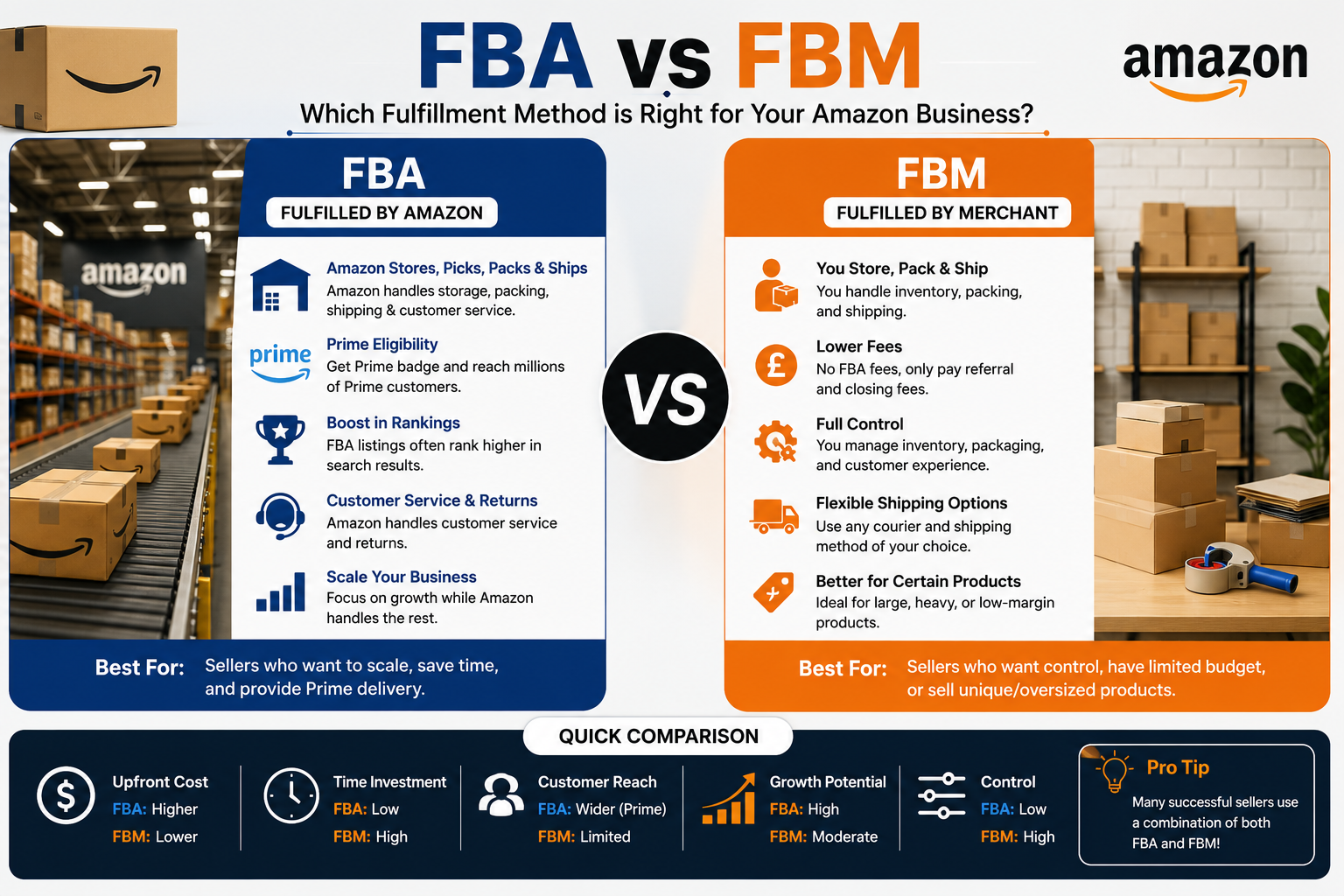
Every Amazon seller eventually asks the same question: should Amazon pack and ship your orders, or should you? Neither model “wins” outright the right choice depends on product size, price point, margin, and how much control you want over the customer experience. But 2026’s fee changes have shifted the maths meaningfully for some sellers, so it’s worth re-running the numbers even if you settled this question years ago.
This guide compares FBA vs FBM on cost, control, and returns handling, then walks through a worked example so you can see where the breakeven point sits for your own catalogue.
FBA vs FBM: Verdict at a Glance
| Factor | Fulfilment by Amazon (FBA) | Fulfilled by Merchant (FBM) |
| Prime badge | Automatic | Not automatic requires Seller Fulfilled Prime (SFP) enrolment |
| Storage | Amazon’s fulfilment centres (monthly fee) | Your own warehouse or 3PL |
| Fulfilment fees | Per-unit fee based on size/weight | None from Amazon (you cover your own shipping) |
| Referral fees | Same rate as FBM, by category | Same rate as FBA, by category |
| Buy Box access | Strong historically, now more level | Improving: Amazon removed structural FBA favouritism from Buy Box selection in late 2025 and stripped the seller eligibility gate entirely in mid-2026 |
| Best for | Fast-moving, standard-size, mid-to-low value items | Bulky, fragile, slow-moving, high-value, or custom items |
| Customer service | Handled by Amazon | Handled by you |
| Returns processing | Handled by Amazon (fee may apply above return-rate thresholds) | Handled by you |
| Control over packaging/branding | Limited | Full |
| Multichannel reach | Possible via Multi-Channel Fulfilment (MCF) | Nativeyou already control the warehouse |
Neither column is uniformly “cheaper.” The rest of this guide shows you how to work out which side your own SKUs fall on.
Costs Compared: A Worked Example
To compare like-for-like, you need four cost components on the FBA side referral fee, fulfilment fee, storage fee, and any surcharges versus three on the FBM side referral fee, your own pick/pack/ship cost, and your own storage cost.
What Amazon actually charges for FBA
Based on Amazon’s current UK seller pricing:
- Referral fee: Amazon charges a referral fee for each item sold, and the amount depends on the product category, with most referral fees falling between 8% and 15%, subject to a minimum referral fee of £0.25 per item in most categories.
- Fulfilment fee: a flat per-unit fee based on the product’s type, dimensions and weight.
- Storage fee: charged per cubic foot per month, and this is where seasonality bites: standard-size products outside the clothing/footwear categories cost roughly £0.76 per cubic foot per month from January to September, rising to about £1.51 per cubic foot per month in the October–December peak.
- Fuel and logistics surcharge: from 17 April 2026, a 1.5% fuel and logistics-related surcharge applies to FBA fulfilment fees across the UK and several EU marketplaces.
- Storage utilisation surcharge: this applies if your storage utilisation ratio average daily inventory volume divided by average daily shipped volume over the trailing 13 weeks climbs above 22 weeks, and there’s a separate aged inventory surcharge for units stored for more than 241 days.
- Low-Price FBA: good news for cheaper SKUs most products priced at or below £20 are now eligible for reduced Low-Price FBA fulfilment rates, with automatic eligibility.
- 2026 fee cuts: Amazon lowered fees by an average of £0.15 per unit sold across its European stores in 2026, including a further average £0.26 reduction to FBA fulfilment fees for parcels effective December 2025, and category-specific referral fee cuts on clothing, home products, pet food, and supplements.
What FBM actually costs you
There’s no Amazon fulfilment fee, but the cost doesn’t disappear it moves onto your own books: warehouse rent or 3PL storage (usually cheaper per cubic foot than Amazon’s peak-season rates, but less flexible), packing materials and labour, courier/postage (typically £2.50–£5 per domestic parcel via a commercial courier account), returns handling and restocking, and any software needed to sync inventory and print labels.
The worked example
Take a mid-size, mid-price product: a £24 kitchen item weighing 900g, standard-size, non-hazardous.
Under FBA:
- Referral fee (Kitchen category): 15% of £24 = £3.60
- Fulfilment fee (standard parcel, ~1kg): roughly £3.00–£3.50 depending on exact tier, plus the 1.5% fuel surcharge (~£0.05)
- Storage (say 0.15 cubic feet held for a month, off-peak): ~£0.11
- Referral fee: same £3.60 (this doesn’t change between models)
- Pick/pack/ship via 3PL: typically £3.20–£4.50 for a similar parcel once postage and handling are combined
- Storage: often £0.05–£0.09 per cubic foot per month with a 3PL, cheaper than Amazon’s peak rate but usually similar or slightly higher off-peak once minimum monthly fees are included
- Approximate total cost: £6.85–£8.19
At this price point and size, the two models land close together outside Q4 which is exactly why so many sellers default to FBA for the Prime badge and convenience rather than because it’s dramatically cheaper. The gap widens in FBA’s favour for small, light, fast-moving items (especially now that Low-Price FBA covers products up to £20), and widens in FBM’s favour for bulky, heavy, or slow-moving stock that racks up Amazon storage fees, especially during the October–December peak when storage rates roughly double.
Run your own SKUs through Amazon’s Revenue Calculator on Seller Central before committing the size-tier boundaries mean a product just a centimetre over a threshold can jump into a materially more expensive fulfilment tier.
Control, Prime Eligibility, and Returns Handling
Cost is only half the decision. The other half is how much operational control you’re willing to trade for convenience.
Prime badge and the Buy Box
This is the single biggest strategic difference. FBA listings get the Prime badge automatically. Standard FBM listings do not. FBM sellers control fulfilment but lose access to Prime customers who filter search results exclusively for Prime-eligible products. The workaround is Seller Fulfilled Prime (SFP), which lets you keep the operational control of FBM while gaining the Prime badge but it comes with strict performance bars: on-time delivery of at least 93.5%, valid tracking of at least 99%, and seller-initiated cancellations of no more than 0.5%. From July 2026, the bar rises further: standard-size items need to show one-day delivery on 40% of Prime customer page views and two-day delivery on 75%, with oversized items facing even tighter speed expectations.
The good news for FBM sellers without SFP: the Buy Box playing field is levelling. In late 2025 Amazon made Featured Offer (Buy Box) selection fulfilment-neutral, removing structural FBA favouritism, and in mid-2026 it went further, removing the seller eligibility gate for the Featured Offer entirely in a phased US-then-EU/UK rollout. FBM and SFP offers now compete on price, speed, and reliability rather than facing an account-level screen: good news if your fulfilment metrics are strong, but it also means more offers are competing for the same slot.
Returns handling
FBA returns are processed by Amazon under its standard policy consistent and low-friction for the customer. But Amazon has been tightening the cost side: recent seller guidance flags expanded returns-processing fees for products with above-average return rates in their category, so high-return categories (electronics, sized apparel) can see this eat into FBA’s fee advantage.
FBM returns put the workload back on you the customer message, the return label, condition inspection, and the restock-or-write-off decision. It’s more labour-intensive, but you keep full control over condition checks, which matters for fragile, customised, or high-value goods.
Multichannel fulfilment
If you sell across your own website, eBay, or Etsy as well as Amazon, FBM naturally supports that your warehouse doesn’t care which channel the order came from. FBA can also fulfil non-Amazon orders through Multi-Channel Fulfilment (MCF), though usually at a step up from standard FBA rates.
Decision Framework by Product Type
Use this as a starting filter, then confirm with your own numbers:
Small, light, fast-moving, priced under £20 → FBA, and specifically check Low-Price FBA eligibility. The fulfilment fee is small relative to the sale price, and the Prime badge helps conversion on impulse-purchase categories.
Standard-size, mid-price, moderate turnover → Run the worked-example maths above for your specific SKU. This is the genuine toss-up zone; the decision often comes down to whether you value Amazon’s operational hands-off simplicity more than the marginal cost saving from self-fulfilment.
Bulky, heavy, or oversized → Lean FBM or SFP.Slow-moving or seasonal → FBM or a hybrid approach.Fragile, customised, or high-value → FBM, for the control over packaging, condition checks on returns, and white-glove customer service.
High return-rate categories (electronics, sized apparel) → Compare carefully. FBA’s returns handling is convenient, but rising returns-processing fees for above-threshold return rates can offset that convenience model both scenarios before deciding.
Can you use both?
Yes, and many established sellers do by SKU rather than by account. It’s common to run fast-moving, standard-size bestsellers through FBA for the Prime badge and Buy Box strength, while keeping oversized, slow-moving, or high-value SKUs on FBM or SFP. Amazon’s own fulfilment guidance confirms sellers can mix fulfilment methods across eligible products, and nothing prevents you from switching a given ASIN’s fulfilment channel as its sales velocity or margin profile changes.
FAQs
Can I use both FBA and FBM? Yes. Most established Amazon sellers run a mixed model FBA for fast-moving standard items where the Prime badge drives conversion, and FBM (or SFP) for bulky, slow-moving, or high-value stock where storage fees or return handling make self-fulfilment cheaper. You choose the fulfilment method per listing, and can switch a SKU’s channel as its performance changes.
What are FBA fees in the UK? FBA fees have three main components: a referral fee (8–15% of the sale price depending on category, minimum £0.25), a per-unit fulfilment fee based on size and weight, and a monthly storage fee charged per cubic foot (roughly £0.76–£1.51 depending on category and season). A 1.5% fuel and logistics surcharge applies from April 2026, and additional surcharges can apply for aged inventory or high storage utilisation. Products priced at £20 or below may qualify for reduced Low-Price FBA rates.
Does FBM get the Buy Box? It can. Amazon removed structural FBA favouritism from Buy Box (Featured Offer) selection in late 2025 and removed the seller eligibility gate entirely in mid-2026, so FBM and Seller Fulfilled Prime offers now compete primarily on price, delivery speed, and account performance metrics rather than facing a built-in disadvantage. Strong on-time delivery, low cancellation rates, and accurate tracking still matter enormously for winning it.
Get the Right Fulfilment Mix for Your Catalogue
Fee tables only tell part of the story the right split between FBA and FBM depends on your product mix, margins, and how much operational capacity you andle the operational side end-to-end through our A-to-Z store handling services if you’d rather hand the whole process have in-house. If you’d like a second pair of eyes on your numbers, our team offers a fulfilment strategy consult to help you map out the most profitable approach SKU by SKU. We also hover.
Fee figures referenced in this article are based on Amazon’s published UK seller pricing as of mid-2026. Amazon updates fee schedules periodically, so always confirm current rates via Seller Central or Amazon’s official pricing page before making fulfilment decisions.
Leave a Reply